In the SAP SuccessFactors Onboarding H1 2021 release, we’ve mainly seen updates to compliance forms and processes as well as some user experience enhancements and security Features. Let’s take a look at what’s new in the Onboarding module below!
Compliance Forms & Processes
As expected, SAP continues to expand the number of compliance forms supported. In this release SAP has included these forms:
In addition, reporting information is also now available for I-9 and E-Verify data so that you can create Stories in in People Analytics using the information.
In addition to compliance features, there’s some nice enhancements to user experience. Of all the modules, I think onboarding is one of the more confusing to navigate as an admin user and these enhancements help address this issue. Let’s take a look!
First, users can now navigate directly to the onboarding dashboard from the global navigation (early adoption feature). I personally liked this one because when I first started with Onboarding, I was used to the main page of every module being accessible through the navigation menu – onboarding was the only one where you had to click on a home page tile instead. I think this will provide some nice consistency for users.
In addition to easier navigation to the dashboard, its features have also been enhanced. Here’s a list of the new feaures:
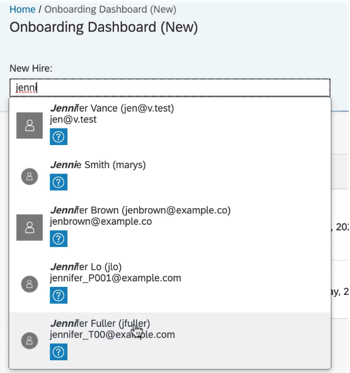
New Hire Search – allows onboarding users to type a name to search through new hires
Checklist Task – can now be viewed under “New Hire Tasks”, items can be added for a specific user using the “Delegated” drop down (delegates can also be notified via email when the task is assigned to them), and under “View Details” users can edit the checklist tasks,
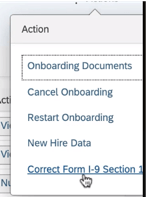
I-9 – corrections to section 1 can now be initiated from the “New Hire Details” action menu
E-Verify – view details from the “E-Verify Case Details” link on the “New Hire Details” screen
User Search
Correct I-9 from the Action Menu
Its great to see the dashboard getting some new features to make transitioning between screens easier!
Next, the locale for external users of Onboarding will now be updated automatically based on their recruiting settings. This is a common sense win. Locale can also be set when manually adding users via the “Add New Hire to Onboarding” screen. If no value is specified in either scenario, the locale will default to the default language set in provisioning.
Security Features
In addition to compliance enhancements and improvements to usability, there’s a few cool security features worth mentioning.
First, the target population for the external user target population can now be based on the division, department, and location of the user. This allows organizations to have multiple admins specific to division, department, and/or location rather than just admins who can see the whole new user population.
Last, read access audit logs for onboarding have been enhanced to show context and reason why sensitive fields were accessed (e.g. through the UI, or APIs, or a downloaded document). This is designed to give auditors better understanding of why data was accessed.
Wrap up
I hope you’ve enjoyed this quick review of the latest Onboarding features available in the H1 2021 release! Do you need help managing your SuccessFactors Release cycles? Download our support services brochure or email info@worklogix.com to see how we can help!
In this release, we saw a wide range of enhancements across the Talent modules – some specific to Succession and others that lay across the modules but help out succession planners. Let’s take a look at what’s new in the Succession module below!
Succession Management Specific Changes
Let’s start with what’s new just for Succession Management before we take a look at some general talent improvements that are relevant to Succession.
Nomination History
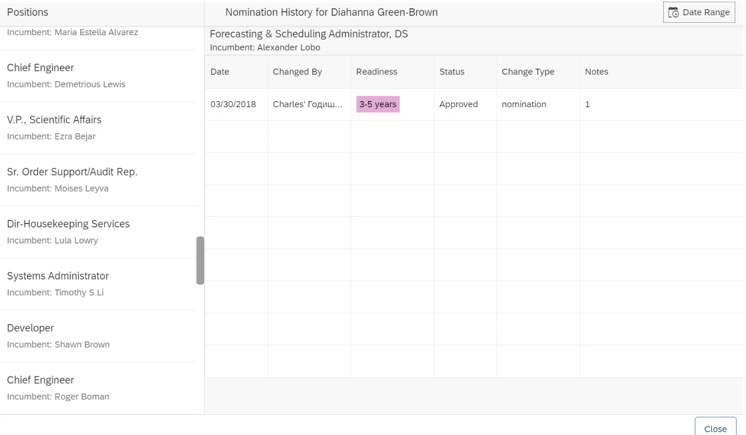
The main new feature exclusive to Succession Management is the ability to view nomination history in the talent card and in the people profile. Users will with Succession Planning permission can click a history icon on these screens to see a list of positions for which the employee has been nominated and information about the nomination history for each including the date, nominator, readiness level, status, change type, and notes. The information includes deleted nominations as well.
Nomination History View
Hide Pending Nominations for Talent Pools
Succession configurators have had the ability to hide pending nominations from succession planners for some time now, but the ability was only extended to position nominations. Now, this feature works for talent pool nominations as well. This configuration setting remains in the same in Admin Center -> Nomination Setup.
Form-Based Nomination Deleted
Another update specific to succession with this release is that form-based succession nomination will be completely deleted as of May 21,2021. This was a legacy method of approving nominations – if you never used it, then don’t worry because no action is required. If you are still using forms to approve nominations, you have little time left to switch to the newer permission-based method!
General Talent Management Updates Relevant to Succession
There are also numerous updates across the talent modules in general that affect not only Succession, but also Performance, Goals, Development, and/or Calibration. Let’s take a look at these briefly below.
Editing Talent Info Directly on a Talent Card
It seems like every customer for whom I’ve implemented Succession has asked why they need to switch between the employee profile view and other views to edit talent information. Why can’t customers just change the information right on the talent card that shows up across the different views that contain the talent card? This way data like impact of loss or risk of loss can be updated when the user has the contextual information they need to make the decision. Well now, customers can!
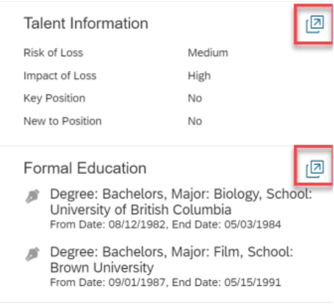
Users can now click the icon shown below to open a popup that allows these fields to be changed.
Editing Information on a Talent Card
My Jobs Downloads
Previously Succession (and other talent reports) could be downloaded from the Scheduled Reports page in Classic View. Reports may now be downloaded from My Jobs page within Report Center. This eliminates the need to switch to Classic View prior to downloading.
A report with multiple files can be downloaded in a compressed .zip file or downloaded individually.
Numerous Calibration Session Improvements
There are a variety of calibration session feature that have been added/updated as well. For example specifying default facilitators or allowing managers to more easily create calibration sessions for their teams. For more information on these improvements, check out our blog on What’s in in H1 2021 SAP SuccessFactors Calibration Release.
That’s a Wrap!
That’s all of the updates for H1 2021! We hope you found this blog informative!
There are five universal updates related to Mentoring and one for Development Goals. Let’s take a look!
Mentoring
The mentoring features are related to the mentor program sign up process and are designed to improve the user experience.
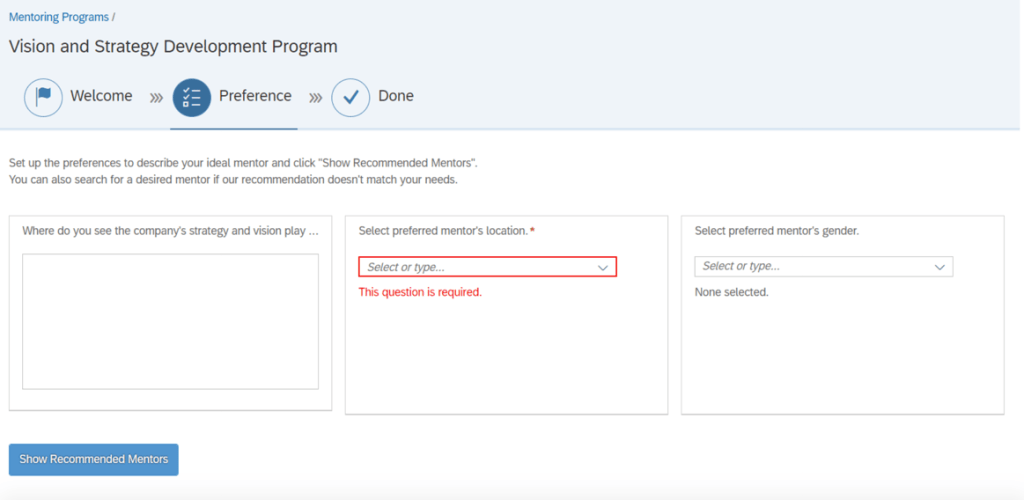
Key Questions Indicated
In the sign up sheet, required entries are noted by a red asterisk. This ensures the mentees complete these fields prior to looking at the recommended mentors. Answering the key questions will improve the recommended mentors match.
Answers to questions will be saved but preferred mentors are not saved.
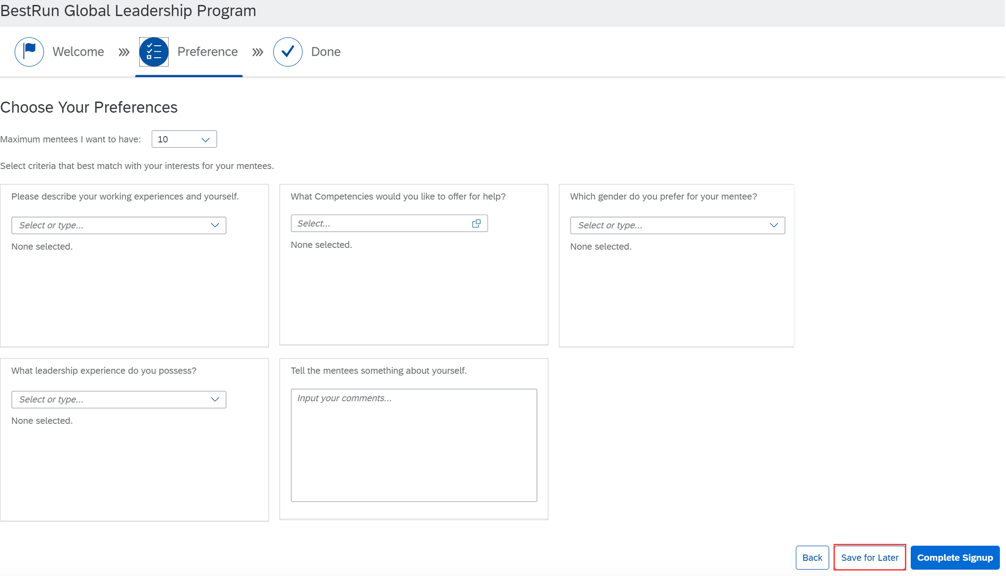
Save Sign Up Program to Complete Later
There may be times when an employee starts to enroll in a mentoring program but is not ready to commit. Maybe they need to consider their mentoring preferences further or need to check in with their manager first. The employee may start to fill out the sign up form, save it and come back to it later to make any updates prior to signing up.
There will be a “Save for Later” button that will display within the program sign up page.
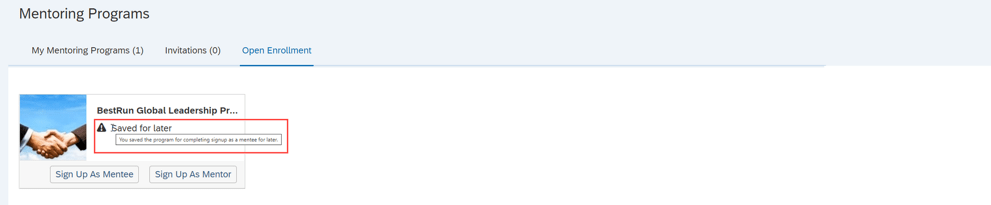
Once saved, the program will appear on either the Invitations or Open Enrollment tab, whichever is applicable.
The program visible on the tab and can be easily be identified with an icon and “Saved for later” text.
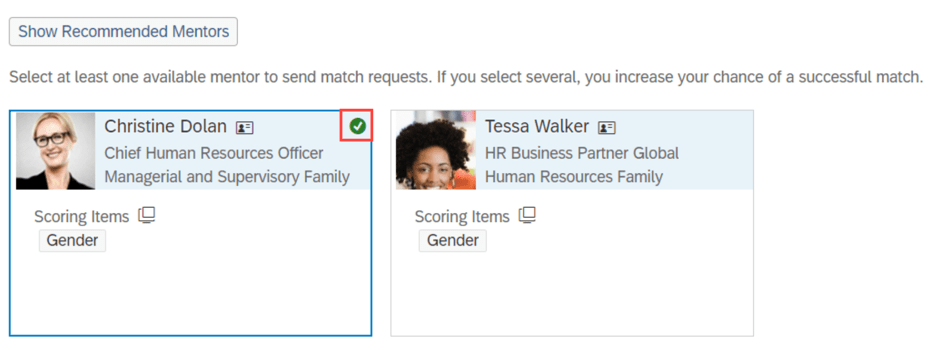
Identify Mentor Requests
While filling out the sign up form, mentors that are selected from the recommended list will display a green check mark on the mentor cards.
Confirm Sign up
A mentee will see a confirmation popup when they are completing a program sign up. This gives the mentee the opportunity to confirm signing up for a mentor program. By clicking the “Complete Signup” button, the mentee is enrolled and mentor requests are submitted.
Your Mentor Requests
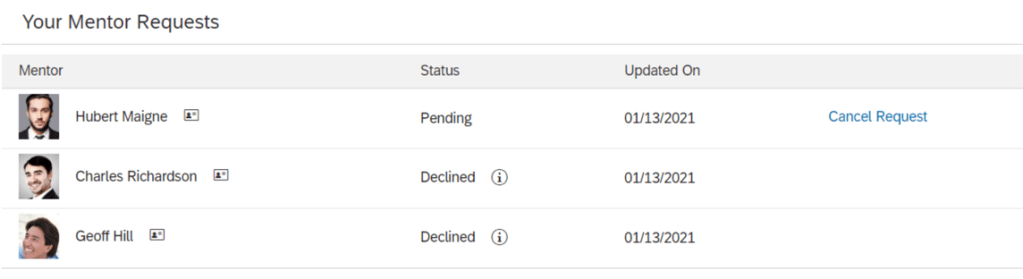
The Mentoring Page will contain a new section that tracks any mentor requests that a mentee has made. The “Your Mentor Requests” section allows a mentee to see the status of their mentor requests. Pending requests will appear as well as any declined requests and reasons. This feature is only applicable to open enrollment and unsupervised programs. Supervised programs rely on a matching program instead.
Mentees may also cancel any pending mentor requests.
Admin Opt-Ins for Mentoring
There is one admin opt-in available to for Mentoring.
Qualtrics Surveys for End of Mentoring Relationships
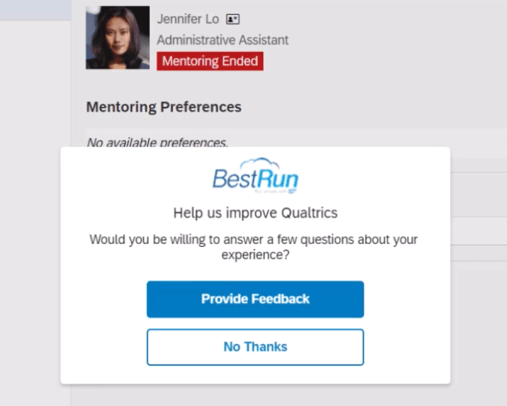
Qualtrics Surveys may now be used with Mentoring. The survey can be used when a mentor program participant opts to end the mentoring relationship. Based on how the program was configured, either the mentor or the mentee may cancel the mentoring relationship. A survey will pop up after a participant ends the mentoring relationship.
An email survey is sent to the other participant in the mentor relationship.
The feedback provided in the survey results are seen by the program owner and may be helpful when designing new mentoring programs.
In order to take advantage of this feature, Manage Qualtrics Integrations from the SAP SuccessFactors Admin Center needs to be set up.
Development Goals
Learning OData V4 Service
There is a new Learning OData V4 service. When using transcript or legacy learning activities, learning activities may be created and updated in mass to be associated with development goals and competencies.
The Job Profile Builder is a valuable tool that helps companies categorize their positions into groups of jobs. Each job profile contains descriptions of what functions that job performs, qualifications needed to perform the job, etc. For more information on the Job Profile Builder in general, see our article Job Profile Builder: An Introduction.
In this article, we go into further detail on how to catalog skills within job profiles. As a company explores what jobs to create and how to catalog their jobs, one of the most important distinguishing characteristics to identify those jobs are the skills and qualifications needed for the job.
Adding Skills in Manage Job Profile Content
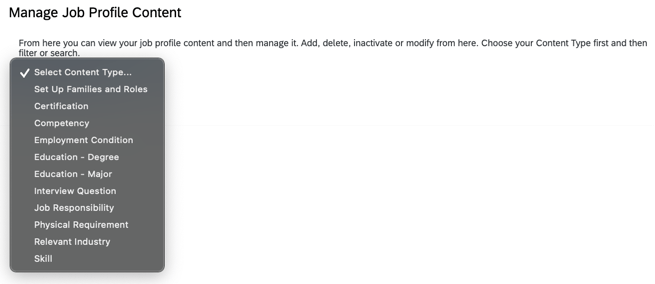
The list of available skills for jobs in SAP SuccessFactors are defined in the “Manage Job Profile Content” screen (just type “Manage Job Profile Content” in the search bar and if you have admin access and the screen name will come up for you to select). You can see in the screenshot below the list of available types of content SAP allows you to create slot populate on a job profile.
Types of Job Profile Content
You can edit the list of available items within each of the categories shown above. Some of these categories are pretty obvious on how to populate with options. For example “Education – Degree” and “Education – Major” would pretty obviously contain lists of degrees and majors that are relevant to the company. The same can be said for certifications and interview questions. Interview questions you create here will show to recruiters. Certifications is where you would list of the certifications relevant to your company’s industry. However, some of these other items can be a little more difficult to understand. A prime examples is “Skill”. This is a very broad term. So how do we go about creating a list of available skills?
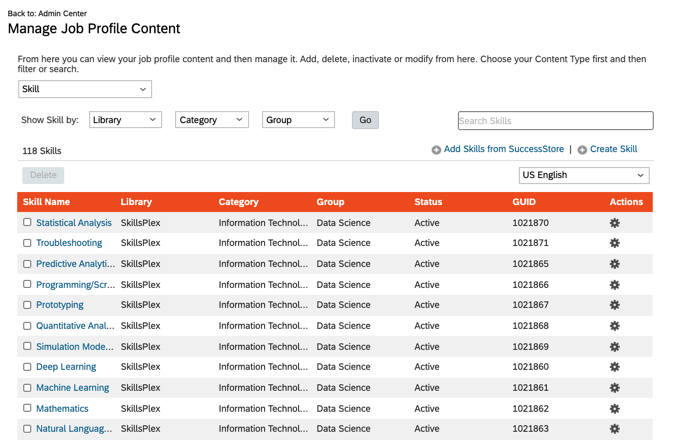
If you click “Skill” from the drop down shown above, you will see a list of the skills currently cataloged in your system as shown below.
Job Profile Content Skills View
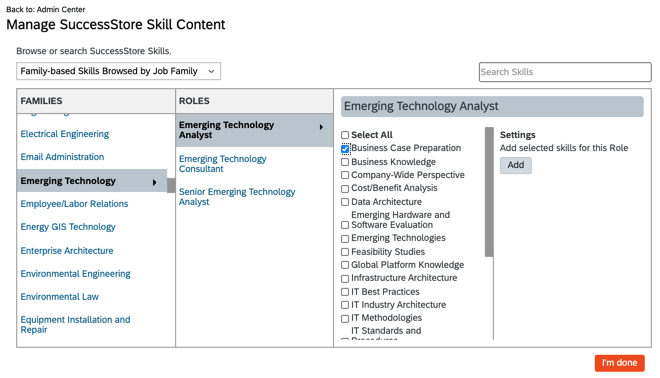
Now, we will take a look at how to add a skill from the library as a demonstration of what makes for a good skill in the SAP SuccessFactors Job Profile Builder. From the screen shown above, we can click the “Add Skills from SuccessStore” link. The screen will update as shown below.
Adding a SuccessStore skill based on job family and role
There are two ways to browse through the catalog of skills. The first way shown above is through families and roles. This method associates the skills to a particular role within the standard SuccessStore catalog. You can learn more about job families and roles in Job Profile Builder: An Introduction. We recommend that if you want to add skills for a standard role within the catalog, that you add them from the “Set up Families and Roles” screen instead as shown below. This will actually add the role and family itself along with the skills instead of just the skill with no role.
Adding all mapped skills when adding a Job Role
The second way to add skills is shown below is to browse through skills that are not assigned to a particular job role but are organized through categories and groups by choosing “Unassigned Skills Browsed by Category” in the drop down in the upper left corner of the screen. You can simply think of categories and groups as two levels of organization to catalog your skills: categories being the highest level which contain groups and groups containing the individual skills. To choose a skill, click a category and then a group, and then click the name of skill(s) you want to add and click “add” as shown below. It might seem a little confusing as to why SAP created both a role taxonomy and a skill category taxonomy to search through skills, but when you consider that not everyone uses the standard roles library from the SuccessStore it makes sense to have another way to categorize skills.
Adding a SuccessStore skill based on Category and Group
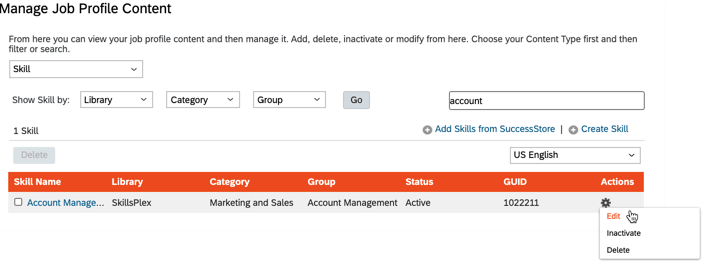
When you return to the main screen as shown below, you will see the skill added to your local catalog of skills. You can then click the gear icon and choose “Edit” to look at the specific contents of the skill.
Selecting a skill in your library to edit
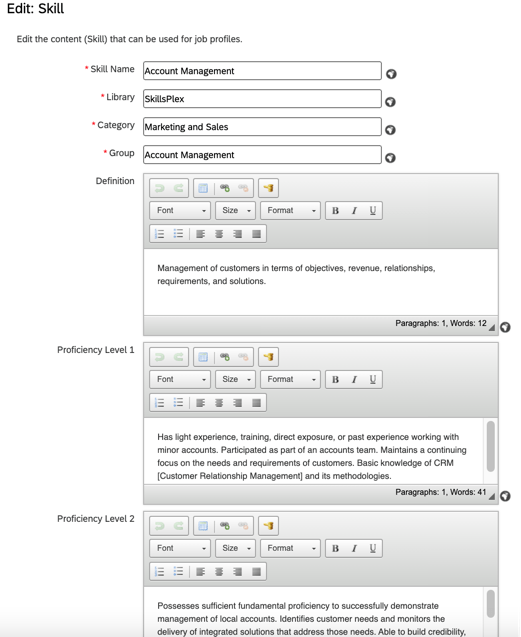
Here in the “Edit: Skill” screen shown below you can see all the predefined content for the skill from the SuccessStore. SAP SuccessFactors skills consist of a skill name, a library name, a category, and a group to help organize the skill into a taxonomy. Getting into the detail of the specific skill, we see the definition and then 5 different proficiency levels (1 being the most basic and 5 being the most advanced – this scale is pre-set and cannot be changed). Looking at the fields and values on this screen, you can start to get an idea of how skills can be useful to define exactly what skills are required and at what specific level and what criteria define that level when interviewing someone for a job posting or guiding someone towards promotion or working with someone to remediate job performance. Now that you have a good understanding of what a skill looks like, you can continue to add or edit skills in the screen shown above. To add a skill from scratch, click the “Create Skill” link in the upper right corner of the screen. This will also take you to the screen shown below but with all the fields blank.
Creating and editing skills
Adding Skills to Job Profiles
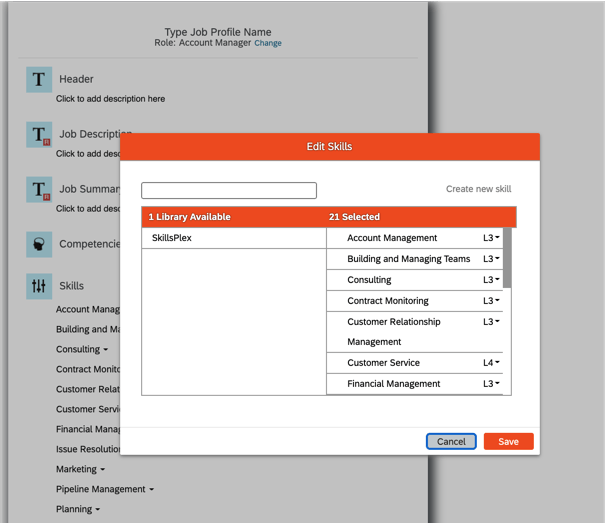
Once we have a list of skills defined, we can start to add them to our individual job profiles (or if you downloaded the predefined skills when you downloaded the SuccessStore job family and role, the skill will already be there when you create the profile). For info on how to create a job profile see Job Profile Builder: An Introduction. You can see in the screenshot below, when we look at an existing job profile or create a new one in the “Manage Job Profiles” screen, the skills show up in the area specified for Skills in the job profile template. You can mouse over the skills section to add or edit skills. For each skill added you will also need to specify the proficiency level expected for the job. So for example we have added the “Account Manager” role and all associated skills to our library in one of our earlier screenshots. When we create a new profile for the role, the skill “Account Management” is automatically added at level 3 proficiency, “Building and Managing Teams” at level 3, etc.
Skill assignments within a job profile
Conclusion
By now you should have a good understanding of what Job Profile Builder Skills are and how to create them on your own, pull standard skills from the SuccessStore library, and add them to a profile. With some good examples shown here and available on the SuccessStore, you should be able to start building your own library of skills specific to your company needs and associate them to your job profiles and roles. Adding these skills can be valuable for recruiters looking for guidance on what to look for in a candidate, or for employees looking to develop themselves for their next role.
For more information on the job profile builder and other talent management modules, check out our book here!
Do you need help setting up your Job Profile Builder? Contact us at info@worklogix.com.
What is the Metadata Framework (MDF) in SAP SuccessFactors? If you’ve been introduced to SAP SuccessFactors, chances are you’ve heard the term “Metadata Framework”. But you may not know the details of what the Metadata framework is exactly. This quick blog will help you understand what comprises the “Metadata Framework”.
To get started, let’s examine the name “Metadata Framework”. “Meta” refers to a greek origin word meaning “beyond”. So the word “Metadata” refers to data beyond the data. Or in other words, Metadata is data about the data. Metadata is data that describes what type of data it is (e.g. a number, or text, or a drop down) how the data looks (e.g. how it is formatted such as a date formatted as 12-31-20 vs. December 31, 2020), what its limits are (e.g. 256 characters long), etc . As the picture at the top of the blog post suggests, a framework is the structure laid out in the initial stages of building a structure. So the “Metadata Framework” is a way to lay out the structure of data in SAP SuccessFactors.
So how do we go about laying out the data structure of SAP SuccessFactors? If you have admin access in the system, you can navigate to the “Configure Object Definitions” screen as shown in the example below. Think of an “Object” as a collection of fields that describe, define, and/or belong to a “thing” in your database/system. Objects could be a chair, a dog, a car, a person or the example below, a position. This screen demonstrates the power of the MDF because you can create objects (as seen in the upper right hand corner under “Create New”, or you can edit existing objects. This ability to create and edit objects lets you store any type of information! In our example, we chose “Object Definition” in the “Search” field and then chose “Position” so we can see how the position object has been defined. You can see below some basic data about the object in general at the top such as whether it is active or not, whether version history is kept on the MDF definition, etc. Below that begins a list of fields within the object and associated attributes of each field such as its technical identifier, length, the type of field it is, etc. Scrolling further down we can even set rules for what happens when a new object is created (such as pre-populating fields) or validation rules to help with data integrity to check fields before the object is saved. We can edit this definition of the overall object and the fields within the object by clicking “Take Action” and then “Make Correction”. Taking a look at the screenshot below, you can start to get a sense of what the MDF is all about.
Configure Object Definitions Screen
It is important to note that not all data in SAP SuccessFactors uses the metadata framework. Most Employee Central data is stored in the MDF–but not all. SAP is working on moving the final few pieces into the MDF within the next few releases. Most of the Talent modules and Recruiting still also reside outside of the MDF. However, as new functionality is built, it is created using the MDF wherever practical.
We hope you enjoyed this quick tour of the MDF! You should now have a basic understanding of what the MDF is and how to configure it. Do you need more help with the MDF? Contact us at info@worklogix.com.
As year-end approaches, it is common for many companies to take a second look at their employee performance and goal setting processes. In the past few weeks, I’ve been helping multiple companies revamp their employee performance processes. While some are just tweaking current forms and processes, others are considering including a new and often enlightening process – 360 evaluations.
What is a 360 evaluation?
The idea behind a 360 evaluation is to get a picture of how others view your performance from all angles. This means that in addition to getting feedback from your manager (top down), you also get feedback from your own direct reports (bottom-up), peers (side), and even external sources (vendors, business partners, customers, etc.).
Why do companies implement 360 evaluations?
Receiving feedback from a variety of sources helps create a more complete picture of how an employee is performing and/or perceived to be performing from different angles. 360 evaluations can help uncover trends and gaps in these different angles. For example, a manager may consider an employee a top performer, but when feedback is asked from peers or external sources on an anonymous basis, the employee might get different feedback (“He’s always on top of his own tasks, but sometimes at the expense of the team as a whole when we need his support”). Similarly, an employee may not be considered a top performer by a manager, but feedback from others could reveal a lot of solid performance feedback into which the manager never previously had sight (E.g. “She’s been so helpful in getting my career on the right path and helping me with work tasks at the expense of her own!”). Allowing this feedback to come to light can help employees and managers work to truly improve employee performance. We’ll take a look in a moment at how SAP SuccessFactors 360 evaluations aid in attaining this kind of feedback.
Walk-through of a 360 form in SAP SuccessFactors
360 forms are launched just like performance forms are. However, it is important to note that 360 forms use a separate screen for launching (don’t worry, this screen pretty much works the same as the other launch forms screen you are used to. After picking a target population, the admin can launch just like a normal performance form.
Search bar showing separate launch screen for 360 forms
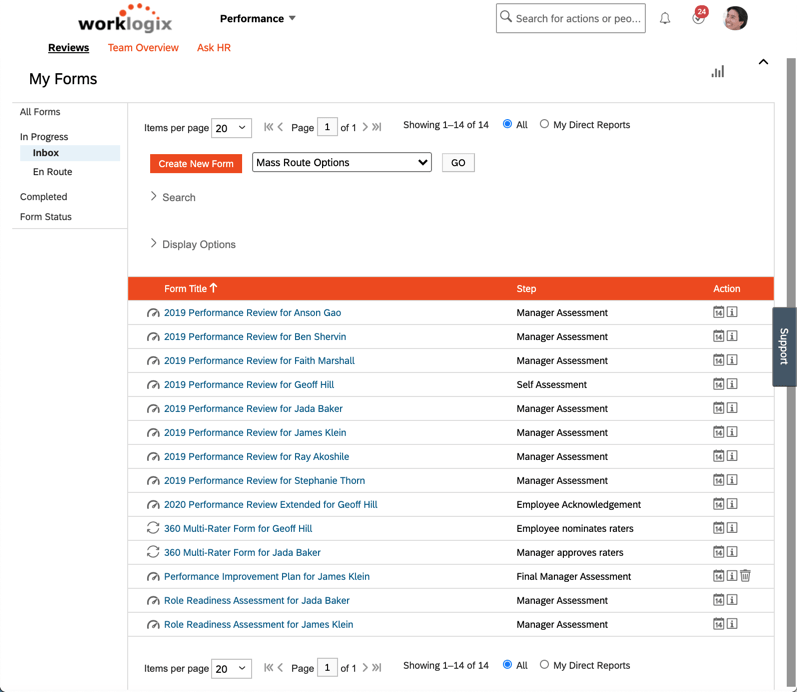
360 forms will also show up in the performance inbox like other performance forms, but with a different icon. It is important to recognize that 360 forms use a template type than regular performance forms and get treated slightly differently in these respects.
View of Performance Inbox with both 360 and regular performance reviews
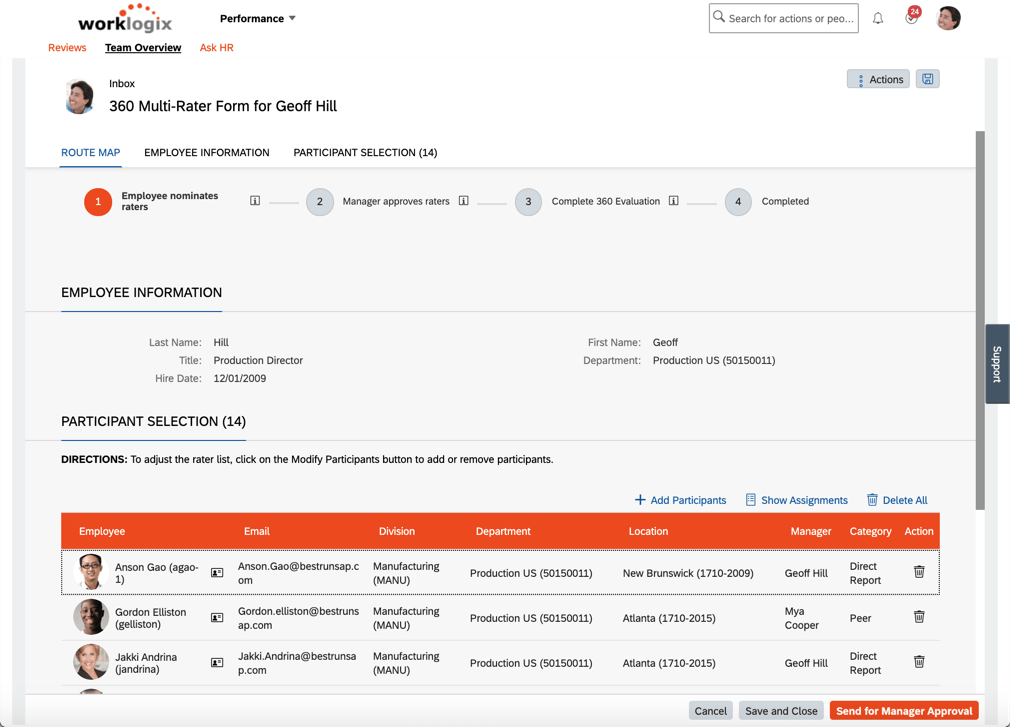
Once the first person in the route map gets the form (in this case the employee), they need to choose who will be involved in the evaluation. The system can be configured to default in people for categories like direct reports, manager, and peers.
Employee nominates raters step of 360 review
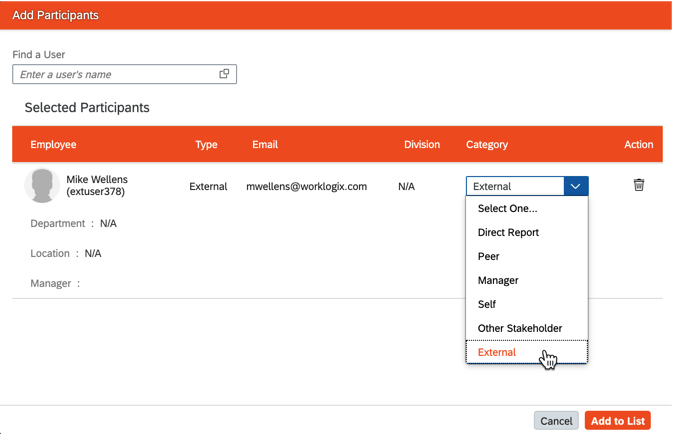
Users also have the option to add external participants as shown below by simply providing a first name, last name, and email and then choosing in what category the person should be included.
Adding an external participant
Once the user is finished adding participants, there is usually an approval step prior to the evaluations being sent out. Evaluations can be designed using sections similar to those you are used to seeing in a standard performance review form. There are sections for objectives, competencies, as well as an introduction and a section for the subject’s information. Unlike regular performance forms that can be configured heavily on the online editor in “Manage Templates”, 360 forms can only be fully setup by partners or SAP (though much of the config is done in the online editor).
For internal participants, the evaluation is sent to the user’s performance inbox like the typical performance reviews where they can then open the form as shown below.
360 Review Form Sent to Evaluator
In the case of external participants, after approval of the evaluators, an email is sent with a link that allows external users to access the form. This can be a security consideration for some organizations since the link is only as secure as the receiving email system.
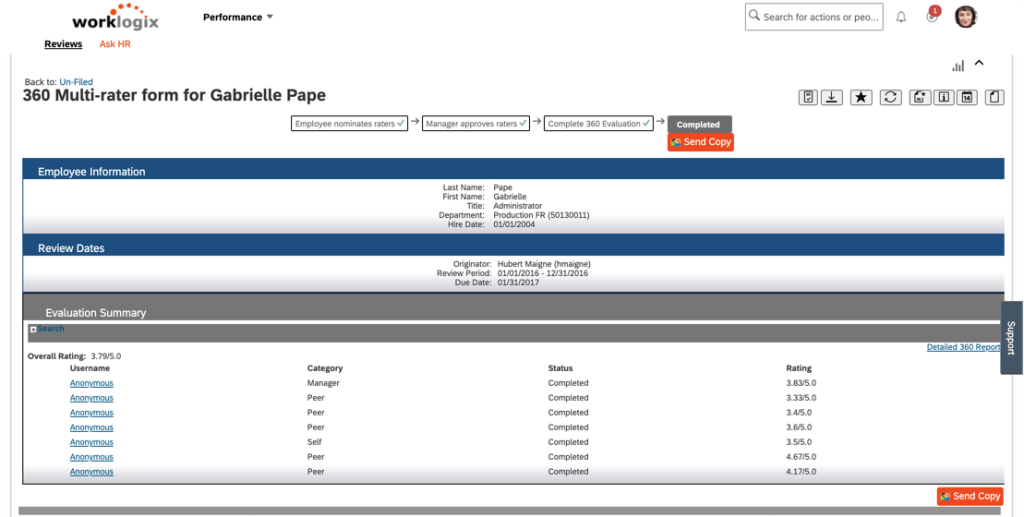
After all evaluations have been completed, the form is put in the completed status and the employee / manger / etc can view the results depending on permission settings. You can see an example completed performance form below.
Completed Review showing Anonymous ratings
One key advantage of the 360 form in SuccessFactors over the typical annual performance review is that the 360 feedback comments and ratings can be made anonymous. Obviously the user would know who their manager is, or they might be able to derive who the other evaluators are based on category if there are only one or two – so the forms allow you to configure minimum counts in each category as well as rollups to combine categories to help keep anonymity. The user can click on the link for each reviewer to see the details of each review and create an HTML or PDF printout of the details as shown below.
Printed Detail of Individual Review Feedback
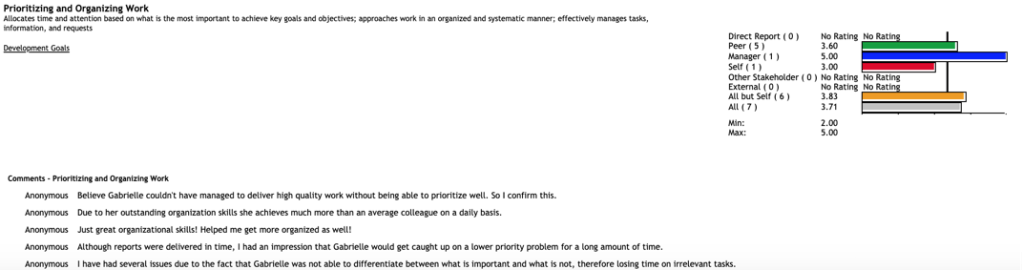
The form also has a nice detailed report showing the combined feedback comments and overall ratings by category. This can help the employee and manager understand where any gaps between self and manager evaluation ratings may exist along with other types of ratings from other categories. For examplem we can see below there is a large gap between the manager’s perception and the employee and other’s perception of “Prioritizing and Organizing Work”. Perhaps the manager is getting too much priority and the employee needs to focus on the work the team as a whole needs completed!
Wrap Up
After this quick walkthrough, hopefully you can now see the advantage of 360 forms as an insightful tool to get employee performance feedback from a variety of sources and understand what a typical end-to-end 360 process looks like.
For more information about 360 forms and other talent management modules in SAP SuccessFactors, check out our book here!
Do you need help implementing or changing your 360 form or other performance and goals processes? Contact us at info@worklogix.com.
With so many jobs lost, we all need to hunker down and concentrate on keeping our current jobs until things get better right? Nothing could be further from the truth!
Realizing the Need
Just last week, I had a call with a customer who wanted to re-examine their Succession Management process. They had the system set up. They didn’t really use it. Then COVID hit. Like many companies, the organization underwent a lot of changes and left a lot of resource gaps. Now they are realizing they could have been better prepared and are looking to quickly ramp back up their succession process. They are not alone.
Throughout this year, I’ve had the pleasure of serving on HR.com‘s advisory board for Internal Mobility, Succession, and Career Development. The organization just recently published the results of the cross-industry study we board members helped create. From what I see, the survey results are consistent with what I am seeing in the example I described above. Let’s take a closer look at the facts!
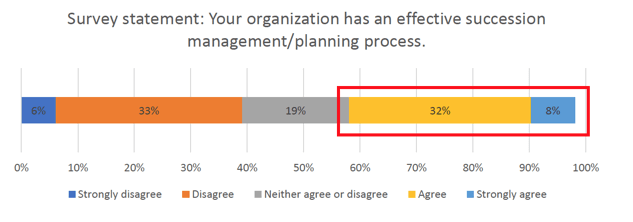
First off, most organizations recognize they don’t have an effective succession management and/or planning process in place. In addition to only 40% of companies agreeing or strongly agreeing that their process is effective as shown below, another survey question revealed that only 26% have a succession management system in place.
Source: HR.com’s Internal Mobility Webinar Nov 5, 2020
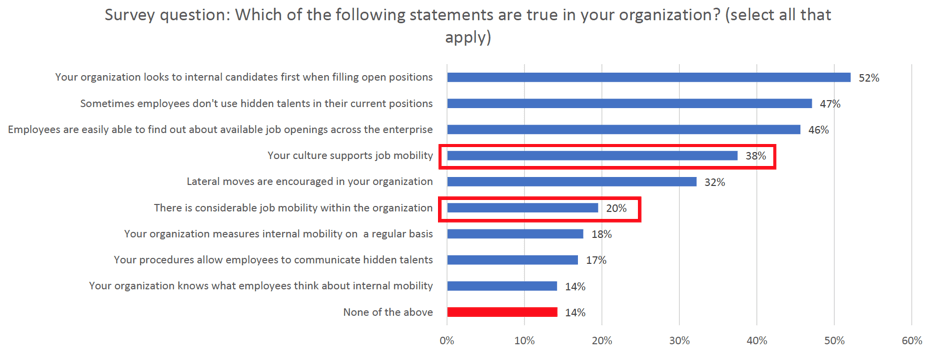
Furthermore, the survey also found that only about 1 in 5 companies have considerable job mobility within the organization.
Source: HR.com’s Internal Mobility Webinar Nov 5, 2020
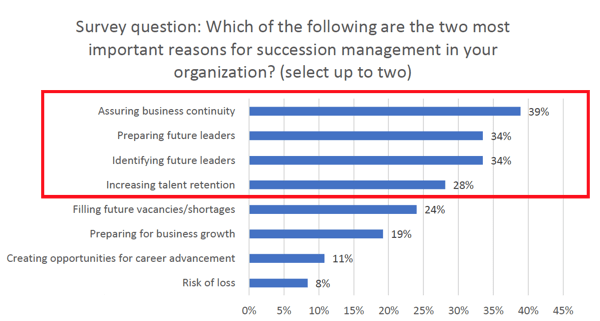
At the same time, companies realize that business continuity (e.g. keeping the lights on!) is the most important reason to promote succession management and internal mobility.
Source: HR.com’s Internal Mobility Webinar Nov 5, 2020
Recognizing The Gap
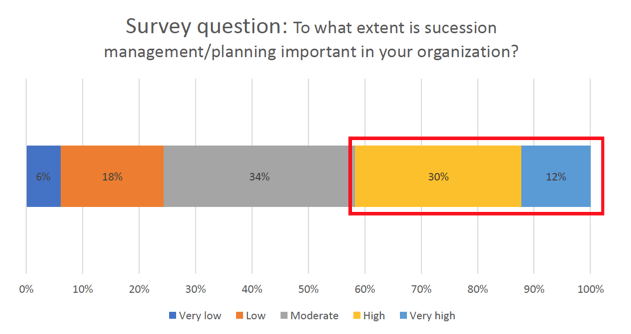
So let’s get this straight, companies recognize that Succession and Internal Mobility are important, but they don’t currently have good systems and processes in place to support them. So why don’t more companies get their Succession Management systems and processes up and running? The problem is, most organizations don’t consider Succession Management important to the organization.
Source: HR.com’s Internal Mobility Webinar Nov 5, 2020
The gap here is that the process really is important for the reasons these companies have already realize and just not acted up (remember what we said about keeping the lights on?). And many companies right now are starting to realize this the hard way during COVID as employees leave both voluntarily and involuntarily and large resource gaps are being felt because of this process gap. I can only attribute this trend to “perception” since the facts point to a real need here. I think it is time to end this perception!
Is It Worth The Investment?
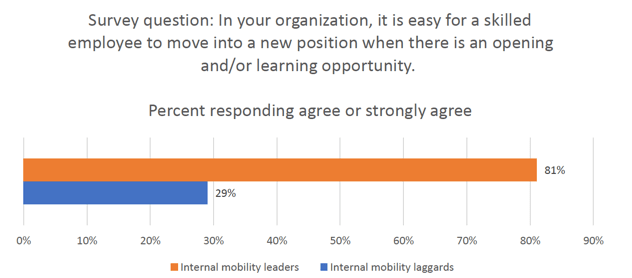
If I invest in a Succession and Development Management strategy, is it really going to work? The answer is “Yes!” The survey found overwhelmingly that those organizations who are internal mobility leaders, it is easier for employees to move to new positions. Making it easy for employees to move from one position to another makes it easier to fill critical roles with people your organization already knows and trusts rather than going through the expense and risk of recruiting externally (which many companies are still unable to do at all at the moment with some still experiencing hiring freezes).
Source: HR.com’s Internal Mobility Webinar Nov 5, 2020
OK, I get it, I need Succession and Internal Mobility! How do I get started?
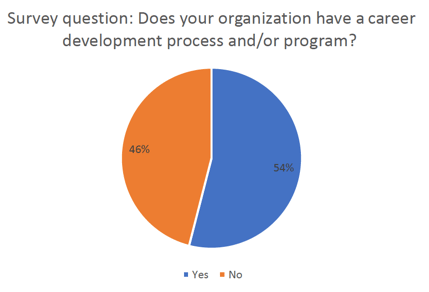
There’s a ton of ways! We’ve talked a lot about Succession Management – which involves tagging which roles are critical to the organization and identifying how to fill those roles. This can help you define who to develop and what they need to develop. But of course, that means investing in employee development itself! Not surprisingly, the survey found a similar trend here. Almost half of companies reported they did not have a development process or program!
Source: HR.com’s Internal Mobility Webinar Nov 5, 2020
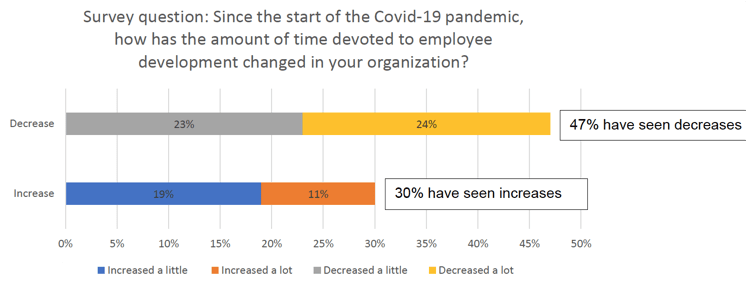
What’s more frightening, is that during the Pandemic, when the concentration should be on developing the fewer employees many companies are trying to make more effective, the opposite seems to be happening. 47% of companies saw decreases in employee development.
Source: HR.com’s Internal Mobility Webinar Nov 5, 2020
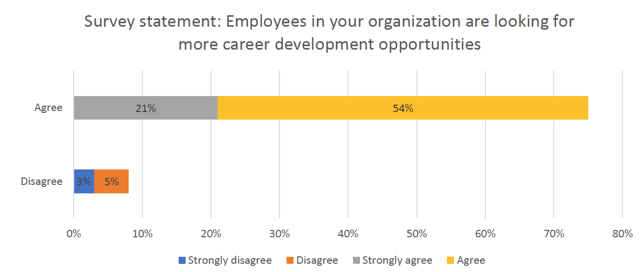
At the same time, employee demand for development opportunities has increased! 75% of companies saw that employees are looking for development opportunities!
Source: HR.com’s Internal Mobility Webinar Nov 5, 2020
Once again, there is a huge disconnect which helps explain further why many company strategies are out of alignment with the needs. Only once employees are able to develop their skills and competencies in order to meet the needs of critical roles will they will be ready to start filling those critical roles.
There are a lot of specific strategies companies are using the promote internal mobility and fill their succession management strategies. To find out more information about the different approaches companies are taking to implement their Succession and Development Strategies, you can download the full survey at HR.com or contact info@worklogix.com to talk more about your strategy!
For more information about Succession Management and other talent management modules in SAP SuccessFactors, check out our book here!
Companies are hiring! A recent LinkedIn article shows that individual companies are now hiring 10,000s of new employees. This is great news for the economy. We at Worklogix have also seen customers gearing up their recruiting systems. But all this renewed activity in the “New Normal” raises the question “How do we keep everyone safe during the process without sacrificing the candidate experience?” In this blog we share how we’ve helped customers expand their recruiting capabilities with SAP SuccessFactors technology to keep candidates and current employees safe.
Engagement
Just because there are more people looking for jobs doesn’t mean engagement needs to go down. Quite the opposite–it means now is your chance to engage the most people to get the best talent! If your company isn’t hiring yet, it makes the challenge even more important because without any postings, you’ll need to come up with creative ways to keep people checking back in with your career site. We’ve helped companies integrate with tools like chatbots that interact with candidates to document their interests and create talent profiles that can be used to trigger email updates. If you are wondering how to create talent pools and target them with email campaigns within SAP SuccessFactors, checkout our other blog article “Actively Engage Prospective Candidates with SAP SuccessFactors Recruiting CRM Features“. Email campaign content can range from virtual career fair announcements and updates on postings, to videos featuring real managers describing why they like working for the company and what they are looking for in a good candidate.
Automated Assessments
Assessment Status and Scores showing within Candidate Overview Screen in SuccessFactors
Even prior to COVID-19, we’ve been helping customers sift through 1,000s of candidates with automated assessments. With more unemployed people seeking jobs, there is increasing pressure to comb through even more candidates per posting. Automated assessments can take the form of surveys or even Artificial Intelligence. For example, we’ve help customers automatically send out 3rd party survey assessments immediately upon applying or at other stages in the recruiting process. From there, the candidate can either be automatically disqualified or be sorted into different statuses and/or given a rating to easily compare against others. Assessment status and scores can also be integrated directly into the SuccessFactors user interfac as shown in the screenshot above and even sorted in descending order for maximum visual efficiency for recruiters. We’ve also worked with cutting edge vendors to give candidate similar ratings based on resume and candidate profile content using AI technology.
One-Way Interviewing / Virtual Interviewing
As in-person interviewing takes on new risk, many are turning to one-way interviewing and/or virtual interviewing. We’ve helped customers setup their SAP SuccessFactors systems to automatically trigger 3rd party video interviewing systems when placed in an interview status. Typically, after the status trigger, the candidate gets an email with instructions, perhaps to download an app on their phone. In a one-way interview scenario, candidates are prompted with specific questions and are allowed to record an audio or audio/video segment answering each question. The recruiter then receives the segments in the vendor system and can even get automated system feedback on how the candidate answered. The advantage here in addition to not having to meet in person is there’s no need to work out scheduling issues and the candidate can often re-record until they are satisfied with the answer they have provided. Two-way interview automations often take the form of automated scheduling systems ending in a virtual conference call.
Will I have to work on site once I get the Job?
Depending on the position, this is probably a question on many candidates’ minds when applying to a new position, and one that recruiters should be prepared to answer with confidence. At Worklogix, we’ve helped companies flagging their positions to denote how critical being “in-person” is to the role and even denote what kind of proximity to other people or exposure risk the role may require. By expanding position objects in the SuccessFactors MDF and linking the field to the requisition, recruiters can post positions and communicate with candidates clearly about the on-site expectations of the role are.
Automated Drug Screening and Background Checks
While some companies may choose to forego drug screenings, others like those subject to DOT regulations have no choice. A recent SHRM article talks about the pros and cons and realities of drug testing during COVID. The question seems to be, are we doing more harm by not conducting screenings designed to provide a safe work environment for employees? Giving candidates options might help here. We’ve helped many customers setup automations with a variety of background check & drug screening vendors. Some of these vendors allow candidates to choose from a variety of facilities that may have different safety options candidates can choose from and feel more comfortable. In a typical automation scenario, the candidate is moved to a background screening status in SuccessFactors which triggers a call to the vendor, which in turn sends an email to the candidate to provide needed information and choose a drug screening facility. Results can also be shown directly in the SuccessFactors UI similar to assessment results.
Delaying I-9 Verification
Once a candidate is ready to hire, companies can also delay unneeded on-site attendance by delaying I-9 verification. As you may be aware, the Department of Homeland Security has delayed the need to verify employee work authorization documents. You can read the updates from DHS here. To comply for this, SAP has made updates to the existing Onboarding 1.0 process. You can read the full SAP note on the COVID-19 onboarding process here. For Onboarding 2.0, the US forms will be out as part of the H2 2020 release.
Wrapping up
Online engagement using chatbots and email campaigns, automated assessments, virtual interviewing, flagging positions for work conditions, automated background checks, and I-9 updates are just a few examples of how company recruiting initiatives are working to make the recruiting and onboarding process both safe and efficient during COVID-19.
SAP SuccessFactors H2 2020 release updates finds us with several admin-opt “latest” versions including Home page, Goal Management and Continuous Performance Management (CPM). Here we will focus on the latest version of Goal Management and discuss how it fits into the new home page and how it integrates with CPM. See my earlier blog post for more information on performance management updates and my blog post for what’s new in CPM.
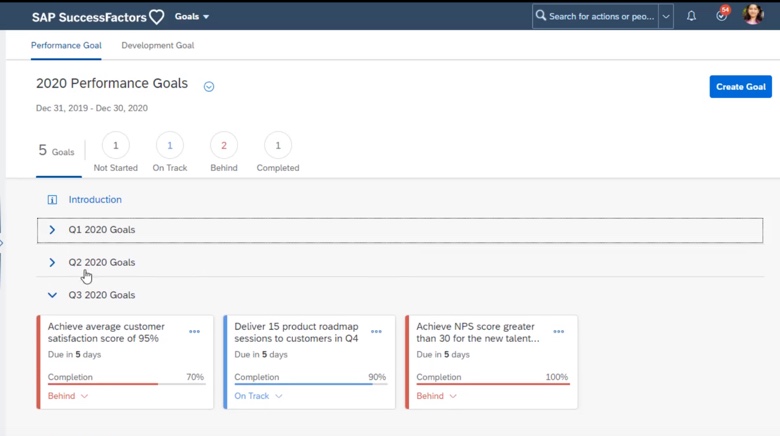
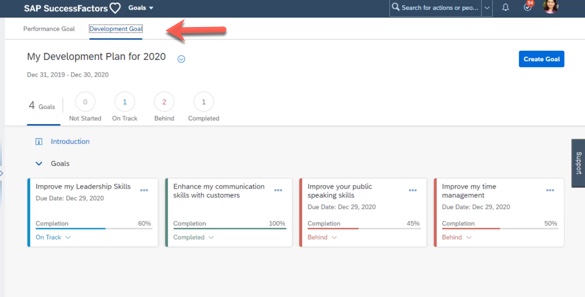
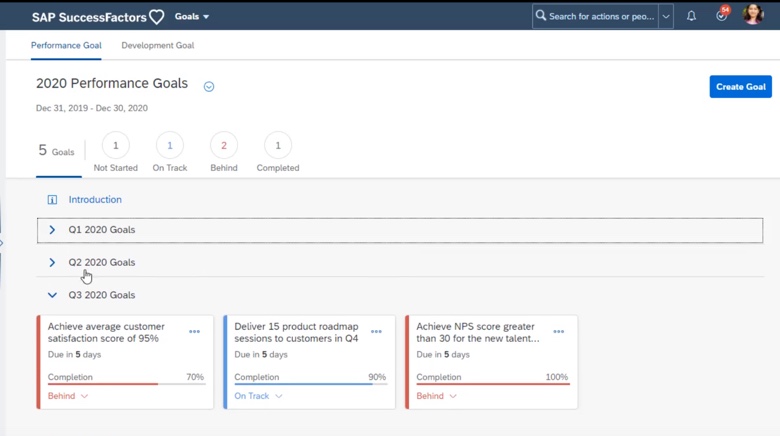
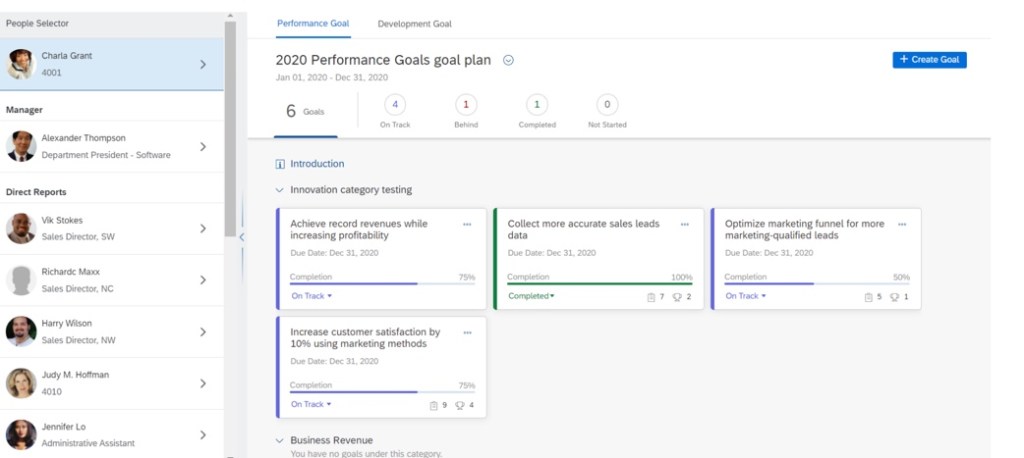
There is a new admin opt-in for the latest version of Goal Management. The latest version of Goal Management provides users with a streamlined view of goals to make it easier to access and manage. Performance Goals and Development Goals are now housed within Goal Management and have improved integration with CPM. Access to Goal Management contains both plans with a tab for each as seen in the example below.
New Goal Management View with Both Goal Plans
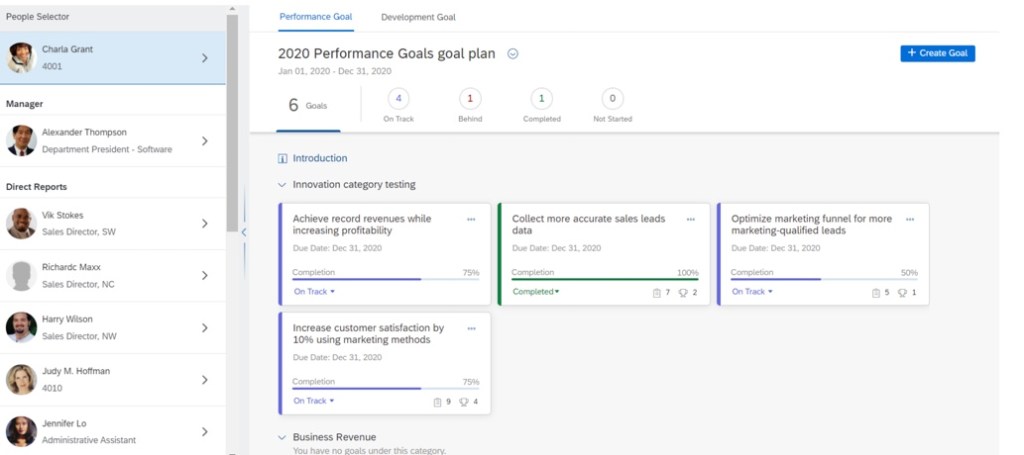
For managers, the new look is especially helpful. It is easy to navigate to direct report’s plans or any other users in their target population. They can swap between between their reports and within the two plans. An example the manager’s goal plan view is seen below.
Manager View of Goal Plans
Latest Goal Plan Features
The latest version of Goal Management still allows for the following existing functionality:
Creation of personal goals.
Development goals can have competencies and learning activities added.
Receipt of goal notifications.
Edit, view, and delete all goals except group goals v1.
Access to other’s goal plans with proper role-based permission.
Existing integration with other modules.
New functionality includes:
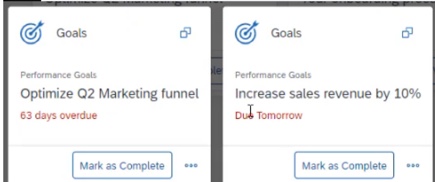
Personal goals not yet at the completed stage and approaching or past due date can appear on the latest home page.
Linked achievements for the latest version of CPM may be created and viewed here rather than having to go out of the goal plan and navigating to CPM.
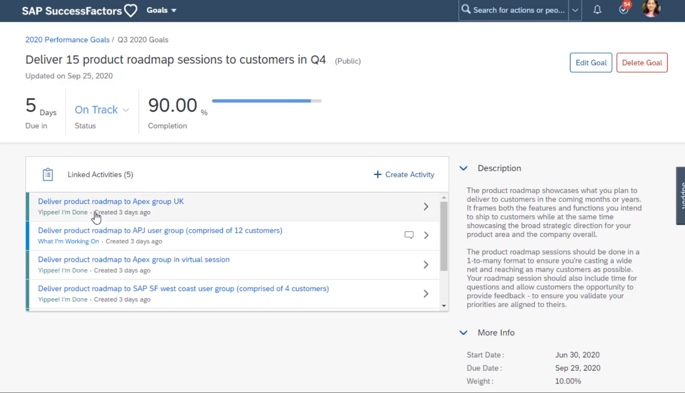
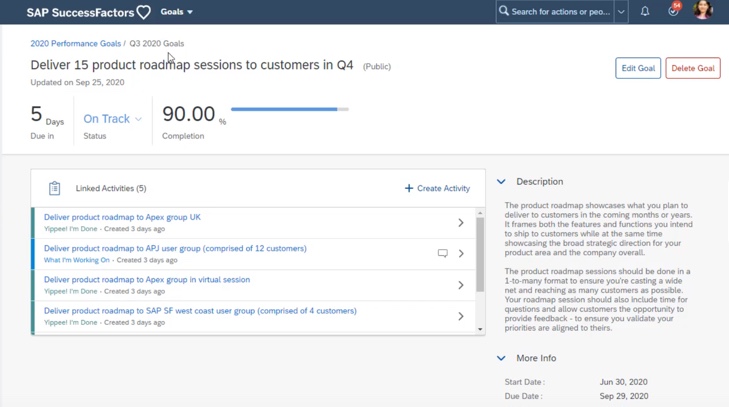
Activities can be added directly to goals and linked activities may also display. An example of activities tied to a goal is shown below.
Add Activity to Goal
However, only the latest version of Goal Management may be used with the latest version of CPM.
Latest Goal Management Limitations
Since this is a new version for Goal Management, there is some goal plan functionality not yet available including:
Mass import of goals.
Ability to cascade and assign goals.
Use of Group and Team Goals.
Changing goal plan states within goal plan.
Use of metric lookup tables.
Use of Coaching Advisor for development goals.
Assigning custom learning activities to development goals.
OData APIs.
Some mobile features which will be identified shortly.
Attributes that may be Configured
Listed below are the the goal plan XML attributes that may be configured in the latest Goal Management:
max-goals
max-weight
max-weight-per-obj
min-goals
min-weight
min-weight-per-obj
new-obj-share-status-public
show-total-goalscore
Unsupported Goal Plan Field Types
Additionally, there are some goal plan field types that are not supported:
Bool
Checkbox
Comment
Link
Table
Text when used for achievement text, actual achievement text, object plan field 1, go to url
Changes to Goal Plan Fields with Latest Version of Goal Management
Name field is required with a maximum length of 500 characters.
Description and metric fields have a maximum 1000 character limit.
State. For use on the latest version of the home page, set the final enum value of the state field to “complete” in order to trigger the change of the goal state which enables incomplete goals to appear on the latest home page.
When using weight, if min-weight-per-obj and max-weight-per-obj attribute values are not met, goal creation is not possible.
For development goals, competencies can only be used in conjunction with Job Profile Builder.
Cannot select a single competency to link to a development goal in the UI.
You may convert existing goal plan templates but the goal plan field types that are not supported will not appear in converted goal plans.
After the upgrade, goal plan templates will need to be converted. Convert a template only once and and one at a time. Only convert the goal plans in use. Goal plans not converted will be read-only. Once converted, the goal plan templates may be used in the latest version of Goal Management.
Mobile Apps Limitations
There are some limitations using the latest version of Goal Management in mobile apps. For Performance and Development goals:
Cannot delete a goal from the goal card.
Cannot enter a negative number in the number field type.
Cannot revert back to the legacy view to see unsupported fields.
For Development goals:
Unable to search for a specific competency.
Unable to display the number of competencies on the goal card.
Unable to add competencies by library or category.
No integration with Learning.
Latest Goal Plan on latest Home Page
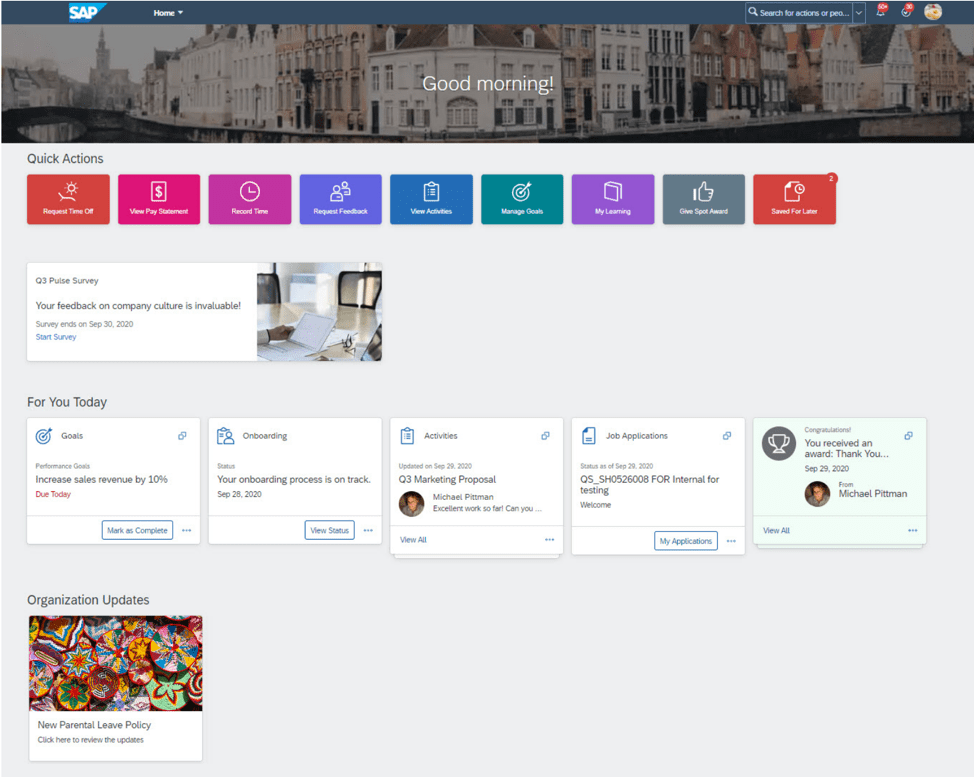
The latest Goal Management may be used in the latest version of the home page. There is a new admin opt-in for the redesigned home page. It is available for early adopters in both Preview and Production. Any existing legacy home page custom tiles or permissions are not impacted by the new page. An example of the new Home page is shown below.
Latest Home Page
The view is less cluttered with customized user and organization content. Tiles are replaced with cards and are system generated and more interactive. The page is divided into three sections:
Quick Actions. For frequent or quick actions.
For You Today. Dynamically generated user content. Displays any recently added goals and CPM activities.
The new Home page shows content from Goal Management, Continuous Performance Management, and Continuous Feedback. On the latest home page, you can view personal goals when the state of these goals is not yet complete and these goals are approaching their due dates or already overdue.
The latest version of the home page handles only personal goals in the following manner:
Updates of goals on the home page appear on for those manually created, modified or deleted.
Goals from an import are not reflected on the home page.
Performance goals appear based on status, if not yet complete and 15 days before due date.
Development goals appear based on status, if not yet complete and 30 days before due date.
Overdue Performance and Development goals will display.
Goals in “For You Today” section
Performance and development goals disappear from the new home page when:
Goals are completed.
Goals are deleted.
Goal due dates are past the due dates configured on the goal plan template.
To-do items list can be opened and acted upon in a side panel on any page. You can take action on each to-do directly from the side panel.Overdue to-do items are indicated in red.
Is the upgrade right for you?
After upgrading to the latest version of Goal Management, you cannot reverse the update, so be sure to fully understand what features you will be gaining and losing. It is wise to fully test in a preview instance before committing to an upgrade to production.
Because there are some substantial limitations to the latest version, it may be premature to upgrade but it is at least worthwhile to anticipate how Goal Management is changing and to gain an better understanding of how modules continue to be more tightly integrated with each release.
There are new universal and admin opt-in features in the H2 2020 Performance Management release along with a large number of universal features. We will start with what’s new. There are two admin opt-in updates and two universal 360 related updates.
New Admin Opt-ins
There are two new admin opt-ins available and we will look at them both.
Latest Version of Goal Management
The latest version of Goal Management provides users with an upgraded user interface with a comprehensive view of goals and development goals. This streamlined tool also enables access to the latest version of Continuous Performance Management (CPM) to create and view linked activities.
A notable change is combining performance goals and development goals within the navigation menu. Development goals now appear as a tab within Goal Management. An example is shown below.
Development Plan Tab
For both plans, the view is cleaner and more visually appealing. Goals are more prominently displayed and may be viewed by status as well. You can see what the new goal plan looks like below.
Linked achievements for the latest version of Continuous Performance Management (CPM) may be viewed here rather than having to go out of the goal plan and navigating to CPM. Activities can be added directly to goals and linked activities may also display. An example of activities tied to a goal is shown below.
Linked Goal Activities
For managers, the new look is especially helpful. It is easy to navigate to direct report’s plans or any other users in their target population. An example the manager’s goal plan view is seen below.
Manager View of Goal Plans
Job Profile Builder Support for Writing Assistant and Coaching Advisor
The other new admin opt-in feature pertains to competencies when Job Profile Builder (JPB) is used. Previously, to use Writing Assistant and Coaching Advisor for competencies in a performance form, the Teasers and Tunings were added to a competency library via an import file in Provisioning.
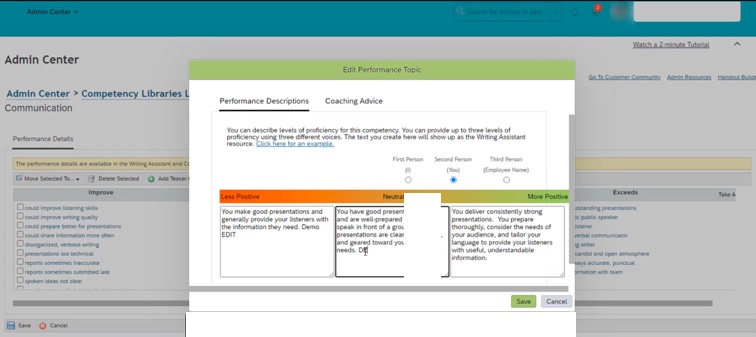
Now this task may be accomplished in the UI with the tool “Manage Writing Assistant and Coaching Advisor“. This update fills a gap between JPB and Job Description Manager. Within this tool, a competency library overview page will display. After selecting the library and finding the competency to update, teasers and tunings can be added to the performance details. An example is shown below.
Adding Teasers when JPB is Enabled
This new feature enables users without Provisioning access to create and modify the writing assistant and coaching advice content.
New Universal Updates
There are two new universal updates for H2 2020 both for 360 Reviews.
Advanced Search of Universal People Search Available in 360 Reviews – SAP Fiori Version
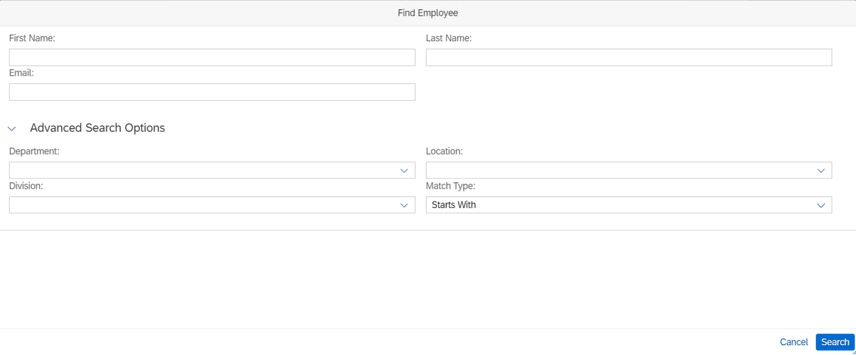
Advanced Search of Universal People Search is now available for 360 reviews. When searching for employees, when the “Find Employee” dialog box appears, there will be advanced search options. This search can be used in the “Add Participants” dialog box, in the “Send a Copy” dialog box and in the “360 Executive Review” page. The updated search screen is displayed below.
Advanced Search of Universal People Search
Detailed 360 Report in 360 Reviews – SAP Fiori Version
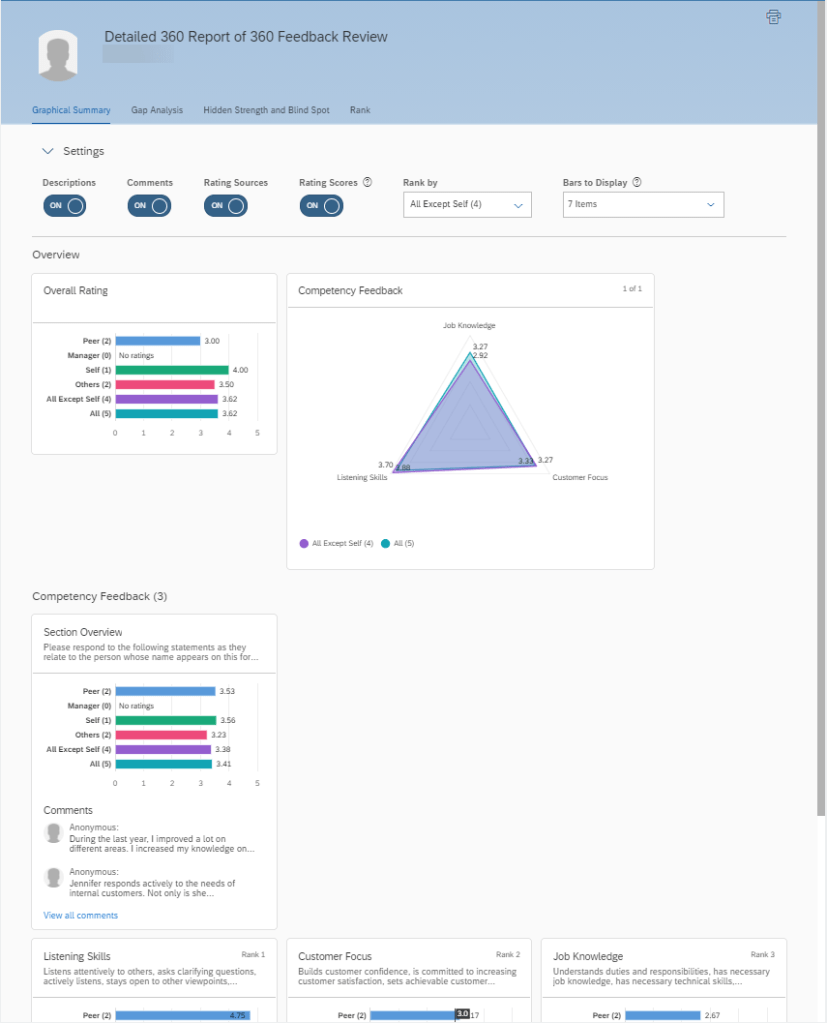
There is a revised version of the Detailed 360 Report. It has cleaner and easier to read layout. An example is shown below.
Detailed 360 Report
The settings are now housed at the top of the report and fonts are bigger and brighter for the gap values. Comments are more visible and appear beside ratings.
There is a radarchart to display competencies and ratings on the Graphical Summary tab. The print set up dialog box now offers an option to print specific views.
Admin Opt-in Updates
There are three admin opt-in updates available: New Competency Picker in Forms, Qualtrics Surveys for Steps in Performance Reviews and Customized Labels for Calculated Rating and Manual Rating in Customized Weighted Rating Section. Since there are sever
New Competency Picker in Forms
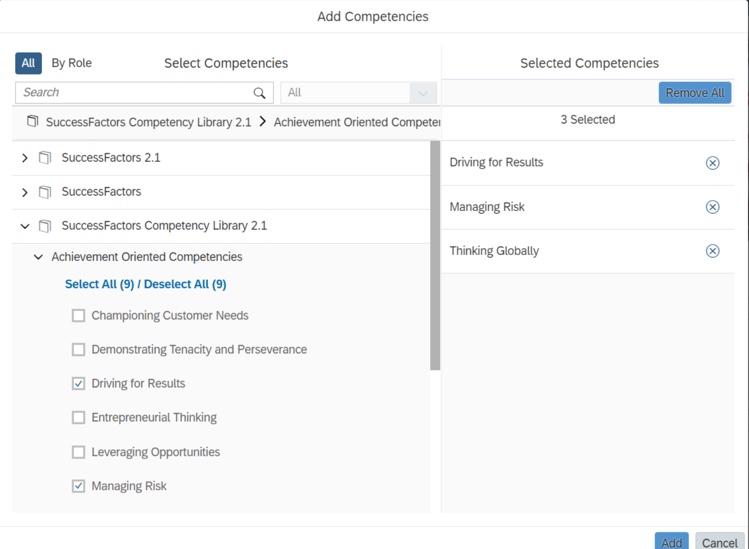
This opt-in is available when Job Profile Builder (JPB) is enabled and is used when adding competencies to a performance form. The new competency picker is used on PM forms to find competencies to add. Competencies can be found using a hierarchy structure and a search option. Competences can be selected by competency library or job roles and using keywords search. An example is shown below.
Add Competencies
Qualtrics Surveys for Steps in Performance Reviews
If you are using Qualtrics surveys in your performance process, the current version only allows the survey to appear after the employee signature step. In the new version, you may select which steps and for which roles the survey should display. The survey can be used for single role, iterative, and collaboration steps.
Customized Labels for Calculated Rating and Manual Rating in Customized Weighted Rating Section
The labels for the calculated rating and the manual rating in the Customized Weighted Rating section can now be customized using an XML file. In the previous version, the labels for the calculated rating and the manual rating were hardcoded as Calculated Form Rating and Overall Form Rating.
Universal Updates
There are several universal updates for Performance Management. Many revolve around the Customized Weighted Rating Section of a performance form. We will look at these but first we will look at the other universal updates.
Message to Remind Users Before Removing Signers
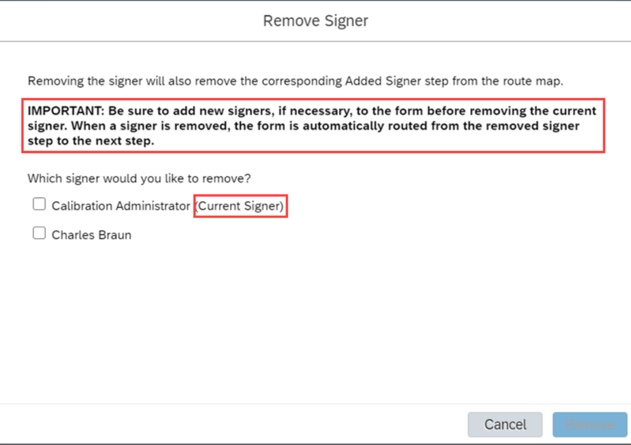
In a performance form that allows for a signer to be removed, there is now a reminder in the Remove Signer confirmation pop-up. The message is to remind users that by removing a singer, the form automatically routes to the next step. If that is not the user’s intent, they need to add a new signer before removing the current signer. An example of the new reminder is shown below.
Message Added to Remove Signer
New Feedback Data in Goal Plans
Feedback from Continuous Performance Management (CPM) is now available to display in performance and development goals plans. The CPM achievements column for a goal currently shows the count of achievements tied to a goal. With the latest version of CPM, achievement related feedback will also display. In the CPM achievements column, clicking on the count will now display the feedback topic title along the topic title and three sets of questions/answers from the Achievements tab.
New Feedback Data in Performance Management Forms
The CPM achievements column in the performance and development goal sections of a PM form currently shows the count of achievements tied to a goal. With the latest version of CPM, achievement related feedback will also display. In the CPM achievements column for a goal, clicking on the count will now display the feedback topic title along with the three related feedback question/answers.
If any achievements or feedback is deleted in CPM, the data is also deleted from PM forms, including completed forms.
You can check out my blog on the H2 2020 CPM Release Updates to see what else is new.
The remaining universal updates that we will discuss pertain to a very specific summary section of a performance form: Customized Weighted Rating.
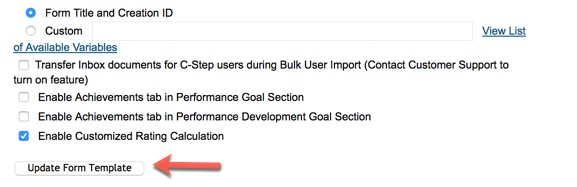
Removal of Enable Customized Rating Calculation from Form Template Settings
“Enable Customized Rating Calculation” no longer appears in Form Template Settings as seen in the example below.
Current Method to Enable Customized Rating Calculation
“Enable Customized Rating Calculation” was a prerequisite to enable the calculation.
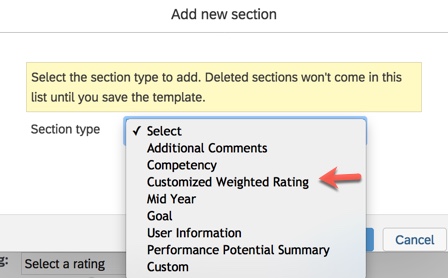
In the new version, simply adding the Customized Weighted Rating section to a form template acts as the prerequisite to enable the calculation of the overall customized weighted rating.
Enable Customized Weighted Rating
The business rules that trigger the calculation must also be configured.
Rating Scale for Customized Weighted Rating Section
In the previous version, the rating scale for the Customized Weighted Rating section used the same rating scale as the other rating section. In the new version, the Customized Weighted Rating section has its own rating scale.
“Unrated” and “Too New to Rate” in Previous Ratings of Customized Weighted Rating Section
In the previous version, “Unrated” and “Too New to Rate” were not in the Previous Ratings table of the Customized Weighted Rating section of a PM form and just displayed as 0. In the new version, “Unrated” and “Too New to Rate” are displayed in the Previous Ratings table of the Customized Weighted Rating section and both are ignored in the calculation of the overall customized weighted rating.
Allow Override of Unrated Manual Rating for Customized Weighted Rating Section
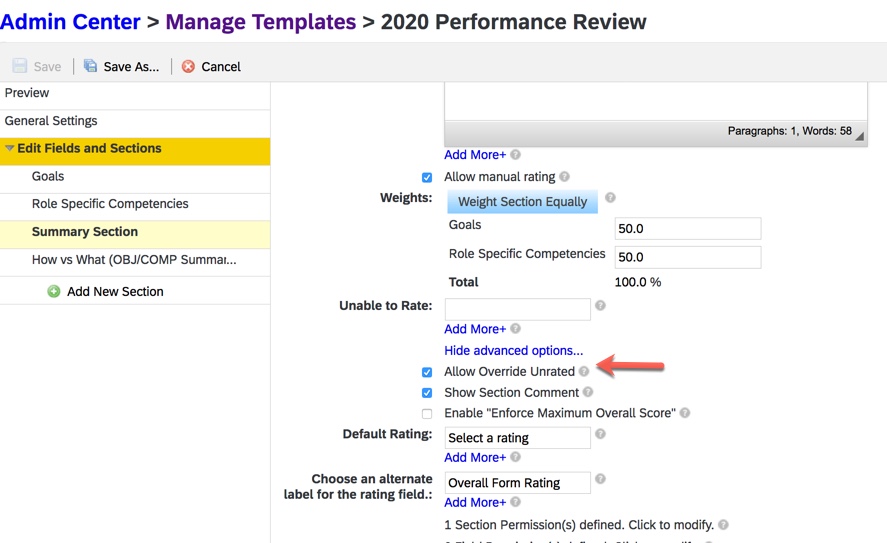
In the Customized Weighted Rating section of a form template, there is now the option to override the unrated manual rating. The option, Allow Override of Unrated Manual Rating has been added so this summary section can work like the others as seen in the example below.
Allow Override Unrated
In the previous version, the unrated manual rating displayed as Unrated. In the new version, the unrated manual rating can be overridden by the calculated rating.
Too New to Rate in Customized Weighted Rating Section
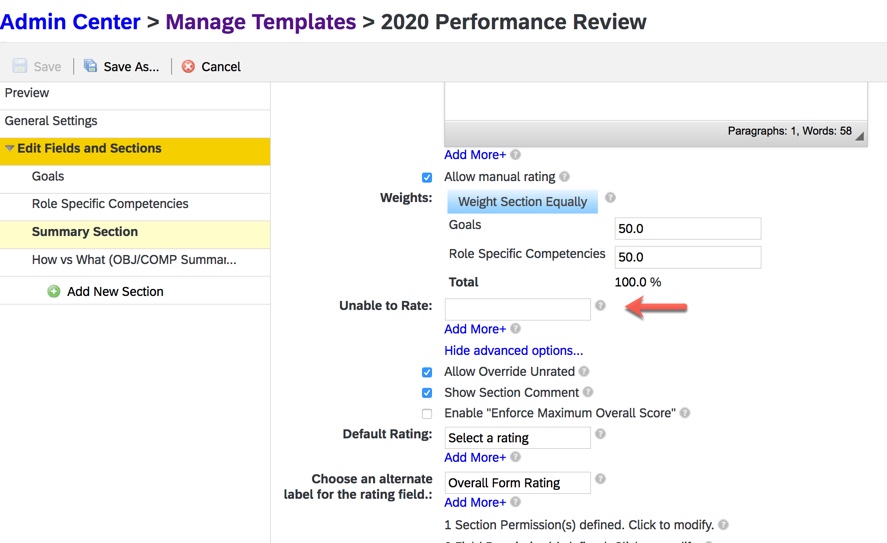
Like the other summary sections, there is now the option to provide a label to explain why an employee is not rated. An example using the current summary section is displayed below.
Unable to Rate Label
The summary section example above shows the Unable to Rate field will be available as an option in the Customized Weighted Rating section of a form template.
Calculated Rating from Customized Weighted Rating Section in Ad Hoc Reports
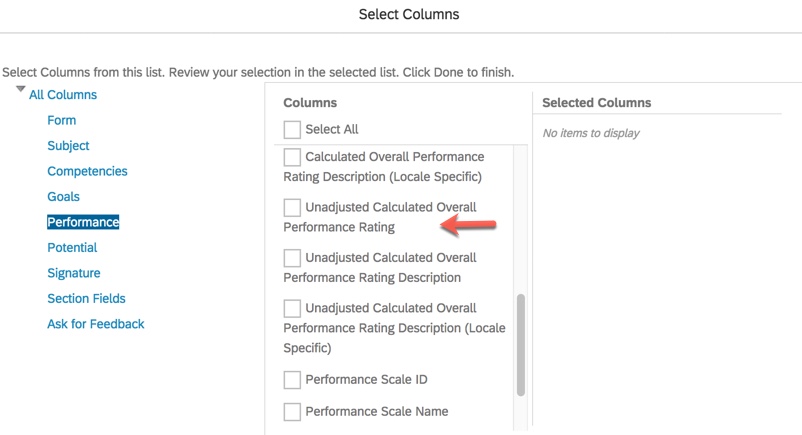
If you are using the calculated rating in the Customized Weighted Rating section of a form template, ad hoc reports use the unadjusted calculated rating from the performance template summary section instead. An example of creating an ad hoc and selecting rating columns is shown below.
Unadjusted Calculated Overall Performance Rating
In the new release, when creating an ad hoc report, when this same field is selected, the Unadjusted Calculated Overall Performance Rating from the Customized Weighted Rating section is used. This means reporting will accurately reflect the ratings in the performance forms. This is especially important when the template has both the Summary section and the Customized Weighted Rating section. The calculated rating from the Customized Weighted Rating section overrides the unadjusted calculated rating from the Summary section.
Customized Weighted Rating Section and Ratings Displayed in En Route Folder
In the prior version, when a form with the Customized Weighted Rating section was in the En Route folder, this section’s ratings were not in sync with the in-progress form. In the new version, the Customized Weighted Rating section section of a form will display in the En Route folder and will be synced with the in-progress form. The Previous Ratings table of the section will contain the ratings from the previous steps for the login role and by other roles.
Calculated Rating from Customized Weighted Rating Section in Bin View
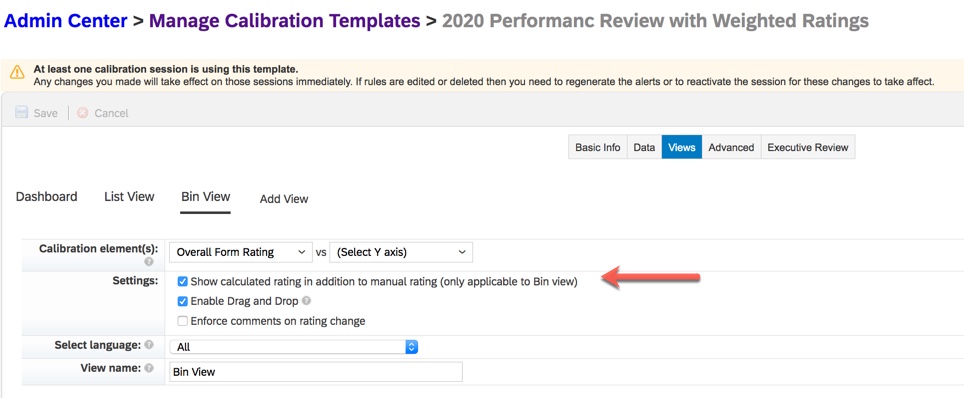
There is a another feature available when a calibration template is based on a performance form template that contains a Customized Weighted Rating section. Currently, when the data source for a calibration template is a performance form template with this summary section, either the manual or the calculated rating can be calibrated. However, the calculated rating cannot be displayed in the Bin view of a calibration session.
With the latest release, the calculated rating from the Customized Weighted Rating section may display in the Bin view if this calculated rating comes form a PM form and the “Show calculated rating in addition to manual rating (only applicable to Bin view)” setting is enabled. An example is displayed below.
Calculated Rating Option for Bin View
Label for Rating Scale Scores in Previous Ratings of Customized Weighted Rating Section
In order to get a clear picture of what the numeric rating means, labels are now visible. In the previous version, the ratings in the Previous Ratings table in the Customized Weighted Rating section were displayed only as numeric values.
An example is shown below.
Numeric Rating in Prior Version
In the new version, the ratings in the Previous Ratings table of the Customized Weighted Rating section are displayed as numeric values with corresponding text labels. If rating numeric values are mapped to labels in the manual rating scale, the label display next to the rating’s numeric value. If no labels were mapped, the rating will continue to just display its numeric value.
And example is shown below.
Customized Rating Section with Rating Labels
There is a checkbox in the form template for this section: “Hide numeric rating values (only show text labels)” similar to other summary sections.
If a rating’s numeric value is mapped to a certain label for the manual rating’s rating scale scores, the corresponding label can be displayed next to the rating’s numeric value in the Previous Ratings table. Otherwise, the rating is displayed as its numeric value.
There is an added checkbox for this form section in ” Manage Templates“. There is the option to hide numeric rating values and only show text labels.
Customized Weighted Rating Section in Print and Save as PDF
In prior versions, the section calculated rating details were not displayed in the printed or saved performance form. Now the calculated rating details of the Customized Weighted Rating section of a performance form will be included in the printed or PDF version of the form.
To Learn More
All in all, there are over 20 items being changed or enhanced in this release for Performance Management and we didn’t cover every detail here. For more information, check out the What’s New Viewer here.
Do you need help managing your SuccessFactors Release cycles? Email info@worklogix.com to see how we can help!



























 Worklogix Blog