Having forms automatically route to the next step can be a efficient method to keep the performance process moving along but there is a wrinkle that can cause lots of manual intervention and even trap you in time loop.
It all starts with the route map
First let’s look at the route map associated with a performance template.
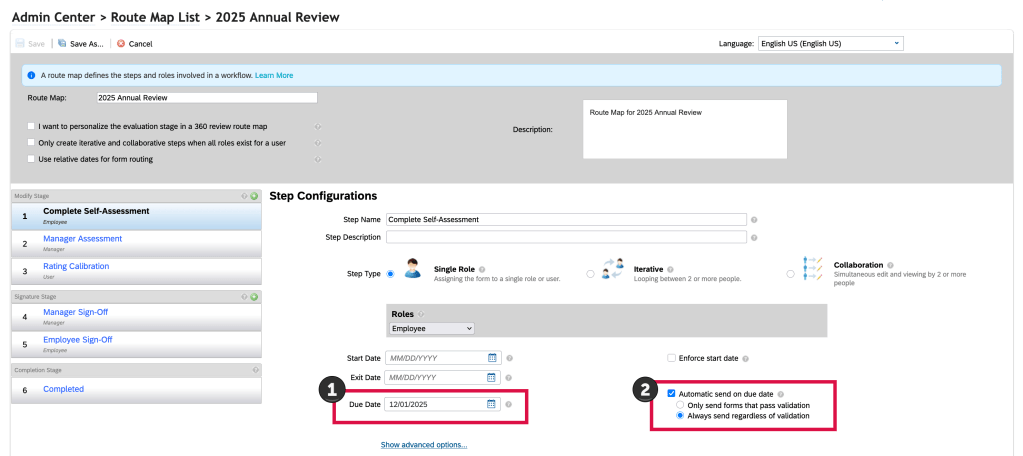
Route maps can be set up to have forms auto route on a designated step due date. Any or all steps can have the forms move based on when you decide the step is due. This means any forms sitting in this step on the step due date will automatically route to the next step the following day.
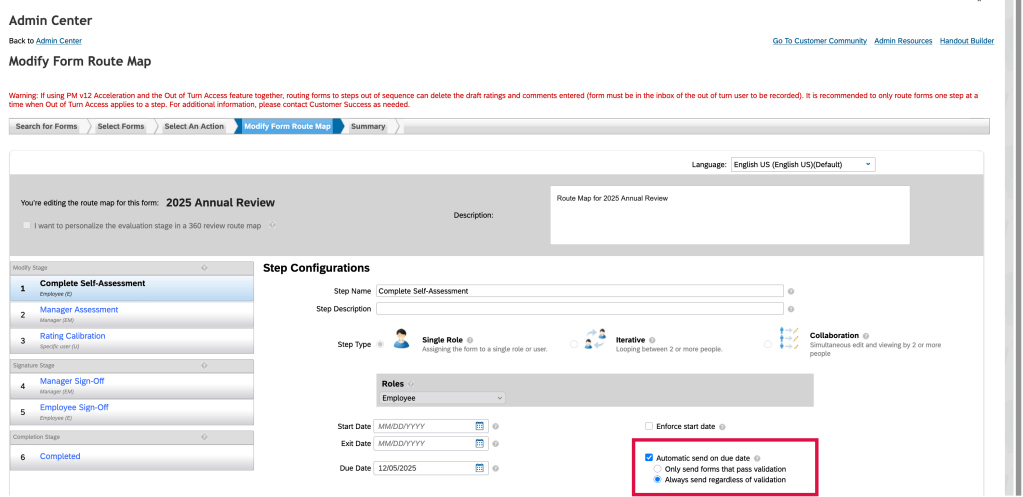
The settings for this auto routing are shown below.
Route Map Auto Route Form on Step Due Date
First, identify a due date for the step (1) and then enable the “Automatic send on due date” box (2).
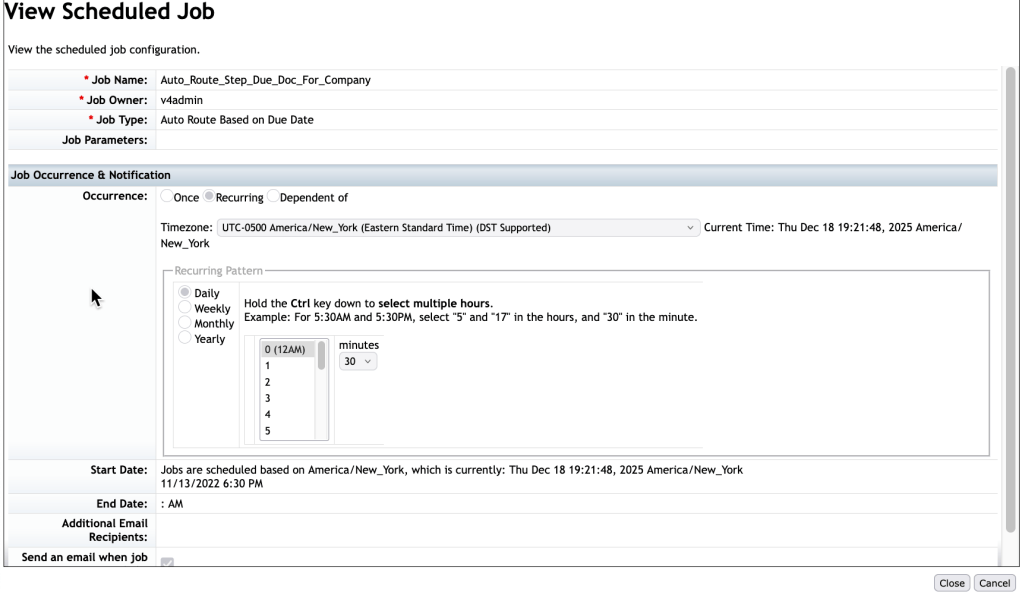
In order for this auto routing to work, a background job needs to be set up in Provisioning. In Provisioning, go to Manage Scheduled Jobs . Here the Auto Route Based on Due Date job needs to be set up and should be configured as a recurring job running nightly.
“Auto Route Based on Due Date “Job
An example of the job details are shown below.
Details of “Auto Route Based on Due Date” Job
In the example, the job is scheduled to run daily, 30 minutes after midnight.
It is best to have the job scheduled to run after midnight so the forms will route immediately at the end of the step due day.
Now the route map is set up with the auto route step due date(s), the background job is set up and the forms are launched.
Once the performance review process is in flight, forms will progress through the workflow. With the scheduled background job running nightly, any form still in a step on the auto route due date will automatically route to the next step at the end of day.
Potential Gotcha
This is where a gotcha may lie. The admin can manually send a form back or a user in the current step can send to the form to the previous step. A hiccup can occur after the step due date when a form is returned to this step.
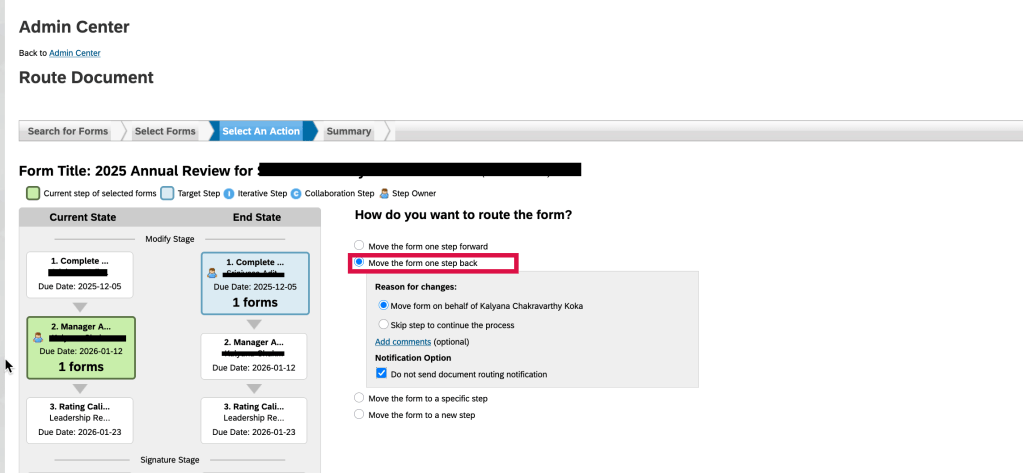
In this example, a user may ask that a form be routed back a step. The admin would have to route the document back.
“Route Form” action to move a form back a step
Another way to have a form move back a step is to have the template configured to allow the form to go back a step.
Button to send form back one step
In either case, the form had auto routed to the next step, but was then routed back to the prior step. If the employee does not make updates to the form that day, that evening the form will route forward again to the next step.
This bears repeating. If a form is routed back to an auto route step, if no action is taken on that day, the form will auto route forward again at the end of the day.
Even though the step due date has passed, if a form resides in that step, it will auto route again the next time the background job runs. This can cause a lot of manual rerouting of forms if the form is not actioned upon the day that the form is routed back.
Workaround
There are a few ways to handle this time loop.
Updating Just a Few Forms
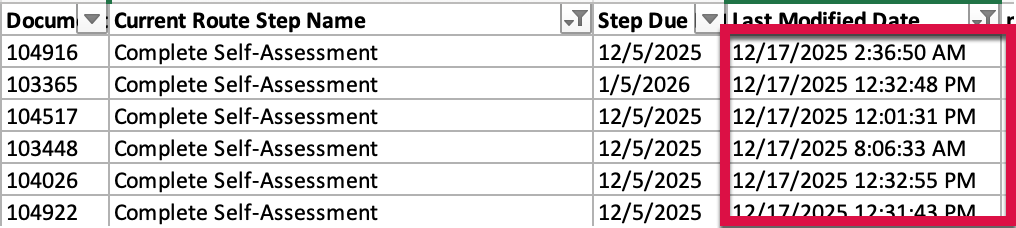
When dealing with just a handful of forms that were impacted, run an ad hoc query to find any forms that are in that prior step based on a recent modify date.
Forms recently moved back a step
The admin would use this information to go to Modify Form Route Map to update the route map for each of the impacted forms.
Modify Form Route Map Action
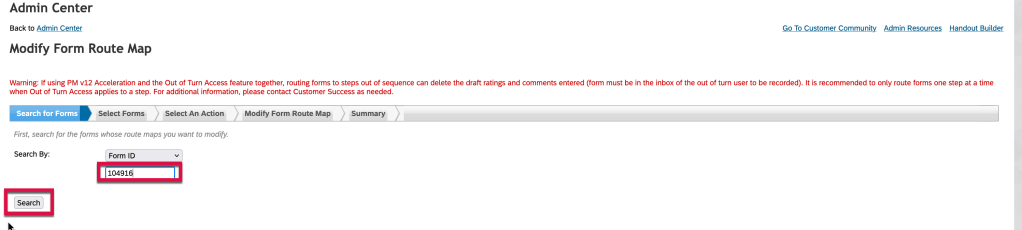
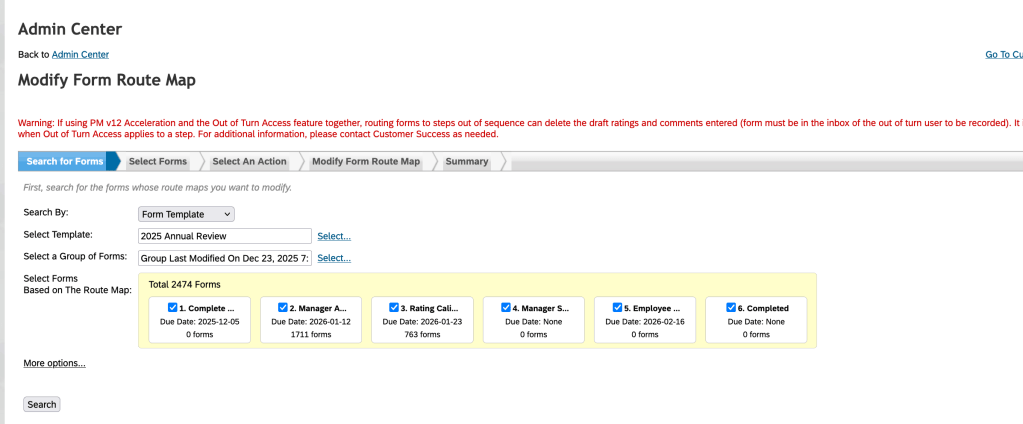
Enter the Doc ID from the ad hoc report and click “Search”. The form route map steps display.
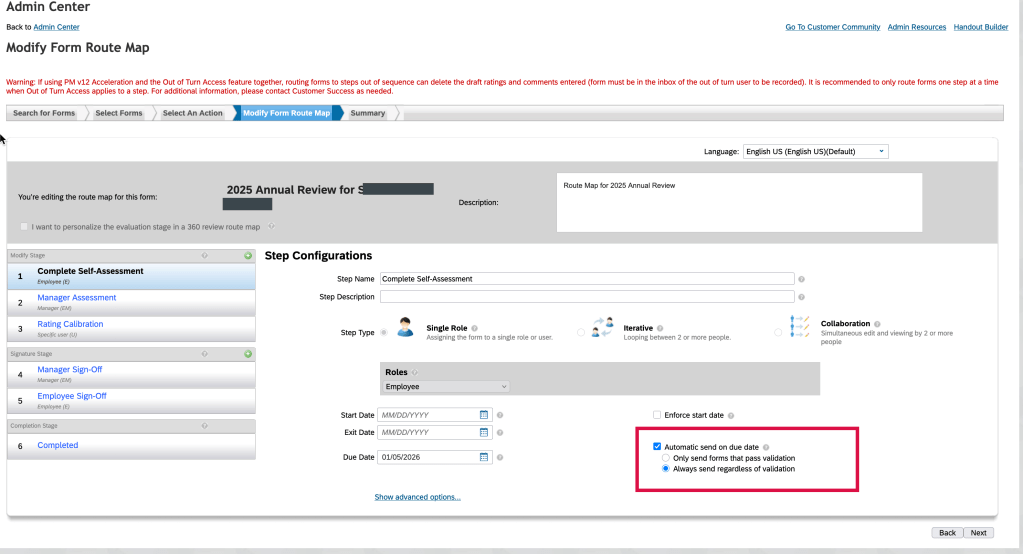
Click on the route map step that you wish to update. This will expand the step configuration section and show the step details.
Modify Form Route Map Step 1 Expanded View
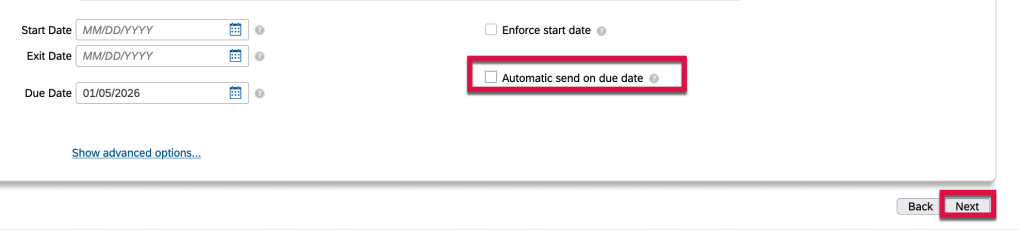
In order to stop this form’s auto routing to the next step, uncheck the “Automatic send on the due date” checkbox and then click on “Next” as shown below.
Remove “Automatic send on due date” for the step
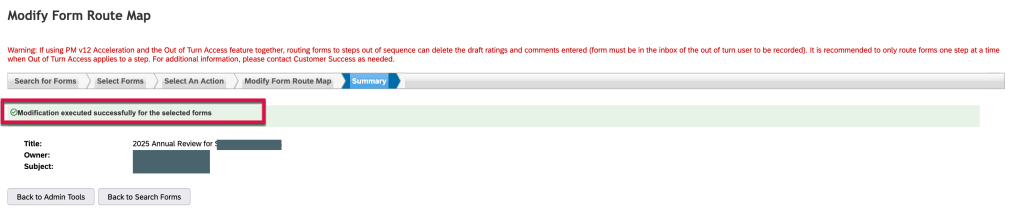
The form has been updated and the the automatic routing for this step has been removed, for this form only.
Form route map step has been updated
Repeat this process for each individual form that needs to have the automatic routing for this step removed. Click on “Back to Search Forms” to update the next form.
To Remedy Auto Route for All Generated Forms
To completely remove the auto route so that it will not continue to occur each time a form is routed back to an auto route step, the admin may modify the route map via Modify Form Route Map.
Modify Form Route Map
Once the forms are selected, remove the automatic send of due date for the step.
Remove “Automatic send on due date”
This means all of the forms generated will now auto route if any forms are returned to this step later in the process.
If this manual intervention seems too cumbersome, you may decide to limit the use of the auto-route feature going forward with other templates.
Other Gotchas
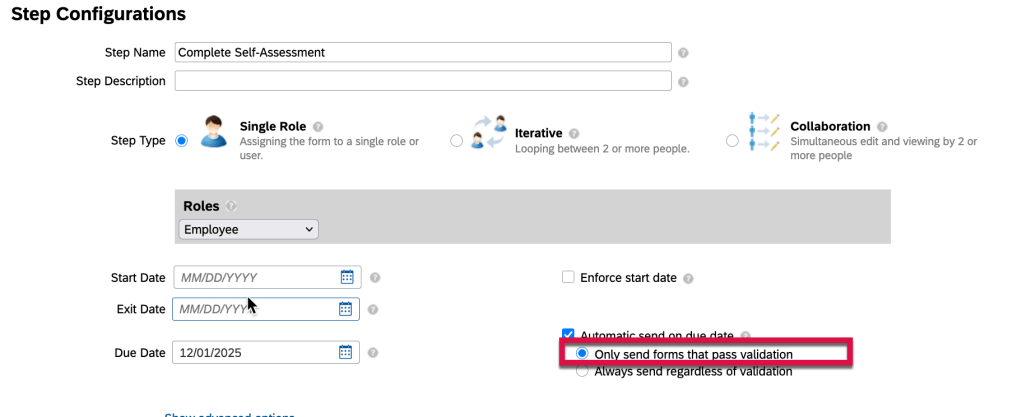
Auto Route Only if Validation Passes
If you find that a form did not auto route on the step due date, check the route map to see if Only Send Forms that Pass Validation is enabled for the step. If a form had required fields that needed to be populated during the current step and they were left blank, the form would not route to the next step.
“Only route forms that pass validation” setting in the Route Map
In this case, the admin would have to auto route the form to get it to the next step.
Cannot Auto Route Due to Missing User in Step Role
Another issue that can arise is when a form is set to auto route to a manager step and the manager role is not populated for an employee’s form. The manager step will be skipped. The form cannot route to a step with any empty role.
To resolve this, the admin route would have to route the form back to the first step and once the manager role is populated, the form will route correctly. This causes the system to re-evaluate employee data, new managers, route steps, and roles.
One more thing
The most successful SuccessFactors implementations aren’t defined by how much functionality is turned on—but by how intentionally it’s designed.
At Worklogix, we help organizations make these decisions with adoption, scalability, and business impact in mind—so talent processes don’t just exist in the system, but actually work in practice. Do you need help implementing or supporting your SAP SuccessFactors system? Contact info@worklogix.com for assistance.
Performance, Talent, and Skills: Designing a Smarter SAP SuccessFactors Experience
When organizations implement SAP SuccessFactors, the technology is rarely the hard part. The real challenge is making thoughtful design decisions that balance structure, adoption, and long-term value.
Below are some of the most important considerations we guide clients through when designing Performance & Goal Management, Dynamic Teams, Talent Development, and Talent Intelligence Hub (Skills/Competencies)—based on real-world implementations and leading practices.
Performance & Goal Management: Structure with Purpose
One of the earliest decisions organizations face is whether performance reviews will include ratings.
Leading practice is yes—most organizations use a 5-point scale. While SuccessFactors allows flexibility (3-point, 5-point, or even custom scales), odd-numbered scales tend to drive clearer differentiation. Rating labels can be fully text-based for managers and employees, while numeric values still operate behind the scenes to support analytics and downstream processes.
If an organization chooses to go ratingless, it’s important to pause and ask: How will performance inform compensation, succession, and talent decisions? Ratingless models require stronger narrative rigor and often more mature processes to remain effective.
Continuous Performance Management
SuccessFactors offers two complementary capabilities:
Continuous Feedback – A leading-practice recommendation to enable from day one. It encourages real-time recognition and coaching without adding administrative burden.
Continuous Performance (Activities & Achievements) – Best positioned as a longer-term goal (in our opinion). While powerful, many organizations find it overwhelming at launch when layered on top of formal goal-setting and year-end reviews.
The key is adoption: more functionality doesn’t always mean better outcomes.
AI in Performance & Goals
AI-assisted capabilities can enhance goal writing, feedback quality, and review consistency. While additional licensing may be required, these tools are increasingly part of forward-looking performance strategies and worth evaluating early.
Dynamic Teams & OKRs: Flexibility for Modern Work
Dynamic Teams enable organizations to form teams outside traditional hierarchies and manage work using Objectives and Key Results (OKRs).
This functionality can be incredibly valuable for project-based or matrixed organizations—but it’s also newer within SuccessFactors. For some clients, it makes sense to adopt immediately; for others, it’s a strong candidate for a future phase, as SAP continues to expand its capabilities.
The guiding question we recommend asking is simple: Will this add clarity and alignment—or complexity?
Typically, this is not a Day 1 feature turned on at our customers.
Career & Talent Development: Turning Data into Decisions
The 9-Box Grid
The standard 9-box within Succession Management remains a cornerstone of talent reviews. Leading practice uses:
3 sustained performance ratings
3 potential ratings
If performance ratings are based on a 5-point scale, organizations must define how those ratings translate into the 3-point performance dimension of the 9-box (hence, our key addition of “sustained” performance).
Ownership matters too. Mature organizations typically empower managers to place employees into the grid, while others may rely on executives or HR Business Partners until readiness increases.
Talent Reviews & Presentations
The most effective talent reviews integrate the 9-box directly into structured discussions, often using SuccessFactors Presentations to support consistency and executive visibility.
Successor Readiness
Leading practice readiness definitions include:
Ready now
Ready in 1–2 years
Ready in 3–5 years
SuccessFactors also supports Emergency Replacement, identifying immediate successors in the event of an unexpected vacancy—an increasingly important capability for critical roles.
Learning & Development Integration
Day-one value comes from allowing employees to link learning activities directly to development goals. More advanced organizations later expand this by associating competencies with learning, enabling targeted searches and more personalized development paths.
Calibration: Aligning Decisions Across the Organization
Calibration ensures fairness and consistency. Leading practice is to use both:
Performance Calibration – Focused on performance ratings
Succession Calibration – Focused on 9-box placement
When used, calibration steps should be intentionally embedded in the route map, not treated as an afterthought.
Opportunity Marketplace: Making Talent More Visible
Opportunity Marketplace connects employees to:
Learning activities
Mentoring
Projects
Internal job opportunities
When integrated with Learning, Talent Development, and Recruiting, it becomes a powerful tool for mobility and engagement. AI-driven opportunity recommendations can further enhance adoption, though licensing considerations may apply.
Talent Intelligence Hub: Building the Skills Foundation
Skills & Competencies
A successful Talent Intelligence Hub implementation starts with clarity:
What skills matter?
What competencies define success?
Are there existing catalogs—or do they need to be rationalized?
Leading practice is to focus initially on skills and competencies only, deferring additional attributes (traits, behaviors) until integration maturity improves across the suite.
Job Profile Builder
If possible, jobs in Employee Central should map 1:1 to job roles in Talent. Skills and competencies are mapped at the job level (within Job Profile Builder)—not the job level hierarchy itself—an important distinction for accurate modeling.
Growth Portfolio
Growth Portfolio defines how skills live at the employee level. For initial releases, leading practice is:
View-only access for employees and managers
No self-selection of skills without approval workflows
More advanced edit and approval models can be introduced later, once governance and definitions are well established.
Final Thought
The most successful SuccessFactors implementations aren’t defined by how much functionality is turned on—but by how intentionally it’s designed.
At Worklogix, we help organizations make these decisions with adoption, scalability, and business impact in mind—so talent processes don’t just exist in the system, but actually work in practice. Do you need help implementing or supporting your SAP SuccessFactors system? Contact info@worklogix.com for assistance
For tips on how to manage a release, check out our blog here.
Check out what’s new for Career Development.
Enhancements to the Employee View in the latest Career Worksheet
Employees will see more information on the Role Details page when using the latest Career Worksheet.
Highlights include:
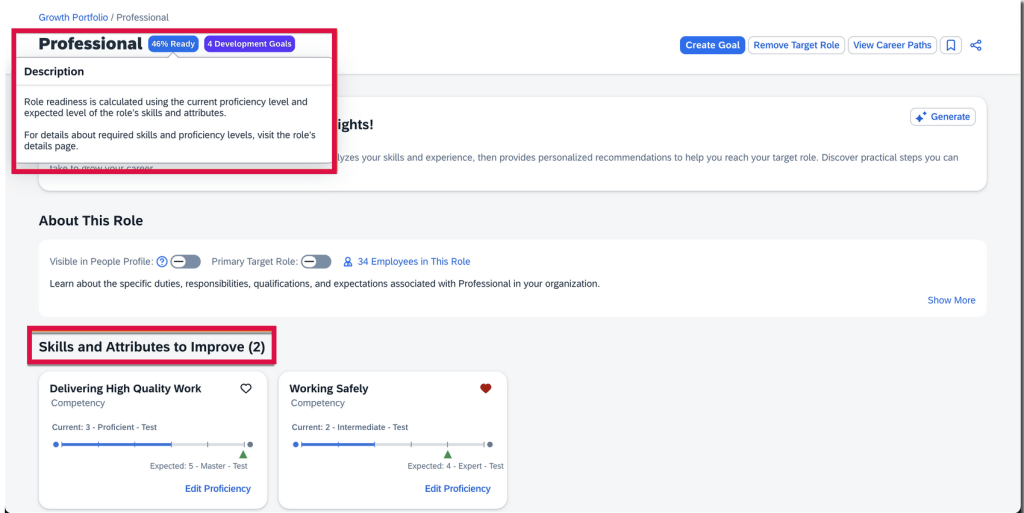
The titles for the Skills and Attributes to Improve and Skills and Attributes You Have sections now include counts
The explanation of how role readiness is calculated displays when selecting the role readiness of a target role
Employee View of Role Readiness
Enhancements to Manager View in Latest Career Worksheet
Managers can also enjoy an enhanced experience when using the latest Career Worksheet.
On the Summary tab of the Team View page in Growth Portfolio, managers have better visibility into employees’ career development, including:
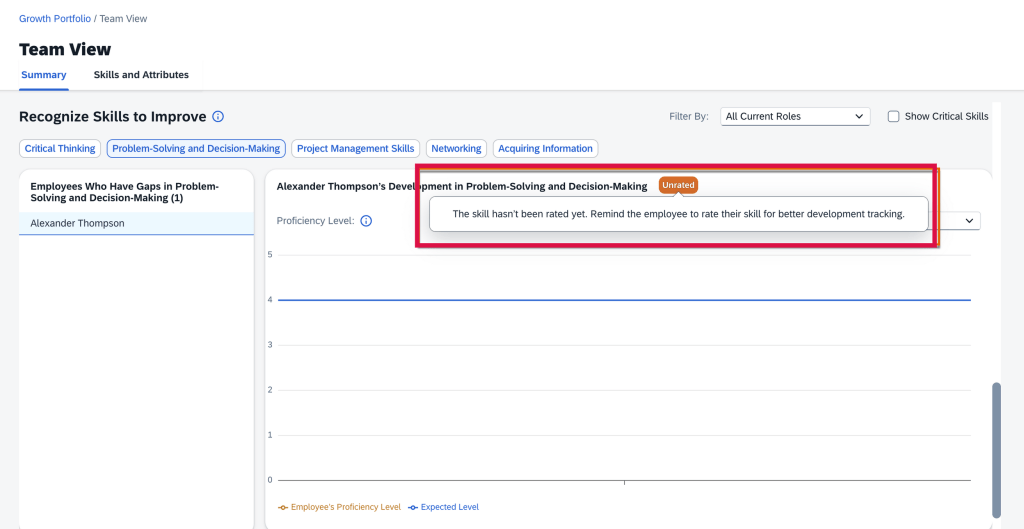
View employees’ unrated skills and attributes
Unrated Skills and Attributes
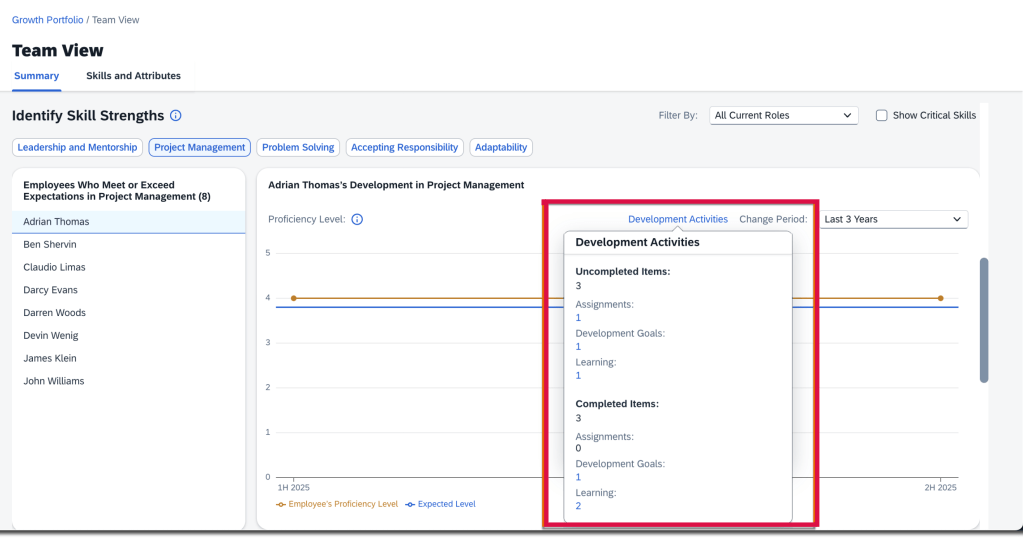
View employees’ development activities linked to specific skills and attributes
Development Activities linked to Skills and Attributes
View their team’s target roles when granted the private-access permission in the Career Worksheet template.
Option to Disable Legacy Career Worksheet
Once the latest Career Worksheet is enabled, the legacy version may be disabled. Please note, when the legacy version is disabled, the Career Worksheet tab isn’t available in the Development module. If you aren’t using Career Path, Career Explorer or Mentoring, the Development module will not be available in the main navigation menu.
View Development Goals in Latest Career Worksheet
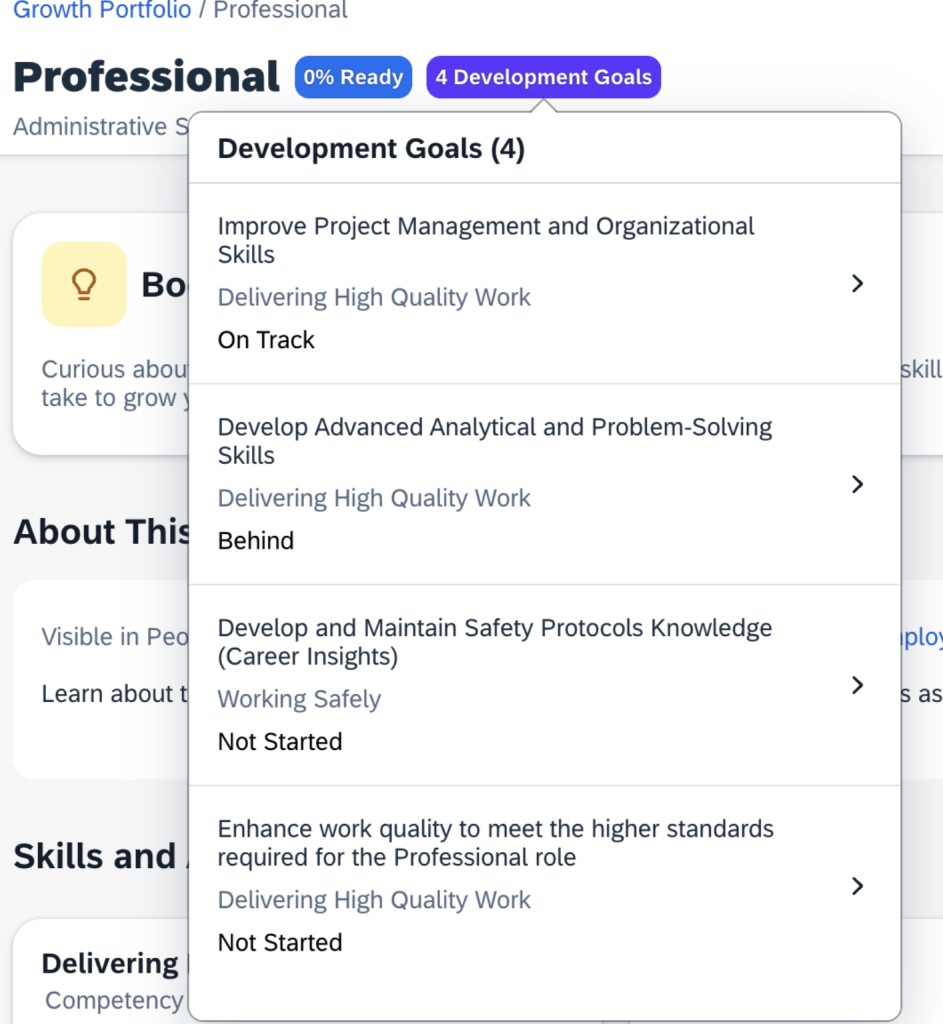
Development goals now appear on a role’s details page in the latest Career Worksheet. However, only development goals from the default development goal plan that have skills or attributes associated with the selected role will be displayed.
The Goal name, associated skills or attributes, and status for each development goal display.
Development Goals on Role Details page
View In-Progress Opportunities in Latest Career Worksheet
Actions and progress that users have made in developing their current or target roles will be viewable.
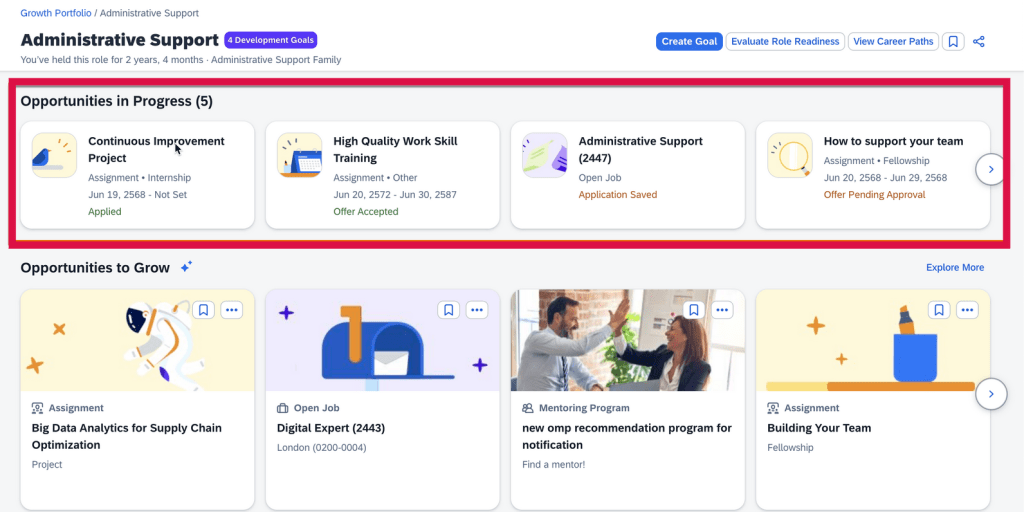
These in-progress opportunities with skills or attributes associated with the selected role appear in the Opportunities in Progress section. Once an opportunity card is selected, the user is directed to its details page.
In-progress opportunities on role detail page
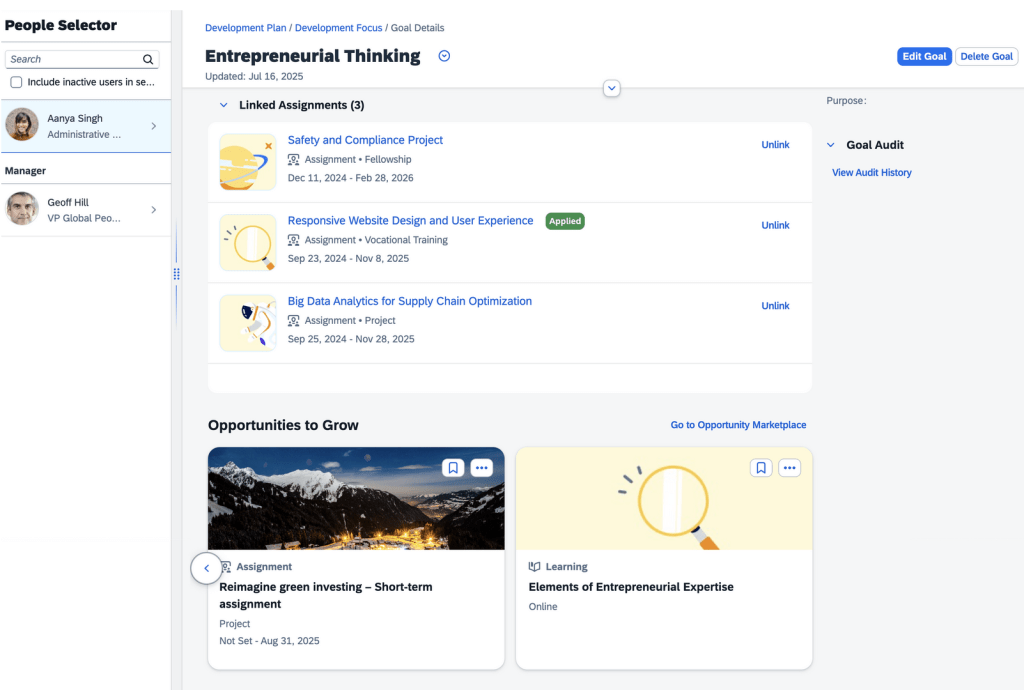
View Recommended Assignments and Learning Opportunities for Development Goals
The assignments and learning opportunities that match skills and attributes selected for a user’s development goals are now viewable. Users can also link assignments of interest to their development goals.
This feature is available on a user’s own goal details page.
Users can view learning activities not linked to development goals. These activities and learning opportunities can be be added/linked through the Linked Learning section on the goal details page. Assignments then appear in the Linked Assignments section.
Users can bookmark recommended assignments and learning opportunities.
Linked Assignments
Features Now Available with AI units license
With the purchase of the AI units license, there are some additional features available.
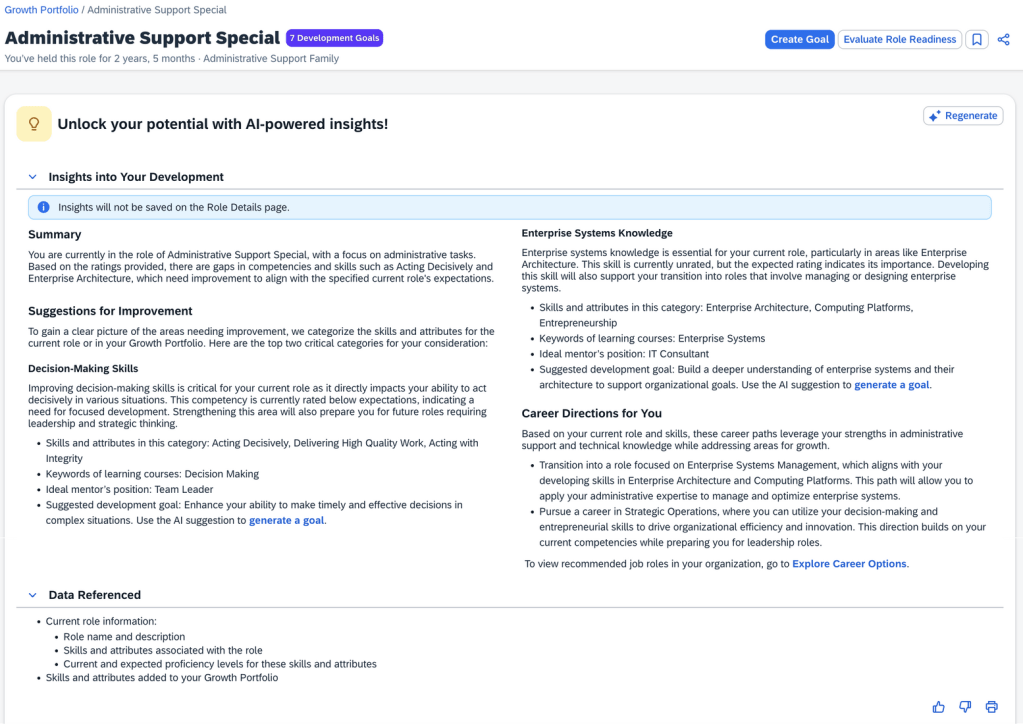
AI-Assisted Career Insights for Current Role
Previously available for target roles only, now employees can gain insights into development actions that help them progress in their current role.
There is a new Unlock your potential with AI-powered insights! section on a current role’s details page which includes:
Role name and description
Skills and attributes associated with the role
Current and expected proficiency levels for these skills and attributes
Skills and attributes added to the employee’s Growth Portfolio
AI Career Insights
The insights are grouped into sections:
Summary which is a high-level overview of the employee’s current role
Suggestions for Improvement which identifies two growth areas for upskilling and career development with achievable suggestions for skills and attributes in the category, learning courses keywords, ideal mentor’s position, suggested development goal
Career Directions which are tailored career paths with a link to view recommended job roles
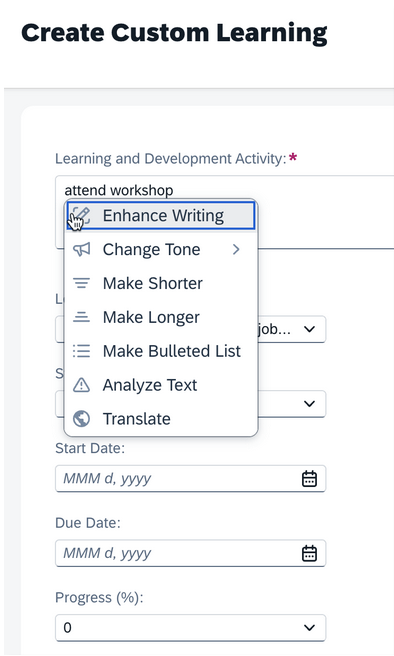
AI-Assisted Writing Available in Custom Learning Activities
Text and Textarea fields for custom learning activities now have AI-assisted writing available.
AI-Assisted Writing
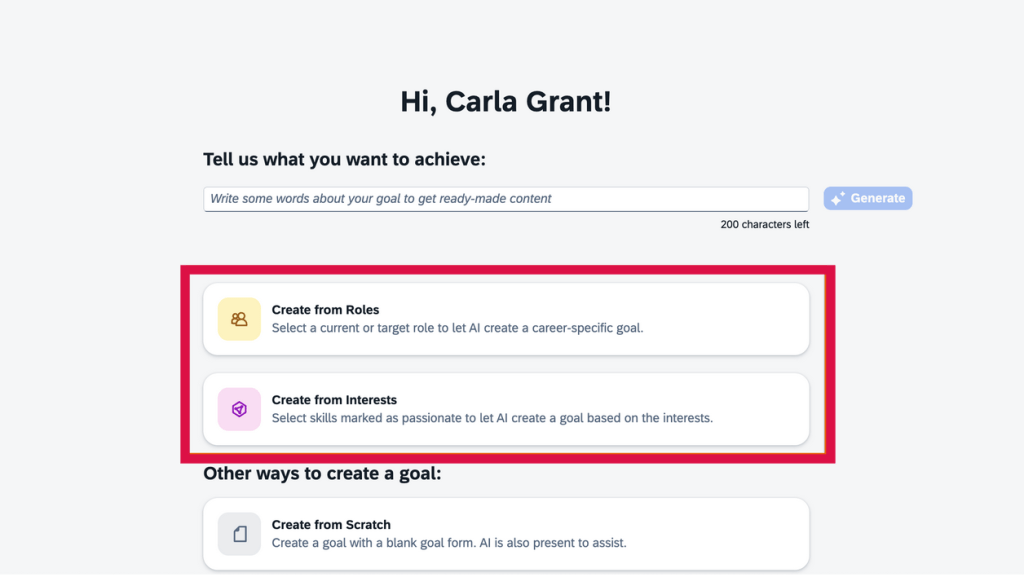
Create Development Goals with AI Based on Roles and Interests
Using AI, users can create personalized goals aligning with specific career roles or skill interests. With the AI-assisted goal creation feature enabled, AI can be used to create development goals based on a current role, target role, or skills and attributes.
Create goals from roles
Create goals from interests
New personalized goal creation options using AI
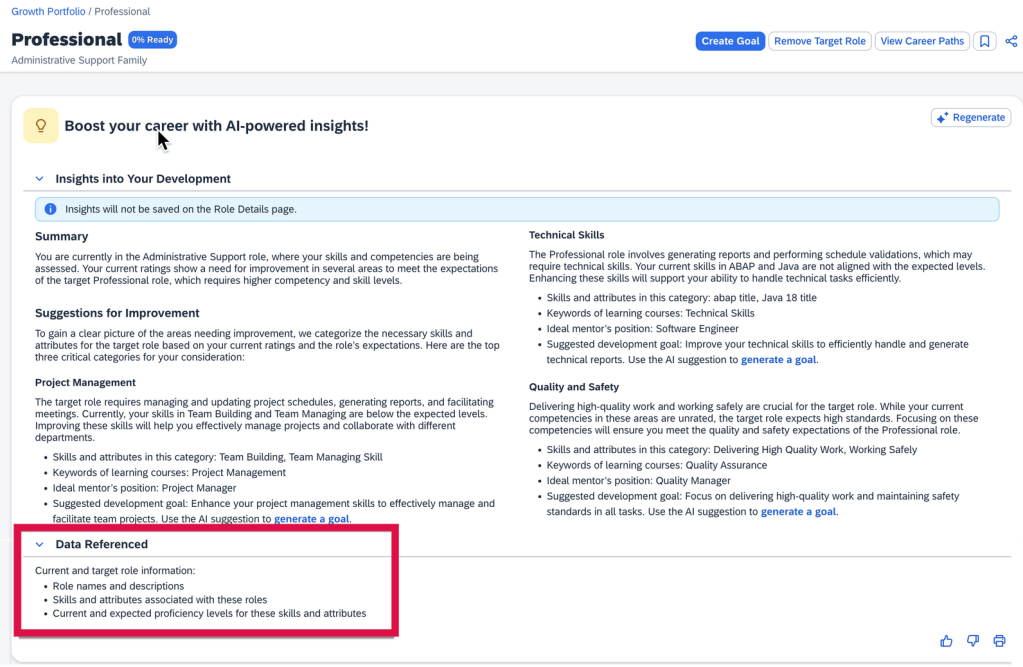
Data Referenced Section Available in AI-Assisted Career Insights
Using AI, can view information being considered on the Data Referenced section on a target role’s details page in the latest Career Worksheet.
Data Referenced section of target role’s detail page
To learn more and get more details, see the full set of documentation in the What’s New Viewer here.
For tips on how to manage a release, check out our blog here.
For your convenience, we’ve summarized the highlights of 1H 2023 minor visual enhancements for Performance Management and Career Development.
Visual Enhancements
There were several minor visual enhancements in this release. The visual enhancements for this release provide a more user friendly and consistent experience.
There are four types of changes:
Text changes (labels, error messages, or roll-over texts)
Iconography (new or changed icons)
Interaction pattern (new position of interaction, new order of list, new or changed buttons)
Styling (layout, spacing, or other design changes)
We will review some of the more notable visual enhancements for Performance Management, 360 Reviews, Continuous Performance Management, Calibration and Mentoring.
Performance Management
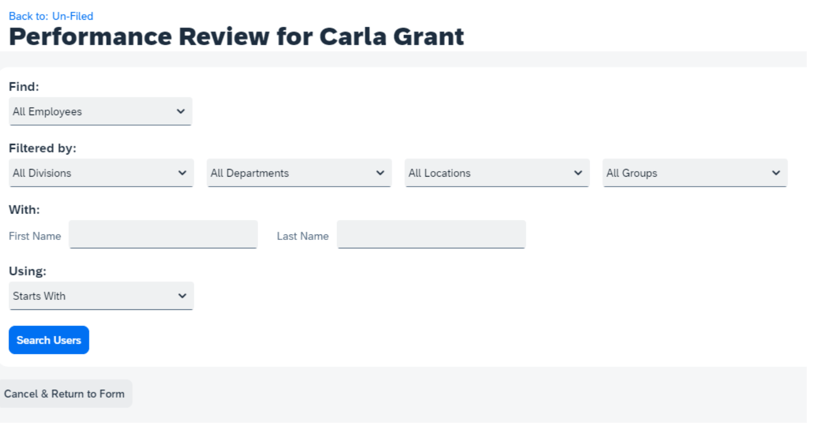
Search for users to send completed form to
Each set of filters is now below its category name
The Search Users button is below all the filters
Search Users
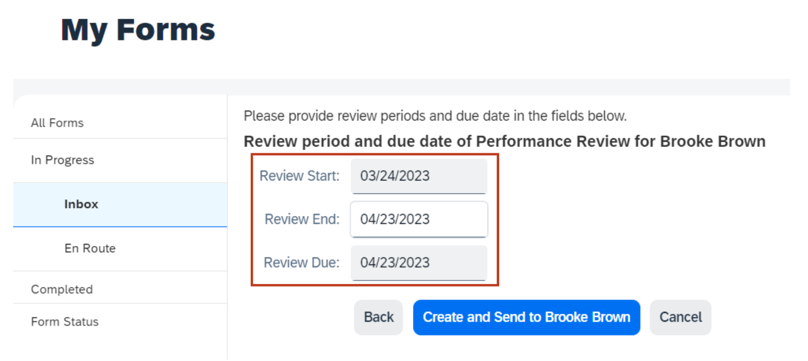
Create New Form from Performance Inbox
When launching a performance form from a user’s inbox, the date fields are now indented and right aligned.
Form Launch
Form Inbox Tooltips
In the Performance inbox, the tooltip for the icon in the Employee column is “View more information about <employee name>”,
Employee Info Tooltip
The tooltip for the icon in the Action column is “Add <form title> to Outlook”.
ActionTooltip
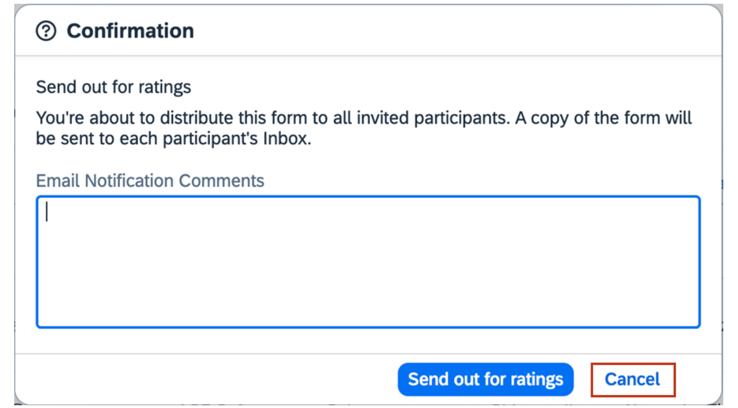
Cancel button placement updated
The button to cancel an action has been moved to the right.
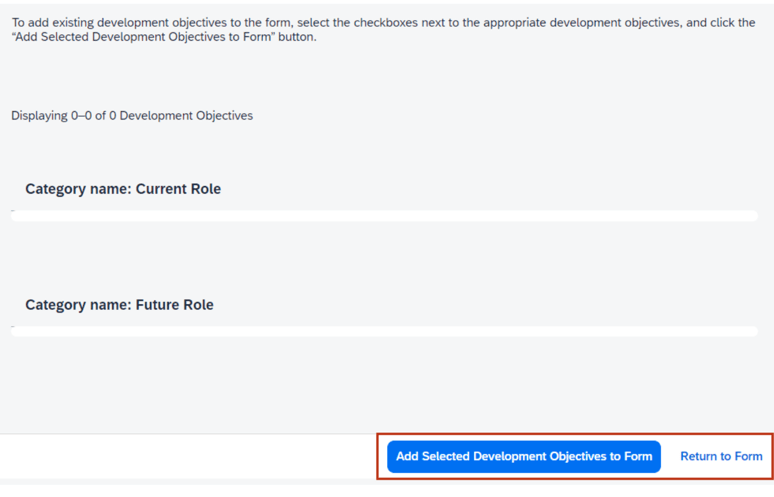
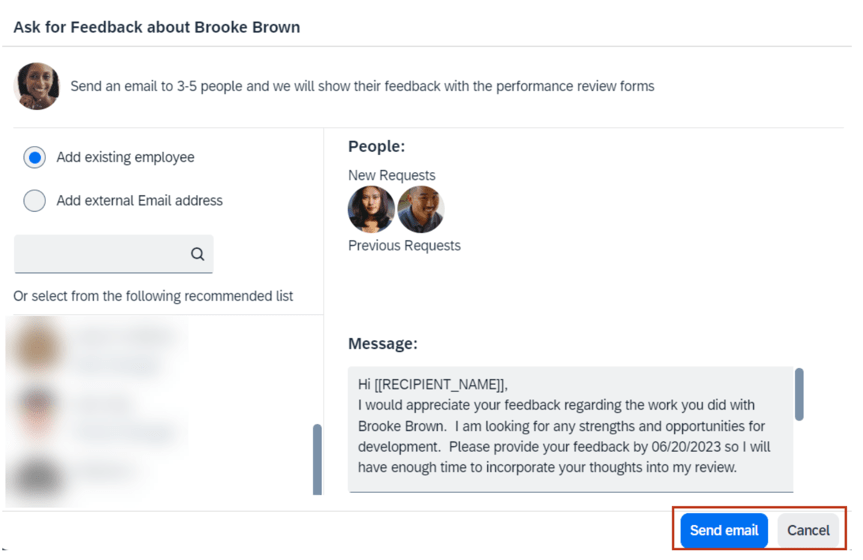
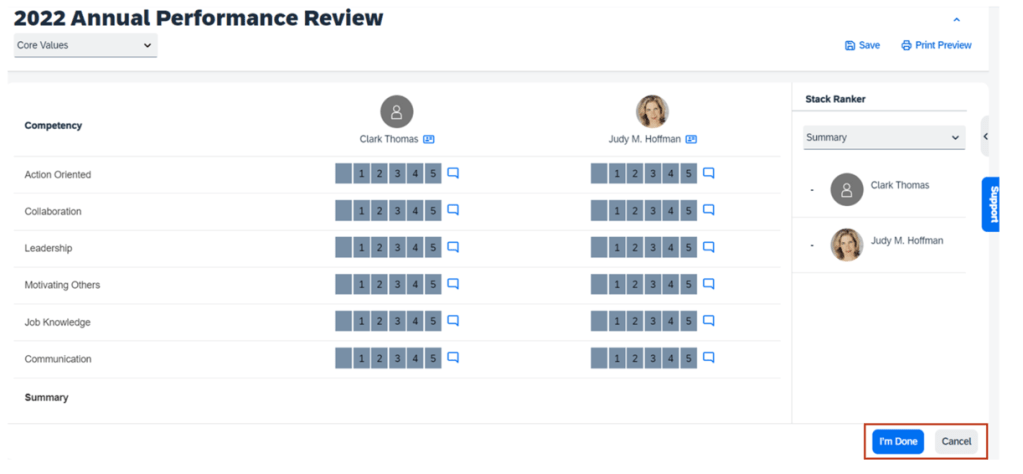
This change applies to almost all user interfaces in Performance Management, including: Add Objectives from Objective Plans dialog, Send to Next Step page, Ask for Feedback dialog, Stack Ranker page, Comment dialog, Legal Scan dialog, and Print Setup dialog.
Here are some examples.
Adding objectives tot a PM form.
Return to Form button placement
Ask for Feedback dialog
Ask for Feedback Cancel button placement
Stack Ranker
Stack Ranker Cancel button placement
Goal in the goal section or Competency in the competency section
The first column header is Goal in the goal section orCompetencyin the competency section of a performance form. Previously Expand All and Collapse All were inthe first column table header
The Expand All and Collapse All options now appear in the top-left corner above the table
Goal section layout
360 Reviews
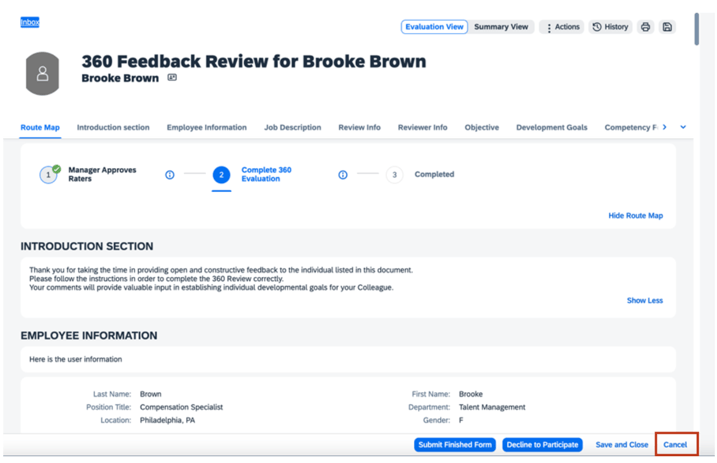
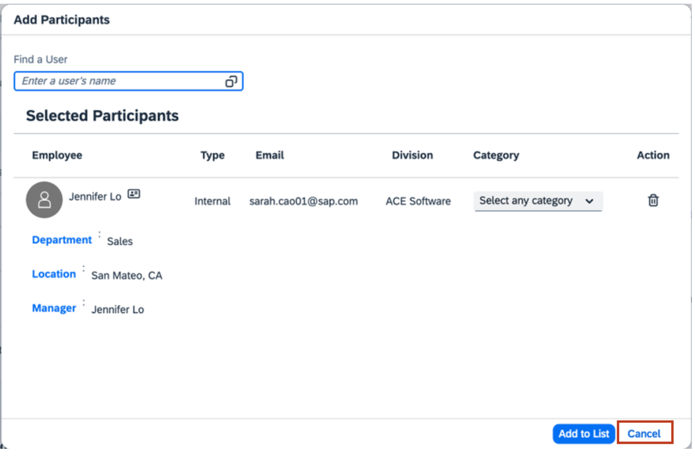
Cancel button placement updated for 360 Reviews
The Cancel button has been moved to the right for 360 Reviews.
Changes include opened 360 Reviews form, Goal Weights dialog, Add Participants dialog, Send Back dialog, Find Employee dialog, and Add Competencies dialog.
Here are some examples.
Canceling an opened 360 Reviews form
Cancel button placement on 360 Review
Canceling a participant search
Cancel confirmation to next step
Cancel button on Confirmation
Continuous Performance Management
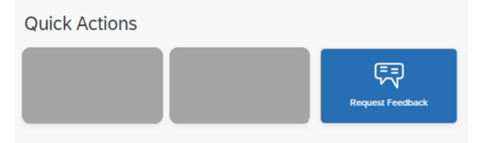
The icon for the Request Feedback on the latest home page has two intersecting talk balloons.
Request Feedback Quick Action
Previously the icon had talk balloons that included a question mark and an exclamation mark.
Achievements on Mobile Device
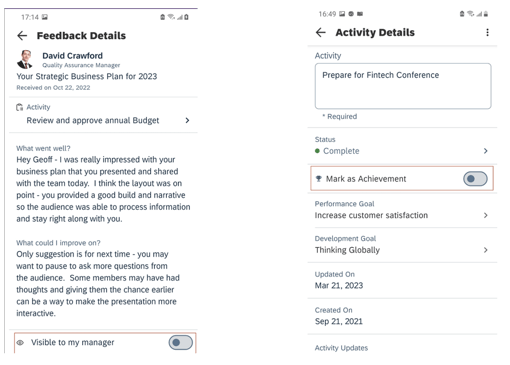
On the Android app, the Visible to my manager switch and the Mark as Achievement switch have wider tracks, and new color mappings.
Achievements on Android
Career Development – Mentoring
Successful Enrollment Message
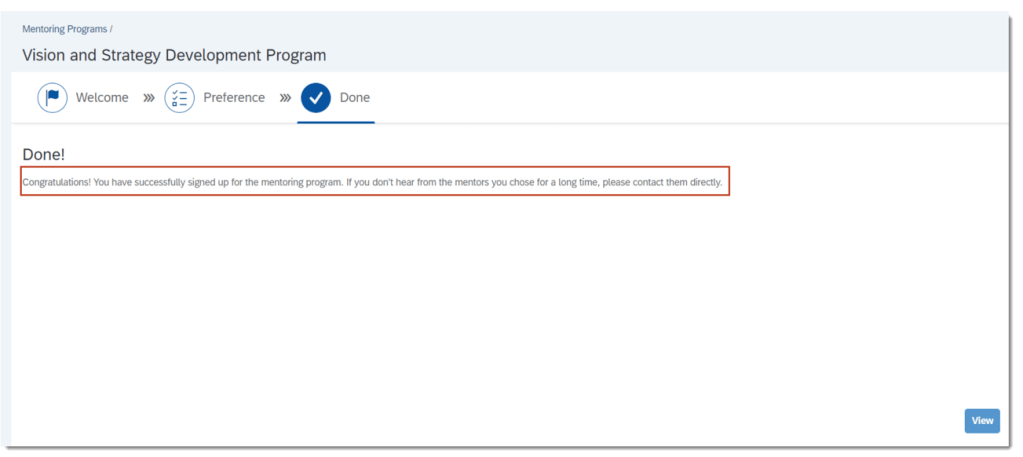
When users sign up for an open enrollment or unsupervised program as a mentee there is a “success” message. The message has been enhanced to now include a reminder for the user that they can contact preferred mentors directly if they don’t hear from the mentors for an extended period of time.
Mentoring Enrollment Message
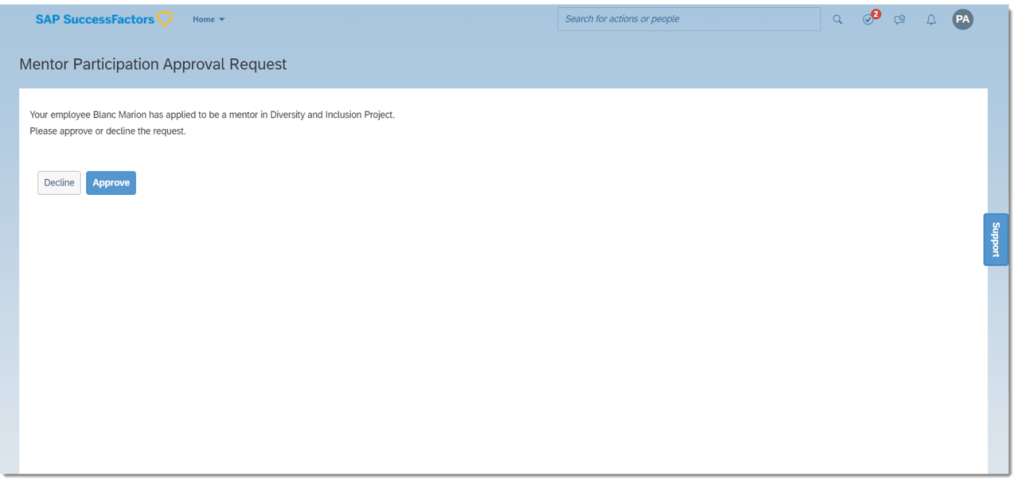
Mentor Participation Approval Request
The Mentor Participation Approval Requests have been updated.
The Approve and Decline buttons are now closer to the message text. The buttons used to be at the bottom of the page.
Mentor Participation Request
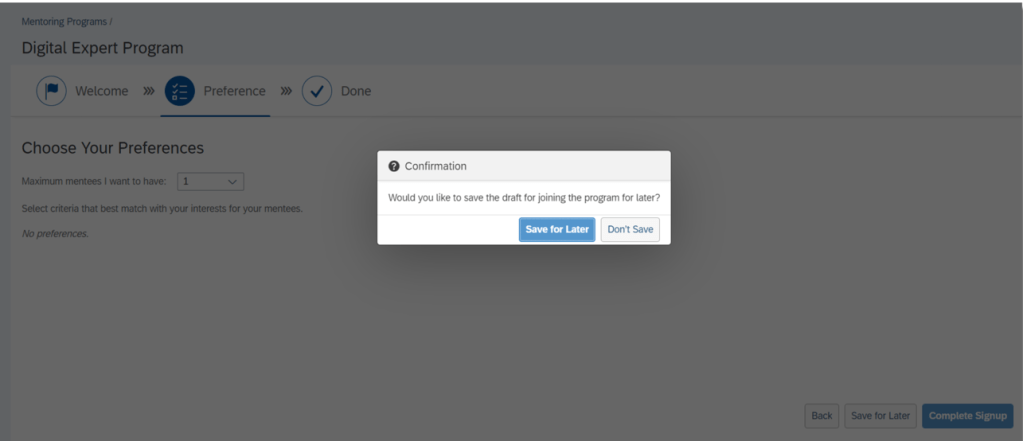
Confirmation for Joining Mentoring Program
When signing up for a mentoring program and a user decides to Save for Later, there is now a confirmation message pop up for them to confirm if they want to save the draft for joining the program for later.
SAP has announced the latest updates and changes for SuccessFactors for the first half of 2023.
Preview release is on April 28 with the production release is scheduled for June 2. You can view the full set of documentation in the What’s New Viewer here. For full details on the release cycle, check out the SAP SuccessFactors official product updates blog.
For tips on how to manage a release, check out our blog here.
For your convenience, we’ve summarized the highlights of what’s new for 1H 2023 Career Development below.
Career Development
There are a few universal updates for Career Development that are reviewed below.
Career Worksheet – General Availability
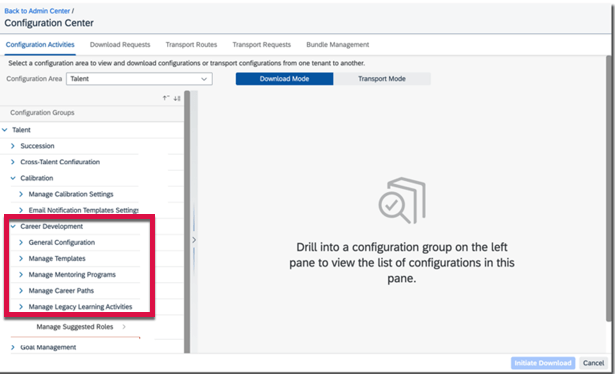
Career Development Configurations Available in Configuration Center
You can now view, download, and transport Career Development configurations using Configuration Center.
Configuration Center
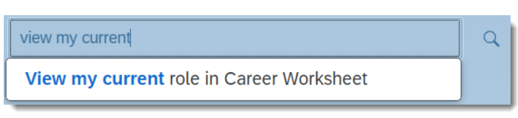
New Action Available in Action Search
On a career worksheet, View my current role in Career Worksheet action is now available for use in the global search box. Users can enter the exact text of the action or select from suggested actions to navigate to the Career Worksheet page.
Current Role Action
The new action takes users directly to a selected page and eliminates multiple steps to get there.
Career Worksheet Data in Story Reports Now Limited to Target Population
The Career Worksheet data that users can view in Story reports, including current and target roles, is now limited to their target population.
Changed Permission for Users to Show Target Roles in People Profile
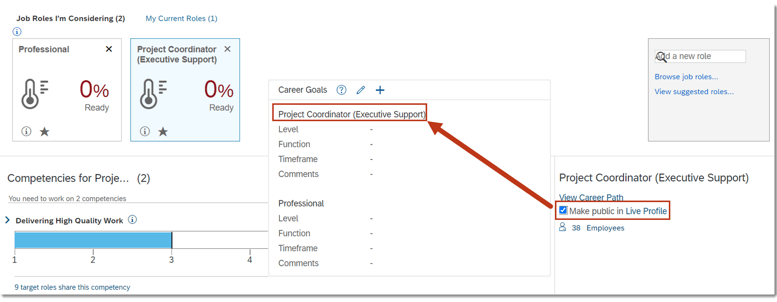
Now a user only needs View permission (User Permissions>Employee Data>Preferred Next Move) in order to select the Make public in Live Profile checkbox in Career Worksheet to show target roles in People Profile.
Previously, View and Edit permissions were required. Now a user can select the option to show a role in Career Worksheet. The role then appears in the Career Goals block in People Profile.
Link to Career Goal Block
Mentoring – General Availability – Universal
Approvals for Mentoring Requests on the Latest Home Page
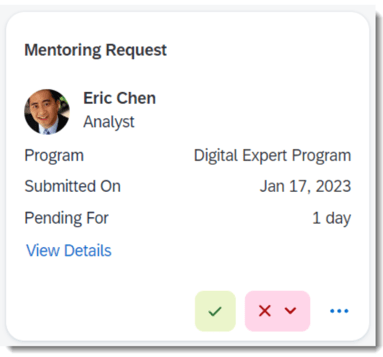
In an open enrollment or unsupervised mentoring program, Mentors can now accept or decline the mentoring requests sent by mentees in the Approvals section on the latest home page.
Accept or Decline Mentoring Requests
View More Recommended Mentors
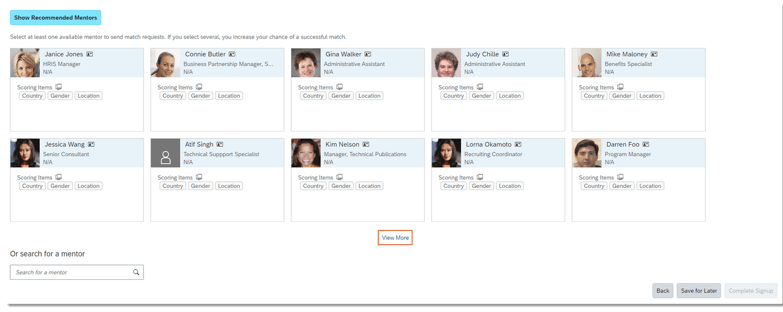
When a user signs up for a mentoring program as a mentee, they can now view up to 100 recommended mentors. Previously, only 10 mentors were recommended.
While signing up and choosing Show Recommended Mentors, now there will be two rows of recommended mentor cards with the View More link below the cards.
Recommended Mentors
Customize Mentoring Email Notifications
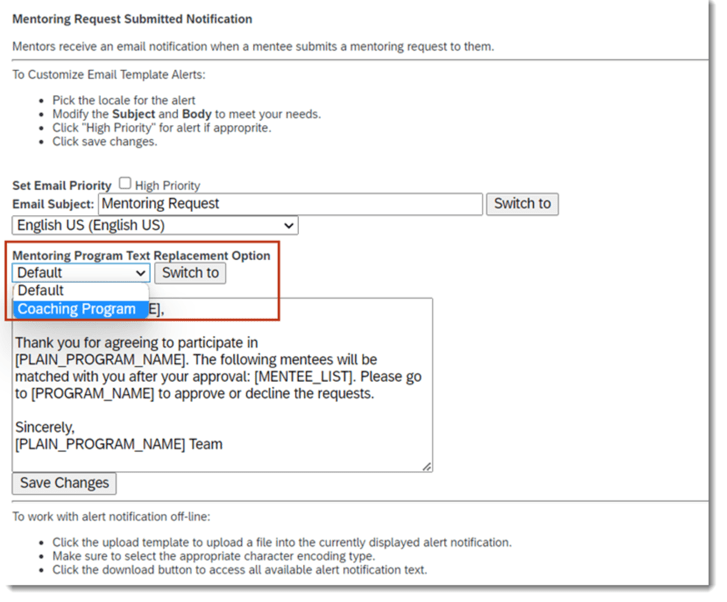
For any customized program type created with text replacement for a Mentoring programs, email notifications for a specific program type may be customized in Email Notification Templates Settings as well.
Customize Mentoring Emails
Approvals for Mentoring Requests on the Latest Home Page in iOS and Android Mobile Apps
SAP SuccessFactors Mobile users can now search for mentors from a recommended mentoring program they haven’t joined in Opportunity Marketplace. Previously, they had to join the program first.
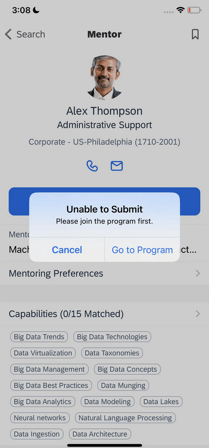
When a user wants to invite someone they found to be their mentor, choose Submit Request on the Mentor or Bookmarks page. They will be prompted with a message guiding them to join the program first.
Mobile Message when Joining
After joining the program, users can submit a mentoring request to their preferred mentor directly on the page.
For your convenience, we’ve summarized the highlights of what’s new for 2H 2022 Succession and Career Development below.
Succession
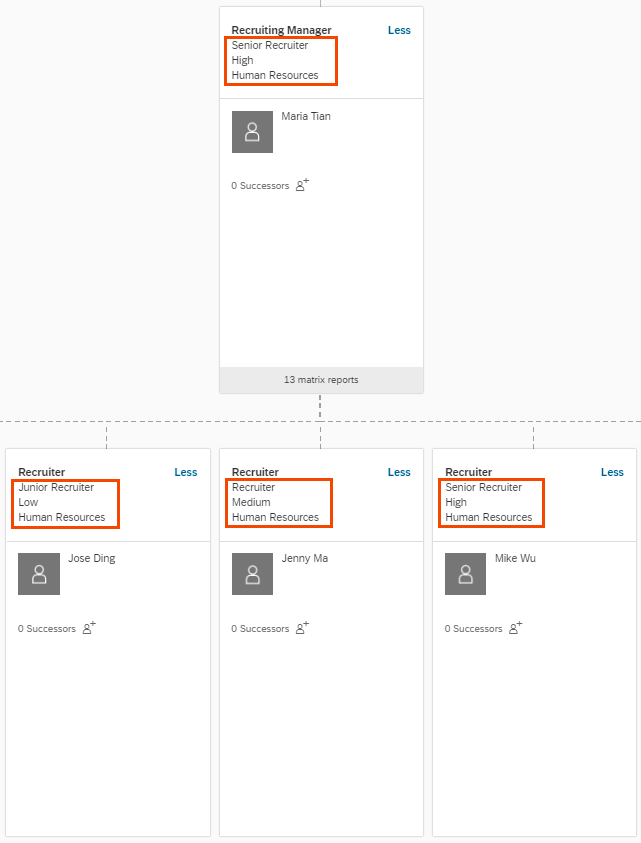
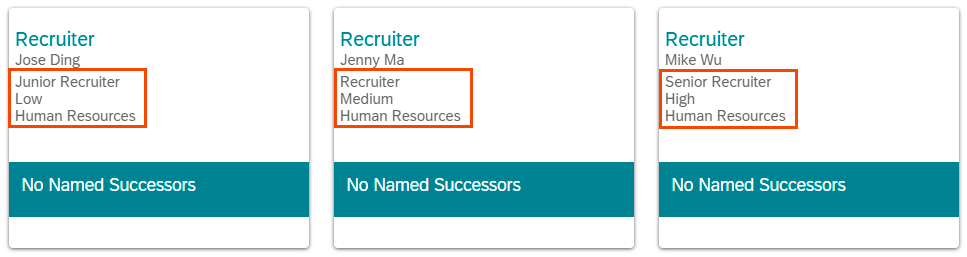
On the Succession side of the house, the Succession Org Chart and position tiles received a functional enhancement to now be able to show the Job Title, Job Level, and Department in the header of the position tile. The options to turn these on is in the Org Chart Configuration screen in admin tools.
Enhancements to Calibration
There have been multiple enhancements to calibration sessions that impact Performance as well as Succession and Development. Specifically, you can now remove subjects from all calibration sessions where before you could only remove from inactive or setup statuses.
Additionally, there’s been enhancements to the enforcement of distribution guidelines so that more guidelines enforcement scenarios are supported when more than one session is finalized at a time. Specifically, you can now include more than one rating in the guideline, you can use operators other than “=”, and not all ratings may have a guideline. Before, these were only supported when you finalized sessions individually.
Reporting
Multiple new options are available in reporting on the Succession and development modules as well. The Career Worksheet is now available in Story Reports.
Mentoring data is also available now for Story Reports and Cross Domain Table Reports. This can be helpful for example if you wanted to cross domains of employee profile with mentoring to see which departments have mentors and mentees and which do not.
Career Development
SAP continues to catch up the old features of the old development module with the new look and feel.
Development Goals
For example, you can now copy goals from an old plan again. The comments feature is also now available in the latest goal management on the goal details page. In addition to Development Goals, this feature is also available for performance and 360 forms. To use this, you must add the comments field in the XML.
Career Worksheet and Career Explorer
The Career Worksheet now visually shows the gaps between target and actual competency levels for a role.
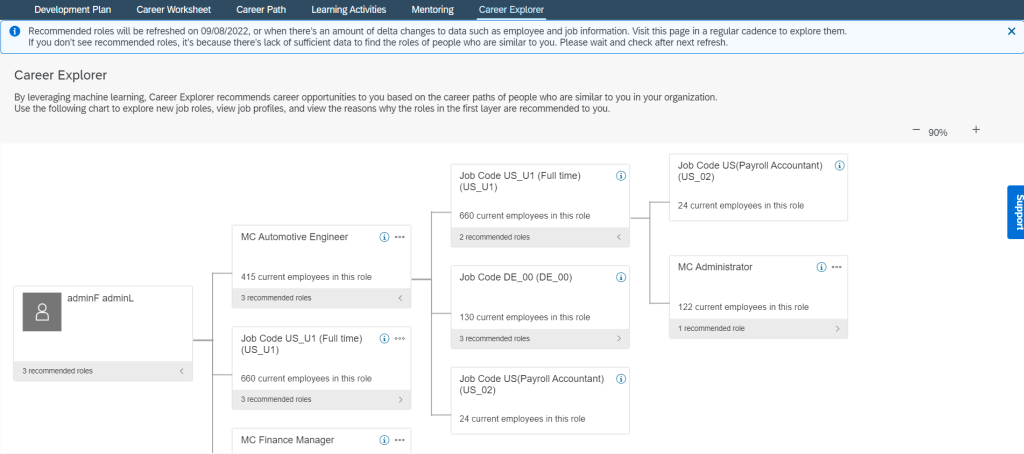
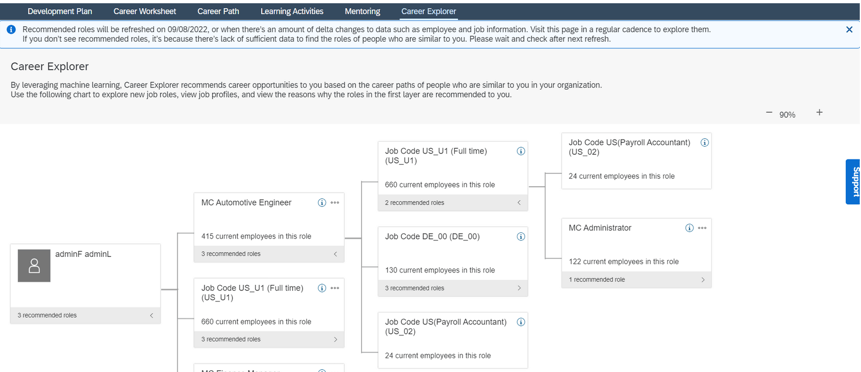
The career explorer is also generally available now with AI powered recommendations. It provides a hierarchy career path that allows for recommendations the employee may not have thought of pursuing based on career moves of people similar to them and/or roles from outside their hierarchy. The feature can also be a data source for the new opportunity marketplace.
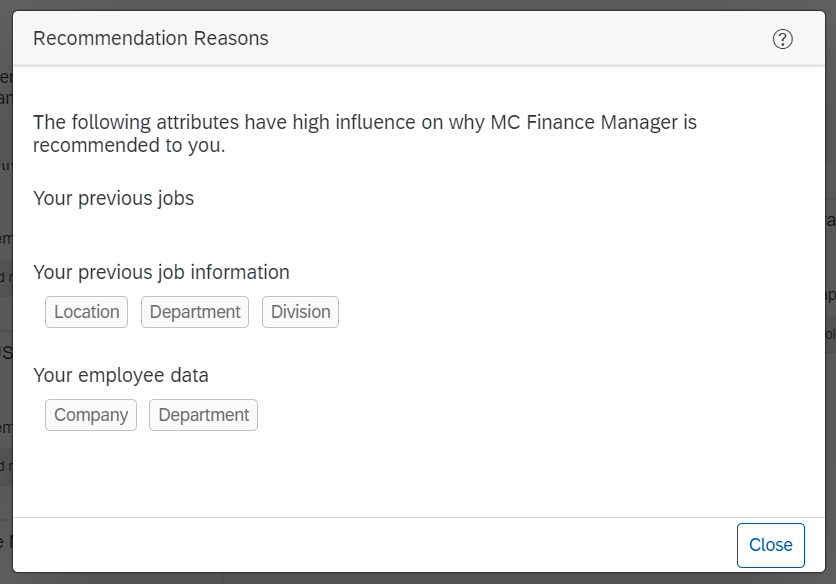
You can also see why the system made such recommendations:
Mentoring
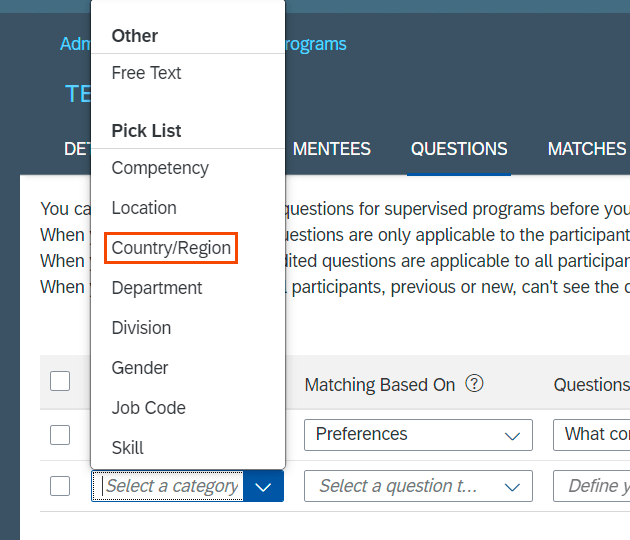
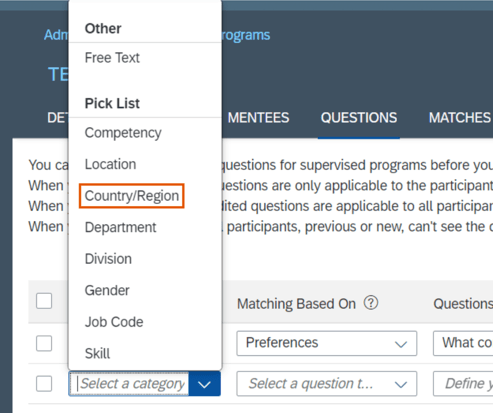
You can now add Country/Region as a matching category criteria for mentors and mentees. This option comes available so long as you have the country/region standard field setup in your data model.
Wrap Up
We have now covered the highlights of the Succession and Career Development related updates for 2H 2022.
Highlights are identified by module and the type of change.
Universal- for modules enabled, universal means no steps are required to have access to the new functionality. These features are automatically made available.
Admin Opt-In – the admin must enable the new feature, usually in Admin Tools
Admin Opt-Out – the admin must disable the new feature, usually in Admin Tools
Provisioning Opt-In and Opt-Out require a Partner or Product Support request For your convenience, we’ve summarized the highlights of what’s new for 2H 2022 Performance Management below.
Latest Goal Management
The updates are for the latest Goal Management are admin opt-ins. The new features are described below. These features are also now available in iOS and Android mobile apps.
General Availability – Admin Opt-Ins
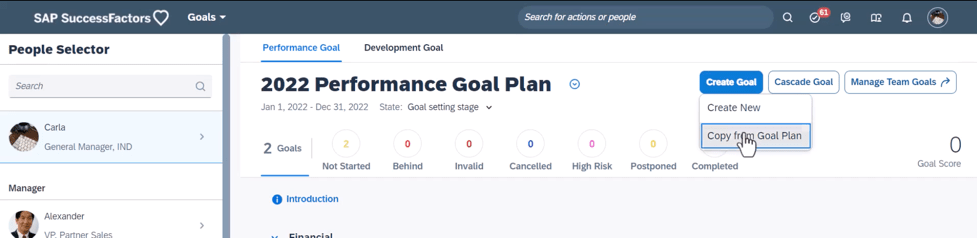
Copy Goals from Goal Plans using the latest Goal Management
Users can now copy personal goals from their own goal plans as a new option to create goals.
Requirements to use this feature include:
The TGM/CDP Goal Transfer Wizard feature is enabled
The create permission is granted in XML configurations
The write permission for goal fields is granted
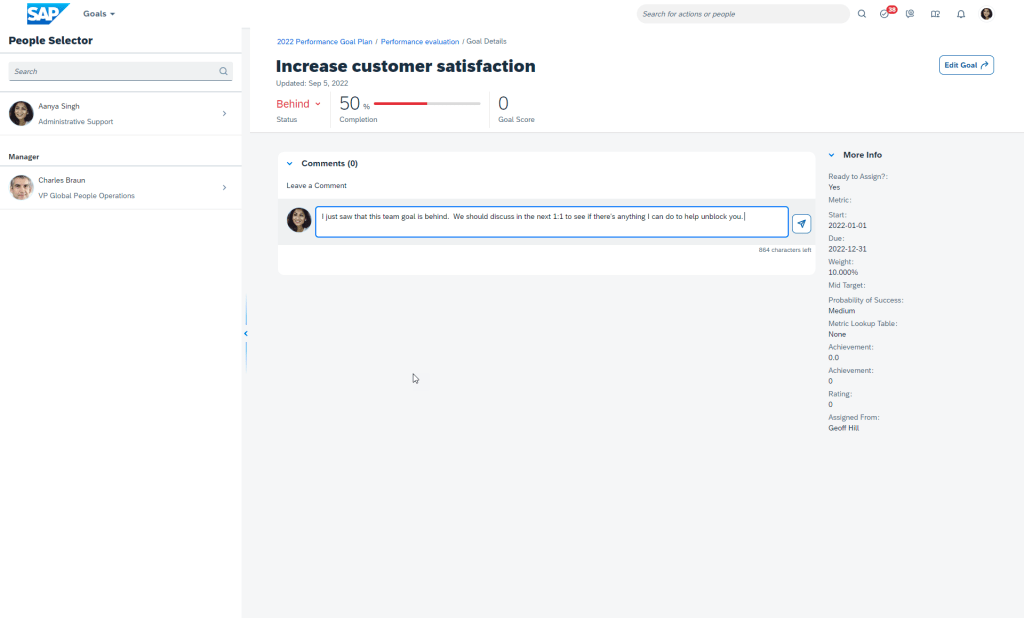
Leave Comments on Goals when using the latest Goal Management
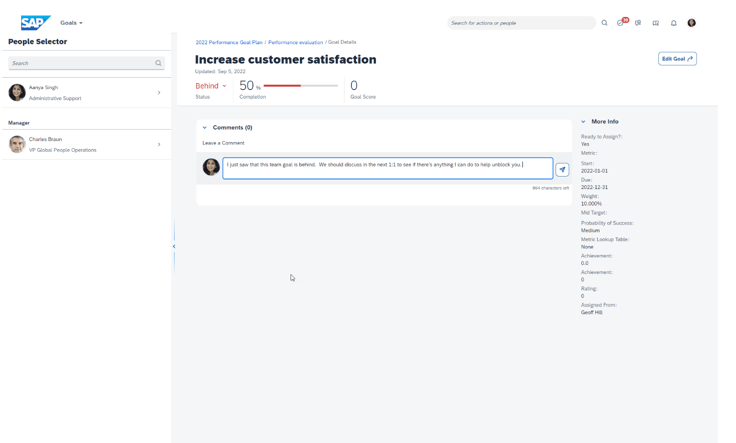
Users can now add, edit, or delete comments on their own goals or those of their direct reports. In legacy Goal Management, comments are shown in the goal list or on the goal editing page.
Copy form Goal Plan
In the latest Goal Management, the updated comment feature is supported and comments are shown on the goal details page.
Comments Section on Goal Details
Comments can also be managed in Performance Management forms, 360 Reviews forms, and Career Development.
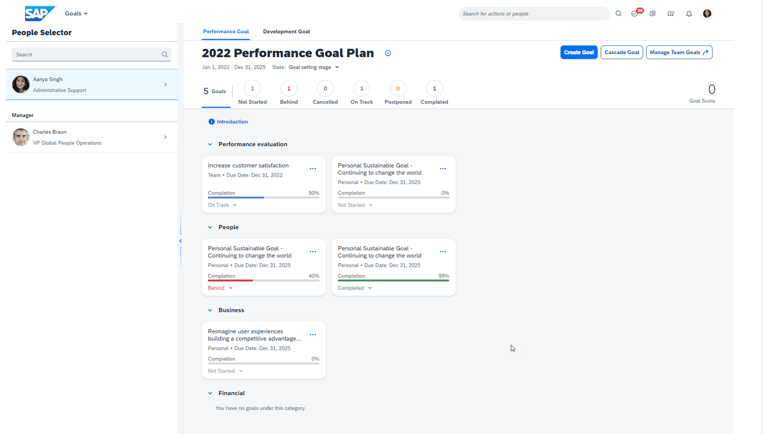
Team Goals Now Available when using the latest Goal Management
Users can now create, manage, and be assigned team goals in the latest Goal Management.
Users may:
Create, edit, or delete team goals
Access team goals from their own goal plan
Assign/unassign team goals to people from their team or people found via search
Share/unshare team goal ownership with others
If configured, users can manage team goals assigned to them in Continuous Performance Management.
Team Goal Landing Page
Users can also manage team goals assigned to them in Performance Management forms, 360 Reviews forms, and Continuous Performance Management.
Group Goals are no longer supported.
These new features are available in iOS and Android Mobile Apps as well.
Performance Management
The majority of the performance management updates involve Multi-Rater 360 forms and Calibration. However there are a few goal and performance related updates that we will begin with.
General Availability – Universal Updates
SMART Goal Wizard not available when using the latest Goal Management
It will not be possible to use the SMART Goal Wizard when adding a goal to a performance form. This feature currently is not supported. Even if you enable the SMART Goal Wizard setting in Form Template Settings this option will not appear when adding a goal.
Enhanced OData Entities for Querying Development Goal Sections on Forms
You can now use APIs to query development goal sections and goal items on Performance Management forms. The FormContent, FormPMReviewContentDetail, FormObjective, FormObjectiveDetails, and FormObjectiveSection APIs. Previously these APIs were used to query performance goal sections and goal items only
General Availability – Admin Opt-In
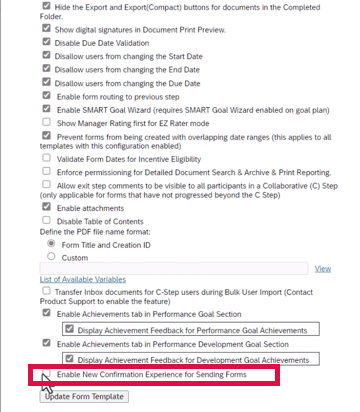
Confirmation prior to Sending Forms
When users send a form, a message popup appears and allows them to confirm the action.
In the advanced settings for the template, there will be a new option to enable the new experience as seen below.
New Setting Available
A pop-up will appear for a user that is sending a form back or forward a step to allows the user to confirm the action. It is also applicable when signing a form, rejecting form or sending a copy of a completed form.
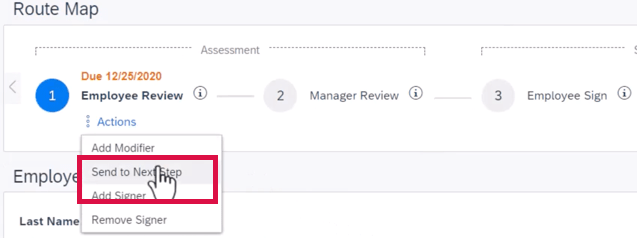
In the route map on the form, clicking Actions in the current step, will display a dropdown list.
Actions on Route Step
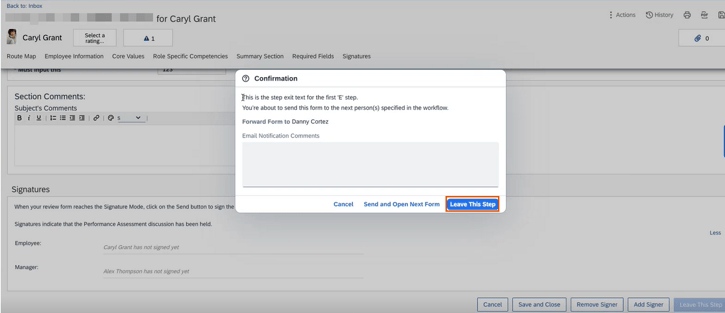
Selecting the action will cause a pop-up to display.
Confirmation Pop-up
Continuous Performance Management
General Availability – Universal
Updated Character Count for Continuous Feedback Topic Field
In the previous version, when users chose the “send” button on a form, a confirmation page appeared.
The character count for the Continuous Feedback topic field to 200 characters.
Replacement of Continuous Performance Management Legacy Version with the Continuous Performance Management Latest Version
The legacy version of Continuous Performance Management (CPM) will reach End of Maintenance on May 20, 2022 and will be retired as of May 24, 2024. The replacement is the latest version of CPM, initially released in 2H 2020, that is currently available in the Upgrade Center. If no action is taken, your company will be automatically upgraded to the latest version after the retirement date.
General Availability – Admin Opt-Ins
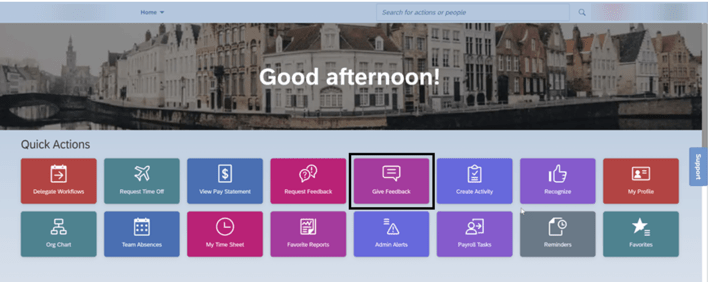
New Quick Action to Give Feedback on the Latest Home Page
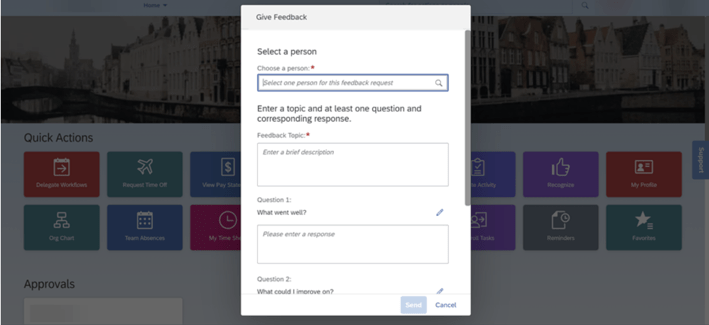
Employees can now choose to Give Feedback from the Quick Actions section on the latest home page.When the Give Feedback is selected, the user can search and select one person, input a topic, and provide feedback to the other user.
Give Feedback from Quick Actions
Once selected, the user may select the person, feedback topic, and questions.
Selections for Feedback
OData v4 API Continuous Feedback for the Latest Version of Continuous Performance Management
You can now use the Continuous Feedback OData v4 API with the latest version of Continuous Performance Management.
The OData v4 API for Continuous Feedback has been added to support third-party integrations and extensions for the latest version of Continuous Performance Management (CPM).
Calibration
General Availability – Universal
Remove Subjects from Calibration Sessions
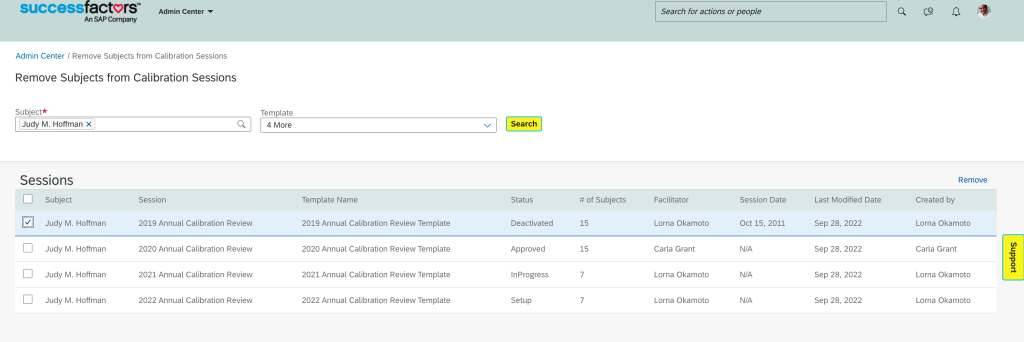
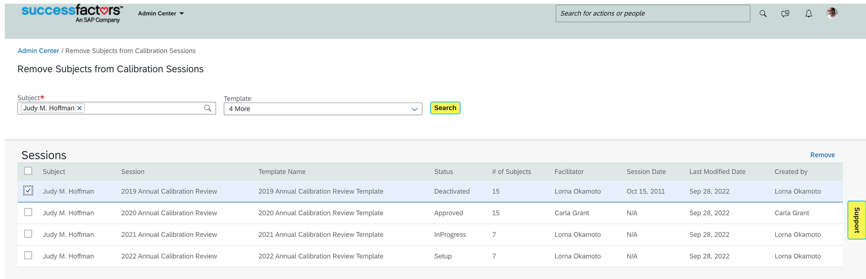
There is a new admin tool, Remove Subjects from Calibration Sessions, used to search for the sessions where an employee has been included as a calibration subject.
When the employee is included in many sessions, you narrow down the search results by selecting a calibration template name. Then, only the sessions created with the specified template are listed.
Remove Subjects from Calibration Sessions
General Availability – Admin Opt-In
More Gender Values in Calibration Views
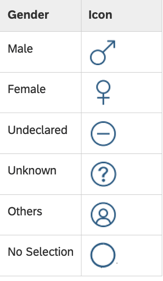
Male and Female were supported for visualization in Calibration Views. Now there are the other three standard values: Unknown, Undeclared, and Others.
The gender icon is displayed next to the employee’s name. When the gender of an employee hasn’t been specified in the system yet, it will be indicated as No Selection.
Gender Icons
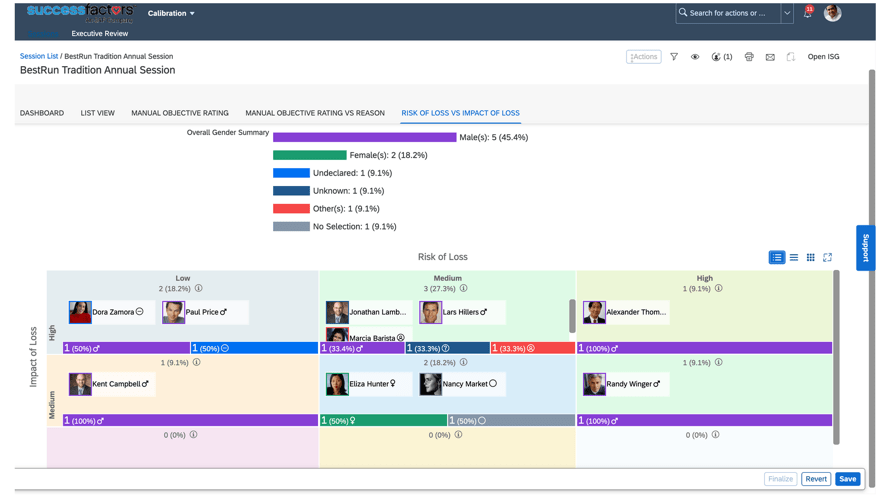
The gender bars in the matrix grid view are now rendered in different colors:
Male: Violet
Female: Green
Undeclared: Blue
Unknown: Dark Blue
Others: Red
No Selection: Grey
Matrix Grid View
Enhancement to Guidelines Enforcement During Mass Finalization
There are more guidelines enforcement scenarios that are supported when you finalize multiple sessions at one time.
More than one rating is included in a guideline defined with a rating group
An operator other than “=” is configured in a guideline defined with a rating range
Not all ratings have a guideline
No longer are guidelines enforced only when finalizing an individual calibration session. With the latest release, multiple sessions can be finalized as long the distribution of subjects doesn’t meet one of the above-mentioned definitions. Distributions would need to be adjusted in order to finalize all of the sessions.
Previously, these guidelines were enforced only when you finalized individual sessions.
360 Reviews
There are several updates for 360 Reviews. Highlights are described below.
General Availability – Universal
Hide Route Map on 360 Reviews Forms
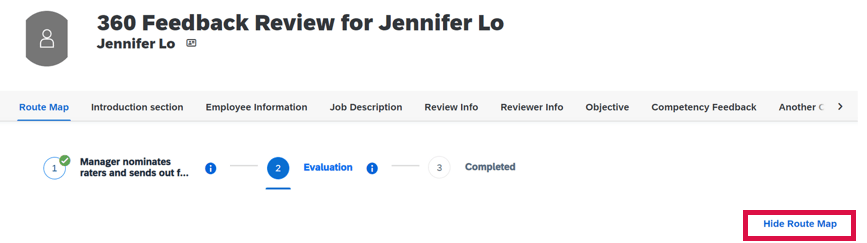
Similar to PM forms, a route map may be collapsed on the form.
This is done through the advanced settings of the 360 Review template by selecting “Hide Route Map on the Form”. Once enabled, when viewing the form, clicking on Hide Route Map will hide the route map from view on the form.
Visible Route Map
Clicking on Hide Route Map will collapse the route map from view on the form.
Click Show Route Map
Hidden Route Map
Required Fields Marked on 360 Reviews Forms
Fields defined as required are now identified with red asterisks on forms in the Evaluation stage. This now matches how required fields display in PM forms.
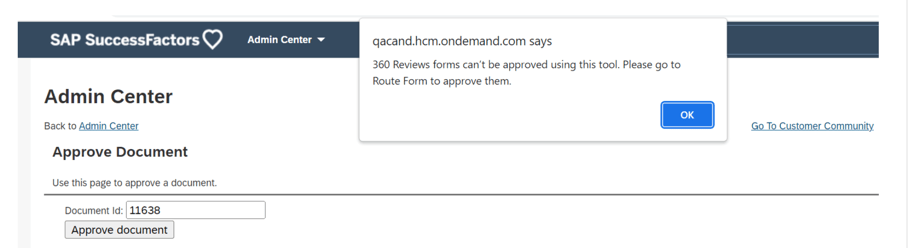
Updated Messages for Users Approving or Routing Forms Using Unsupported Tools
In the Approve Form or Route Signature Stage Form tool, once users enter document IDs and chose the buttons to approve or route forms, they weren’t informed that these tools don’t work for 360 Reviews forms.
Now if a user tries to approve or route 360 Reviews forms using unsupported tools in Admin Center, a message will display reminding them that these tools aren’t supported and are shown the correct tool to use.
Messaging when Routing using Unsupported Tools
“competency-filter” Attribute Supported in 360 Reviews Forms
The competency-filter attribute can be used to control what competencies users from different participant categories can view and rate on 360 Reviews.
Within the meta-cat element in the meta section of the form XML, define different participant categories in order to:
After the form is launched, in the Show Assignments dialog, participants belonging to the categories allowed to rate a competency are automatically selected for that competency. However, users can still select any competencies for a participant that weren’t initially included in the competency-filter defined for the participant’s category.
If a participant’s category is changed in the Modify stage, the participant’s competency assignment will be automatically updated to comply with the new category’s competency-filter.
If a participant is added in the Evaluation stage, the participant’s competency assignment will follow the competency-filter defined for the participant’s category.
If a competency is added to the form, filters including or not including this competency will apply to related competency assignments.
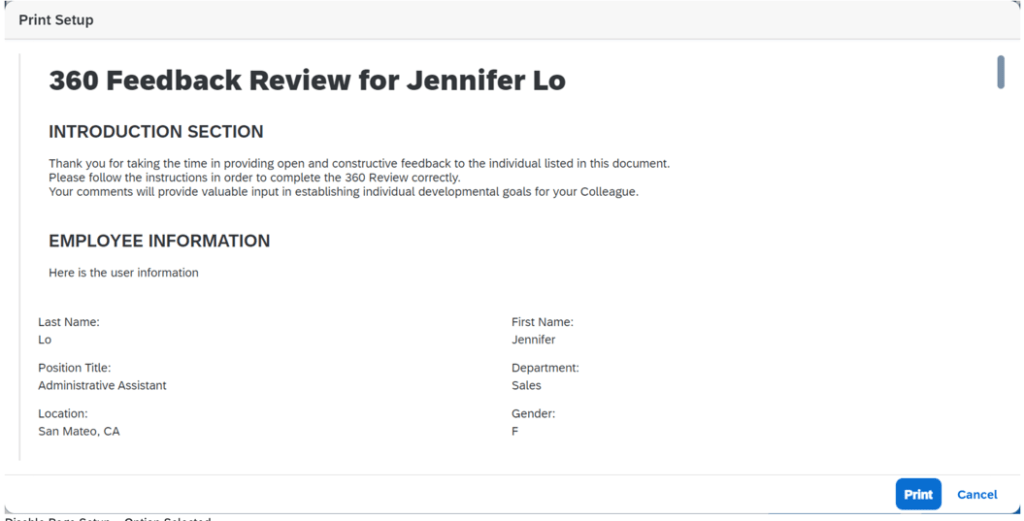
Disable Page Setup When Printing 360 Reviews Forms
It is now possible to prevent a user from specifying to print the Summary View or 360 Executive Review form. Instead the form will be printed in its entirety.
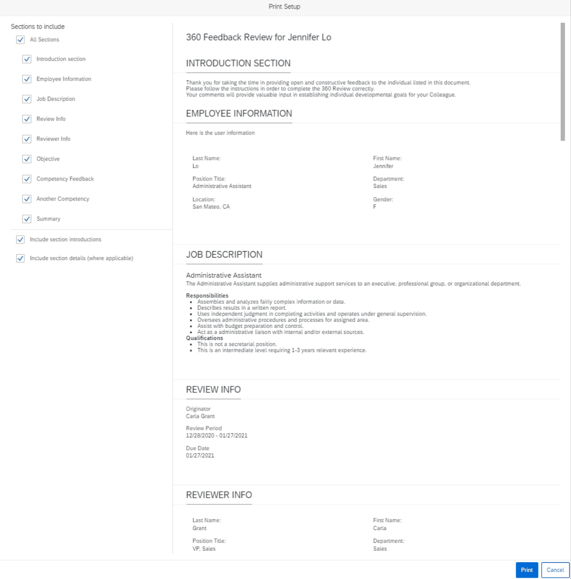
In Form Template Settings there is a new option – Disable Page Setup. When enabled, users aren’t allowed to specify the sections to print and the entire form will print.
Print Setup without Section Option
Show Behaviors in Summary Section by Enabling Rate-by-Behavior
When behaviors are associated with competencies, it is now possible to show behavior names and ratings in the Summary section.
To enable rate-by-behavior, set use-behavior to true and behavior-mode-opt to 0. In the Summary section, add the show-behaviors-in-summary element.
Purge Data of External Users in 360 Reviews
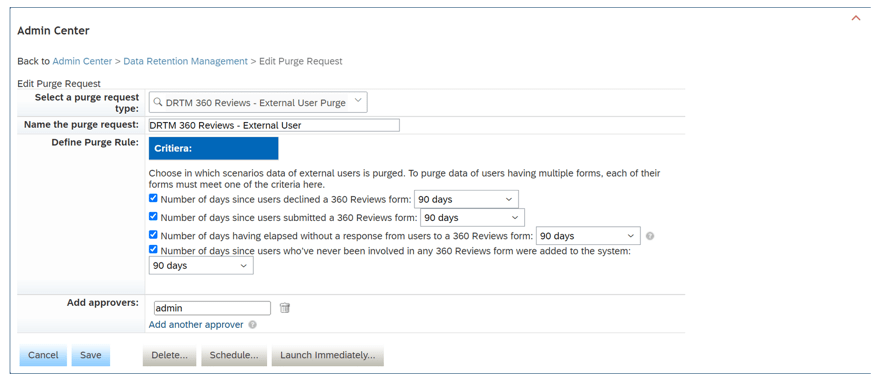
There is a new purge request, DRTM 360 Reviews – External User Purge used to delete data of external users no longer needed in 360 Reviews forms.
The External User Purge for 360 Reviews can be defined by the following purge rules.
A specified number of days have passed since the user declined a form
A specified number of days have passed since the user submitted a form
A specified number of days have passed and the user hasn’t responded to a form
A specified number of days have passed since the user who has never been involved in any form was added to the system
To successfully purge a user’s data who has multiple 360 Reviews forms, each form must satisfy one of the first three criteria.
360 Reviews External User Purge Request
Deprecation of 360 Reviews v11 Version
The 360 Reviews v11 version will reach the end of maintenance on May 19, 2023 and will be deleted on November 17, 2023.
360 Reviews v11 Version is being depreciated because 360 Reviews – SAP Fiori Version is generally available and includes the majority of features and functions that were available in 360 Reviews v11. In addition the SAP Fiori version has an enhanced user experience and updated visualizations.
If you’re using 360 Reviews v11 Version, please migrate to 360 Reviews – SAP Fiori Version.
Career Development
There are a few universal updates for Career Development that are reviewed below.
Career Worksheet – General Availability – Universal
Enhanced Competency Gap Graph in Career Worksheet
Previously, the gap graph was shown only when a competency had both a last rating and expected rating. With the latest release, if a competency has either a last rating or expected rating, a horizontal bar graph for ratings is shown below the competency.
In the example below, the competency has an expected rating shown in blue with no last rating.
Gap Graph
In the previous version, no horizontal bar graph was available if both ratings were not available.
Career Worksheet – General Availability – Admin Opt-Ins
Career Explorer Now Generally Available
Previously, Career Explorer was only available for customers in an Early Adopter Care (EAC) program. It is now generally available.
Career Explorer recommends career opportunities to employees based on the career paths of people who are similar to them in the organization. It provides a means for employees to find relevant opportunities in their organization outside their hierarchy, career moves of people who are similar and paths that they may not have considered.
For a recommended role, an employee can expand the card to see a career path in a lineage chart and view job profiles and recommendation reasons. The role may be added to Career Worksheet to do gap analysis for personal skills, or dislike the role to further personalize subsequent recommendations.
Recommended roles are refreshed every two weeks or when there are enough delta changes to the data. This allows employees to visit the Career Explorer page regularly to explore new recommendations.
Career Explorer Page
Mentoring – General Availability – Universal
Country/Region Picklist Available for Mentoring Matching Questions
A “Country/Region” picklist is now available in the question category to use for automatic matching. Matching rules can be created to allow mentees to define their preferred country/region when signing up for a program, and mentors’ country/region information is pulled from their profile data.
Country/Region Picklist for Mentoring
Mentoring Program Available in Cross Domain Table Reports
Mentoring Program is now available as a domain in Cross Domain reports in Table reports. This can be used with Performance Management, Goal Management and Employee Profile domains to gather mentoring program related data.
In Conclusion
We have now covered the highlights of the PM related updates for 2H 2022.
I’ve implemented and supported many SAP SuccessFactors systems across my 15+ year career. One repeated issue I’ve come across throughout these years is how to catalog skills, competencies, and the like in a systematic way that allows employers to record, categorize, evaluate and search through employees who have specific skills at specific skill levels. Imagine starting a new project or opening a new plant and being able to see who out in your existing talent pool has the skills you need to success instead of hiring new full time talent or contractors. Up until recently, the only way SAP SuccessFactors customers have had to do this out of the box has been the employee profile which lacks the rigid structure needed to really properly catalog skills.
As the SAP SuccessFactors product as continued to expand, SAP has set out to solve this problem. SAP’s answer to the problem of how to record, categorize, evaluate and search through employee skills, competencies, and the like in a systematic way is the Center of Capabilities.
The Center of Capabilities provides a framework where the skills, competencies, and other similar employee attributes that matter to your organization can be cataloged and assigned to employees. The framework consists of two main components: the Capabilities Library and the Capabilities Portfolio. As you might expect, the library contains the listing of all capabilities (skills, competencies, etc.) that are important to your organization. The portfolio shows which particular skills, competencies, etc. are assigned to individuals or job roles (for more information on job roles, check out our blog Introduction to the Job Profile Builder or our book that covers this and more talent management topics). Let’s take a closer look at these two components of the Center of Capabilities.
The Capabilities Library
A Capabilities Library stores a collection of related skills / competencies / attributes. For smaller organizations you may have only one library divided into a few major categories. For larger organizations you may have multiple libraries each containing a single relevant functional area further divided into smaller categories and even groups beneath those. In addition, behaviors can also be added to competencies. Two examples are below, the first a snippet of a simple single company-wide library, and the second a snippet of a larger company collection of libraries with competencies that also contain behaviors (note that as of writing this blog, only competencies are supported in the library, but the long term plan appears to be to include more types of capabilities):
Library: ACME Company Library
Category: Finance
Competency: Analytical Approach
Competency: Financial Responsibility
Library: Information Technology
Category: IT Project Management
Group: Project Planning
Competency: Achieving Deadlines
Behavior: Clearly lists key/critical dates
Behavior: Provides consistent status reports
Competency: Being Adaptable to Changes in Plan
Behavior: Takes in New Requirements following change control procedures
Behavior: Adjusts project plan using proven estimation techniques
Group: Meeting Facilitation
Competency: Listening to Others
Behavior: Implements active listening techniques
Behavior: Records key group member discussion points into meeting notes
Competency: Guiding Others to Desired Outcomes
Behavior: Understands and interjects when meeting is becoming derailed
Behavior: Facilitates agreement between meeting participants
Category: Systems Administration
Group: Configuring Systems
Competency: Following Change Control Procedures
Behavior: Reviews change control procedure documentation
Behavior: Listens to and implements architectural review board feedback
The screenshot below shows a sample of what a competency with behaviors assigned looks like within the Library. You can access the library via the “Manage Center of Capabilities” screen (make sure you assign this permission first as well as end user permissions – you can find more details in the admin guide at help.sap.com).
The Capabilities Portfolio
The capabilities portfolio is what ties an individual to a set of capabilities from the library via their job role. Capabilities can be assessed via a performance form. Each capability has a proficiency rating scale assigned to them that determines what their scores can be. Before you can use the portfolio, you’ll have to use the setup wizard pictured below in the “Manage Center of Capabilities” screen to setup the rating scale / proficiency levels. You will also need to associate which performance forms will show the proficiency history.
Once your setup is complete, you can select “Capabilities Portfolio” from the main navigation to look at your capabilities. As capabilities are rated via performce forms, they are updated here. You can look at the capabilities of another by searching for their name and selecting “Go to -> Capabilities Portfolio” from the action menu.
Conclusions
As of right now, the “Center of Capabilities” is mostly a rebrand of the existing competency library. However, taking a look at the SAP release roadmap, we can see that subsequent releases should prove to have more functionality that will expand the functionality beyond the initial limits of the legacy competency library. Speaking with contacts at SAP, the vision is to have the Center of Capabilities serve as the location where HR resources can find out all kinds of information about what individuals within the organization can do for it and conversely empower individuals to seek other opportunities in the organization that need their unique capabilities.
Do you need help setting up the Center of Capabilities? Contact us at info@worklogix.com!
For your convenience, we’ve summarized the highlights of what’s new for 2021 Performance Management below.
The updates for Performance Management are primarily targeted for 360 Reviews so we will start with those. The PM form updates will be discussed after these features have been reviewed. Calibration updates can be found in our separate blog here.
What’s New for 360 Forms – Fiori Version
Here are the 10 universal updates made for the Fiori version of 360 forms to provide the same features that are available 360 Reviews v11.
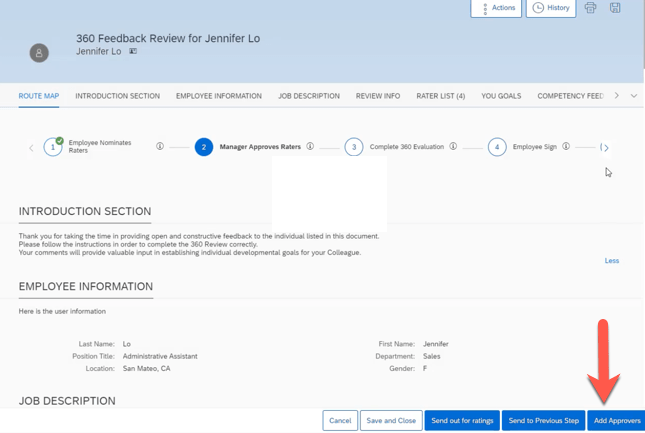
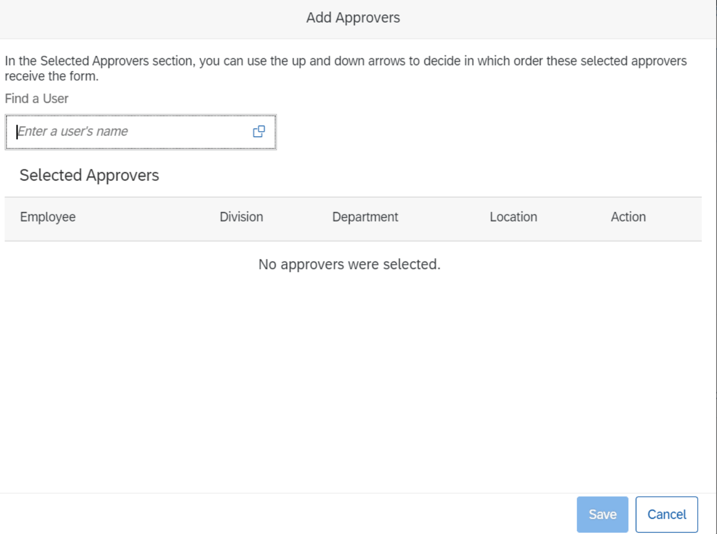
Add Approvers in 360 Reviews
Approvers may now be added in the Modify stage.
Development Goal Section Available in 360 Reviews
A development goal section may be added to a 360 Review form template. These enables employees the opportunity to add and edit development goals.
Display a Data Table for a Chart
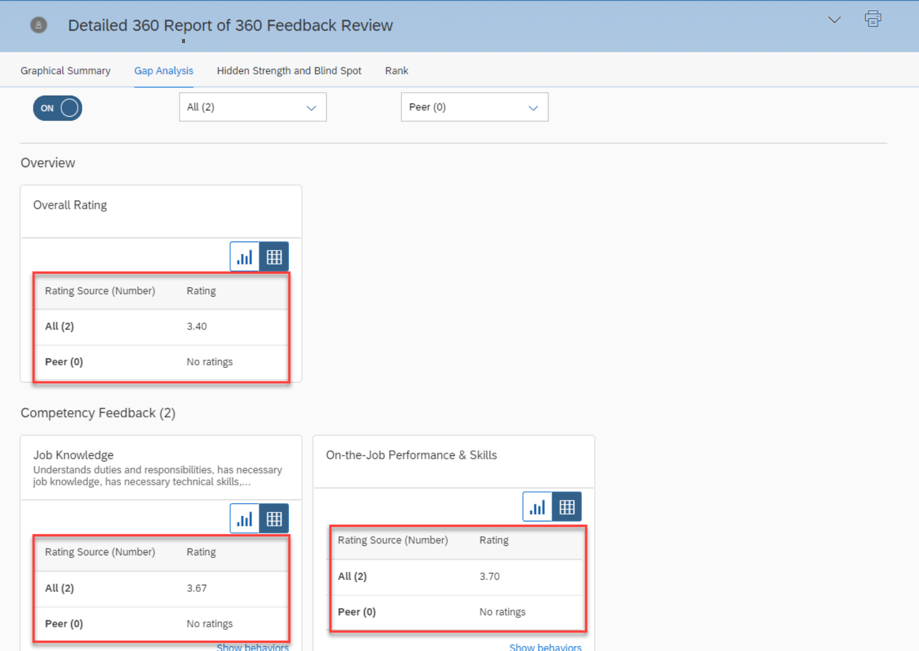
Within a 360 Executive Review and Detailed 360 Report, a user may select the table icon on a chart to see a data table. This provides text equivalents for non-text content.
Display External Users in Search Results When Adding Participants
It is now possible to add external users as participants without having to disable the system setting Hide External Users from search results.
EZ Rater Available in 360 Reviews
When enabled, the EZ Rater option provides a more condensed list view for rating goal and competencies.
Form History Available in 360 Reviews
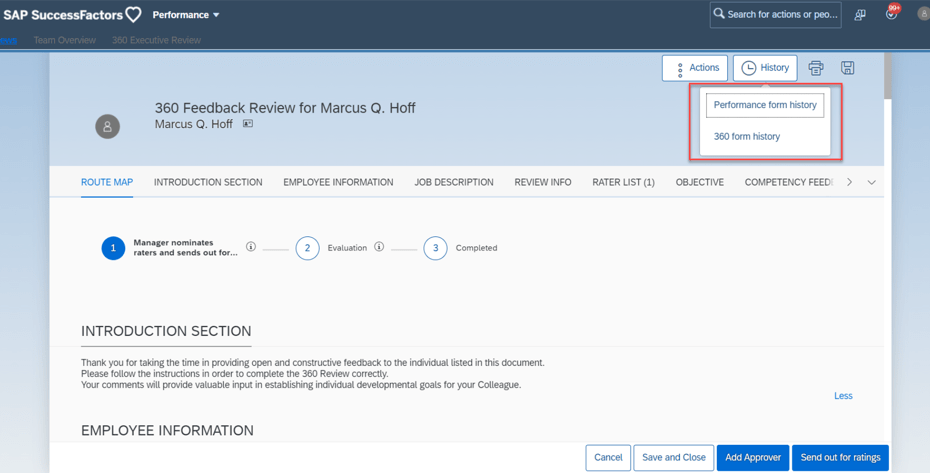
Prior performance and 360 forms are now available within a 360 Review. The History button will display options to view either form type if available.
More Form Actions Available in 360 Reviews
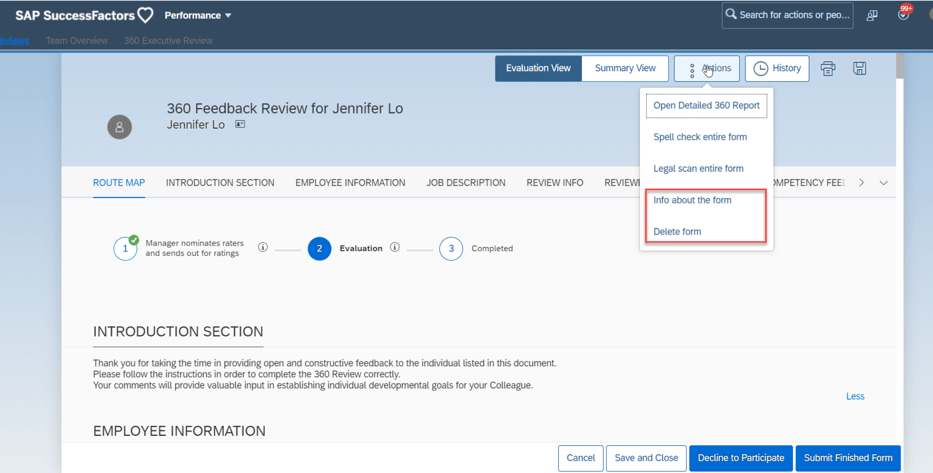
Additional action options are now available for 360 forms. Information about the form may be viewed and the form may be deleted.
Print Preview Available in 360 Reviews
When the user clicks the Print button, a popup displays a preview of the form. This provides the user the opportunity to select the entire form or selected sections to print.
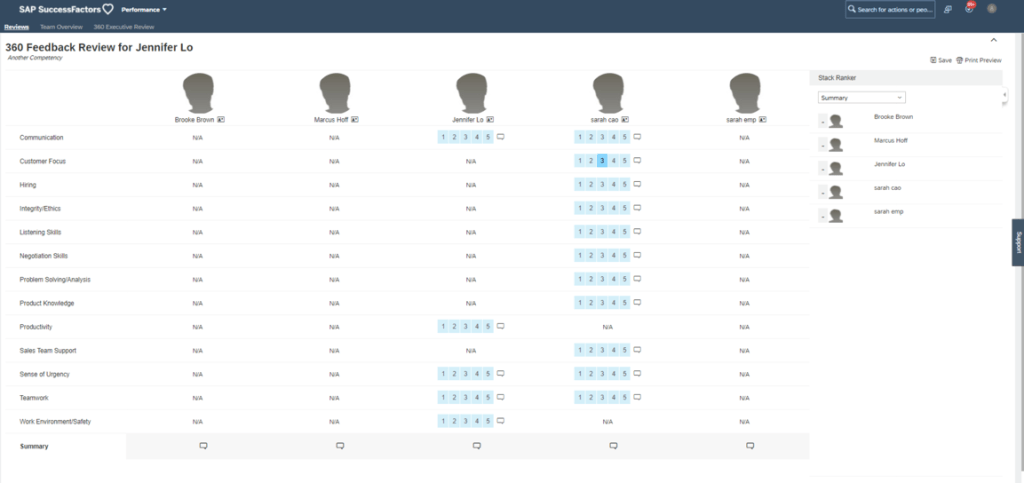
Stack Ranker Available in 360 Reviews
Stack Ranker can be enabled which allows side by side ranking of employee competencies. Ratings may be modified and comments added.
Section Descriptions Fully Displayed by Default
Now section descriptions are fully displayed by default and can be collapsed. Clicking Show Less to hide content. Previously sections were collapsed and the user had to click Show More to see the content.
What’s New for PM Forms
There are 5 universal updates for PM forms.
Customized Weighted Rating Supported in Import Overall Scores
Previously it was only possible to import overall scores into the Objective Competency Summary, and Performance Potential Summary, and Summary sections. The new release enables you to update overall scores for the Customized Weighted Rating section.
On the import file, use <PERFORMANCE> rating in the CSV file. The rating field is also used to update the Summary and Performance Potential section overall rating. If there is more than one PERFORMANCE rating, there is a priority for updating. The section order for uploading from high to low is:
Customized Weighted Rating
Performance Potential Summary
Summary
Deep Link to Performance Management Forms
There is now a deeplink available to access a performance form: /sf/openFormByDocId
New OData V2 API Entity FormCustomizedWeightedRatingSection
There is a new OData V2 API Entity: FormCustomizedWeightedRatingSection. It can be used to get the Customized Weighted Rating section details of a performance form in order to update the manual ratings section of the performance form.
Target Population in Role-Based Permissions for Import Overall Scores
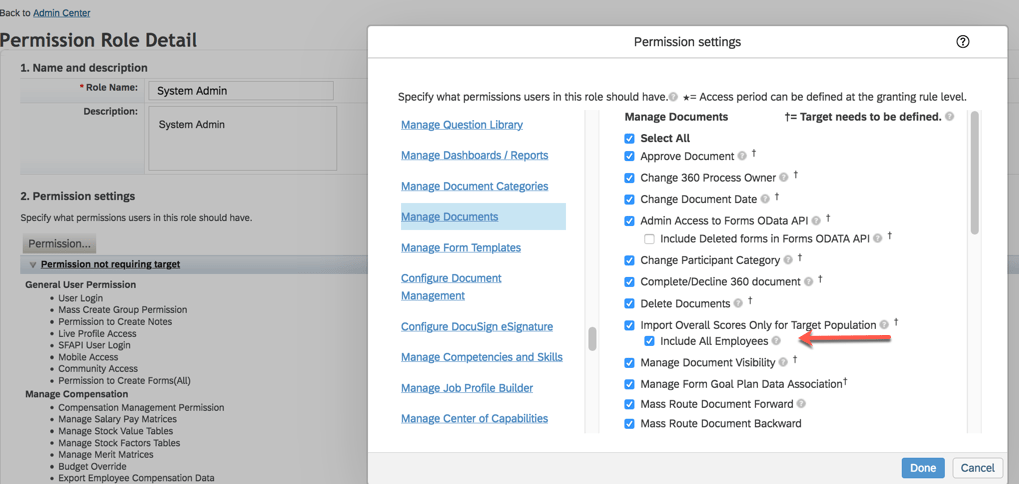
This update pertains to the Customized Weighting Rating import that we just covered. Role based permissions may now be used to restrict users to importing scores for only their target population.
Select a role in Manage Permission Roles. Go to Permission>Administrator Permissions>Manage Document and select “Import Overall Scores Only for Target Population” and “Include All Employees” which allows granted users to update manual overall scores for all employees.
Live Profile Section Deleted
A Live Profile section can no longer be added to PM forms. Information in the existing section is no longer available. A link to People Profile can be used on the form instead.
What’s New in Continuous Performance Management (CPM)
There are some new early adapter features for the latest version of Continuous Performance Management (CPM). They are admin opt-in or opt-out features. We won’t cover these here since the latest version is not widely enabled. When the latest version of CPM is enabled, these email reminder notifications will become obsolete: Conduct 1:1 Meeting, Update Status, along with Activity and Achievement reminder notifications.
The latest version will handle notifications differently since multiple roles can be used and meeting channels can be created. Requests and meeting notifications can be created for anyone in the user’s meeting channel.
We have now covered the highlights of the PM related updates for H1 2021. See our blog for Calibration release features.
In this release, we saw a wide range of enhancements across the Talent modules – some specific to Succession and others that lay across the modules but help out succession planners. Let’s take a look at what’s new in the Succession module below!
Succession Management Specific Changes
Let’s start with what’s new just for Succession Management before we take a look at some general talent improvements that are relevant to Succession.
Nomination History
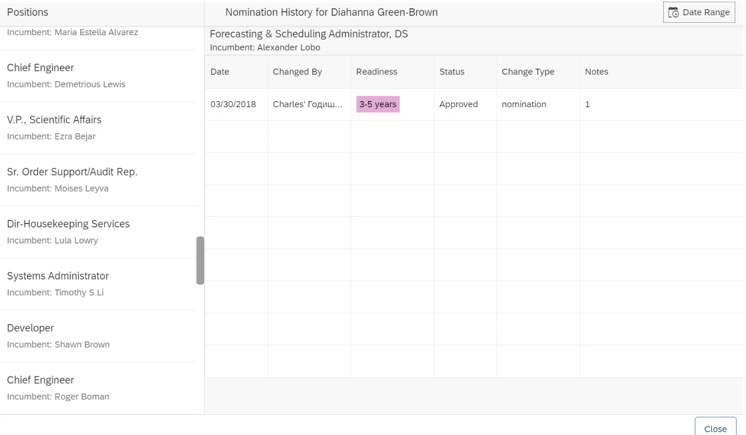
The main new feature exclusive to Succession Management is the ability to view nomination history in the talent card and in the people profile. Users will with Succession Planning permission can click a history icon on these screens to see a list of positions for which the employee has been nominated and information about the nomination history for each including the date, nominator, readiness level, status, change type, and notes. The information includes deleted nominations as well.
Nomination History View
Hide Pending Nominations for Talent Pools
Succession configurators have had the ability to hide pending nominations from succession planners for some time now, but the ability was only extended to position nominations. Now, this feature works for talent pool nominations as well. This configuration setting remains in the same in Admin Center -> Nomination Setup.
Form-Based Nomination Deleted
Another update specific to succession with this release is that form-based succession nomination will be completely deleted as of May 21,2021. This was a legacy method of approving nominations – if you never used it, then don’t worry because no action is required. If you are still using forms to approve nominations, you have little time left to switch to the newer permission-based method!
General Talent Management Updates Relevant to Succession
There are also numerous updates across the talent modules in general that affect not only Succession, but also Performance, Goals, Development, and/or Calibration. Let’s take a look at these briefly below.
Editing Talent Info Directly on a Talent Card
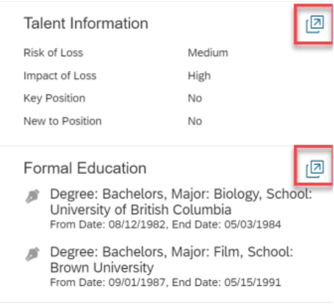
It seems like every customer for whom I’ve implemented Succession has asked why they need to switch between the employee profile view and other views to edit talent information. Why can’t customers just change the information right on the talent card that shows up across the different views that contain the talent card? This way data like impact of loss or risk of loss can be updated when the user has the contextual information they need to make the decision. Well now, customers can!
Users can now click the icon shown below to open a popup that allows these fields to be changed.
Editing Information on a Talent Card
My Jobs Downloads
Previously Succession (and other talent reports) could be downloaded from the Scheduled Reports page in Classic View. Reports may now be downloaded from My Jobs page within Report Center. This eliminates the need to switch to Classic View prior to downloading.
A report with multiple files can be downloaded in a compressed .zip file or downloaded individually.
Numerous Calibration Session Improvements
There are a variety of calibration session feature that have been added/updated as well. For example specifying default facilitators or allowing managers to more easily create calibration sessions for their teams. For more information on these improvements, check out our blog on What’s in in H1 2021 SAP SuccessFactors Calibration Release.
That’s a Wrap!
That’s all of the updates for H1 2021! We hope you found this blog informative!
























 Worklogix Blog