For tips on how to manage a release, check out our blog here.
Hide “Create from Scratch” Option for Goal Creation
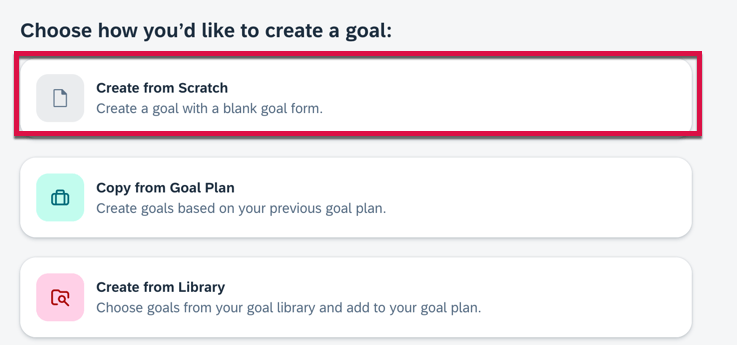
When creating on goal on a goal plan using the latest Goal Management, it is possible to create a performance goal from scratch, copy a goal from another goal plan or create a goal from a goal library. The options are shown below.
Create Goal Options
The Create from Scratch goal option for performance goals may be hidden. To hide this option, there is a switch to set in the goal plan template XML:
Once the switch is set to turn off this button, the option to create goals from scratch will no longer appear.
Copy Goals on Behalf of Others
In the latest Goal Management, managers can now go to a user’s goal plan and copy personal goals on the user’s behalf. The Copy from Goal Plan option is available only for the latest goal plan.
Configuration Requirements
Using the latest Goal Management
The TGM/CDP Goal Transfer Wizard feature is enabled
Users are assigned more than one goal plans
The create permission for goals is granted in the goal plan template XML
Goal Modification Email Notification Jobs in Admin Center
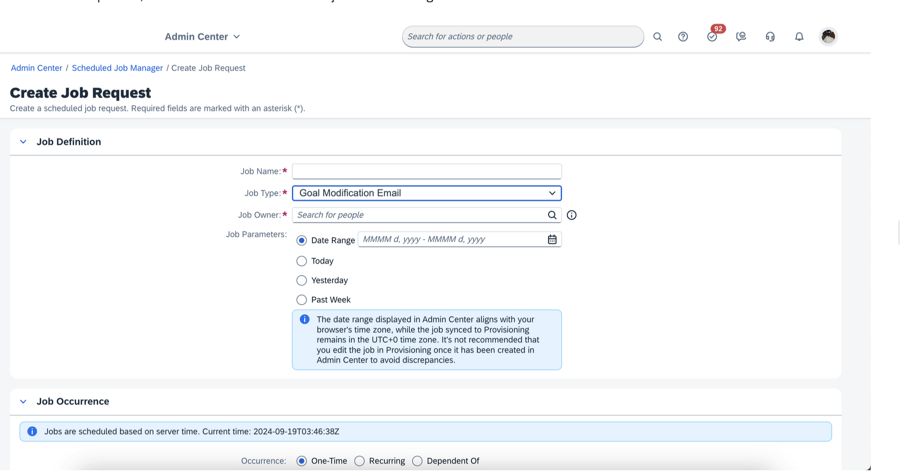
You can now create a job request for the goal modification email in Scheduled Job Manager. It no longer has to be set up in Provisioning.
Create Goal Modification Notification
The date range displayed in Admin Center aligns with your browser’s time zone, but the job synced to Provisioning remains in the UTC+0 time zone.
Link and Unalign Goals
In the latest Goal Management, It is now possible for users to link their performance goals with another user’s goals or unalign goals In their own goal plan:
Choose the Link Goal option on a goal card and follow the on-screen instructions.
Go to another user’s goal plan, choose the Link with Mine option on a goal card, and complete the linking steps.
Goal Plan Template Cascade/Align Permissions
In the goal plan template XML:
Grant cascade-align permission for roles to link goals
Grant unalign-parent or unalign-child permission for roles to unalign goals
Minor Enhancements for latest Goal Management
Some enhancements for the latest Goal Management have been added to make it easier to use.
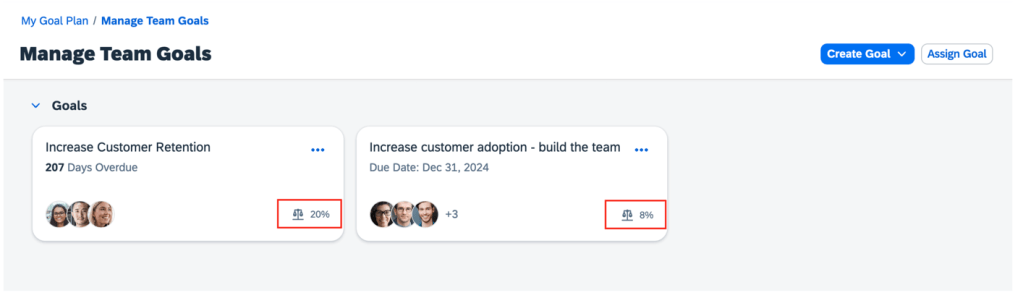
Weights for Team Goals on Goal Cards
Weights are now displayed for team goals on goal cards.
Weights on Team Goals
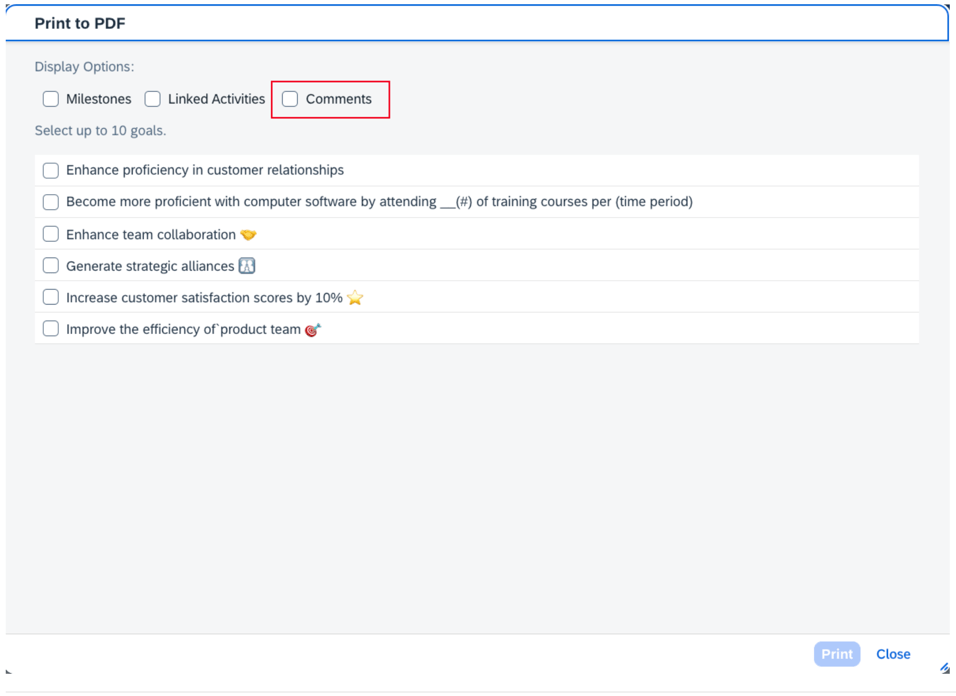
Comments on PDF
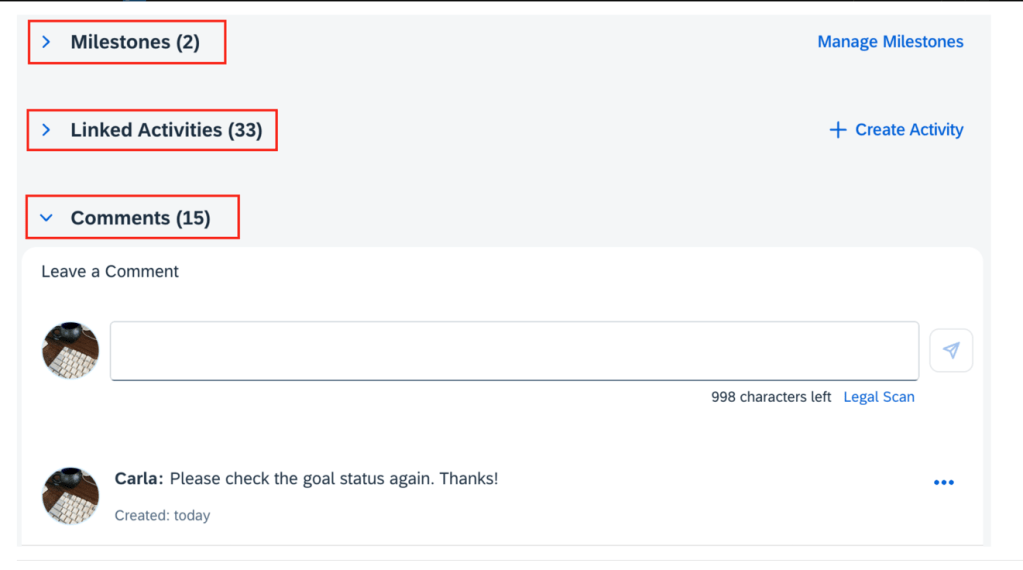
Users can now include comments in the PDF output for goals.
Print Comments
Inactive Users in People Search for Goal Plans
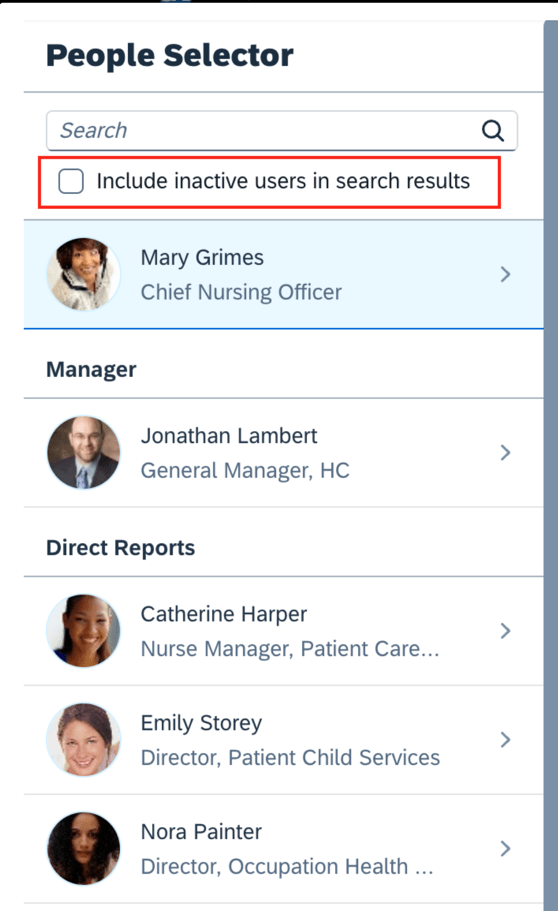
Inactive users may now be included in search results in People Selector and their goals may be edited.
Search for inactive users
Goal Details Page Updates
There are enhancements to the goal details page.
The left-hand sections of the goal details page can be collapsed.
Collapse Goal Sections
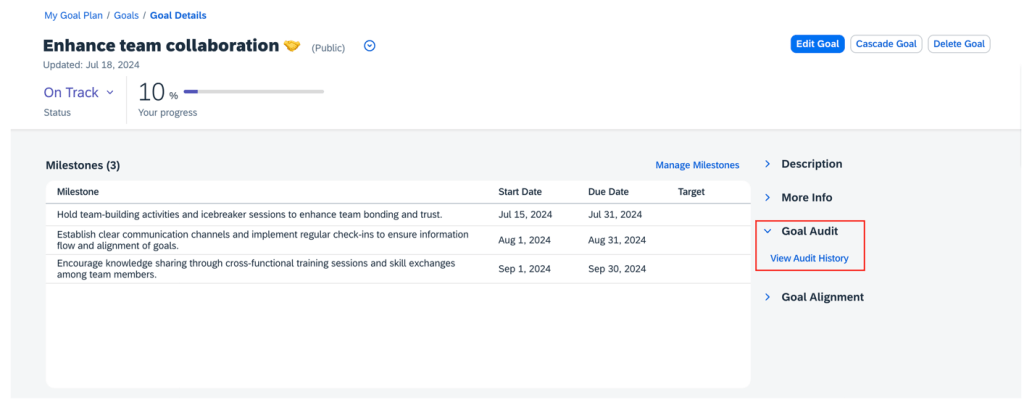
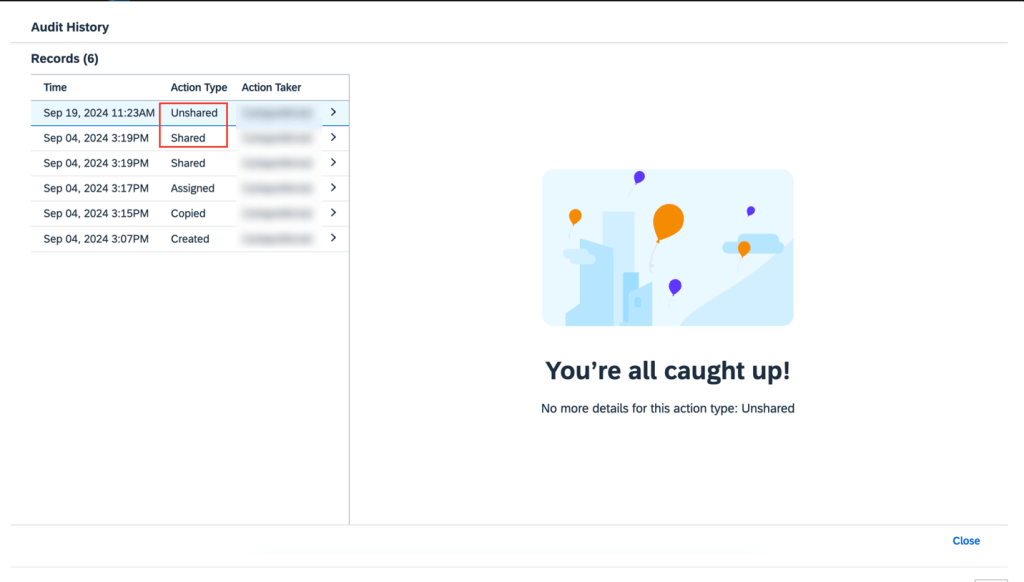
Audit history is now a new section on the right side of the page instead of a button to click to view the audit history.
Audit History in Right Panel
All milestone fields are visible and the milestone table can be scrolled horizontally.
Milestone Fields
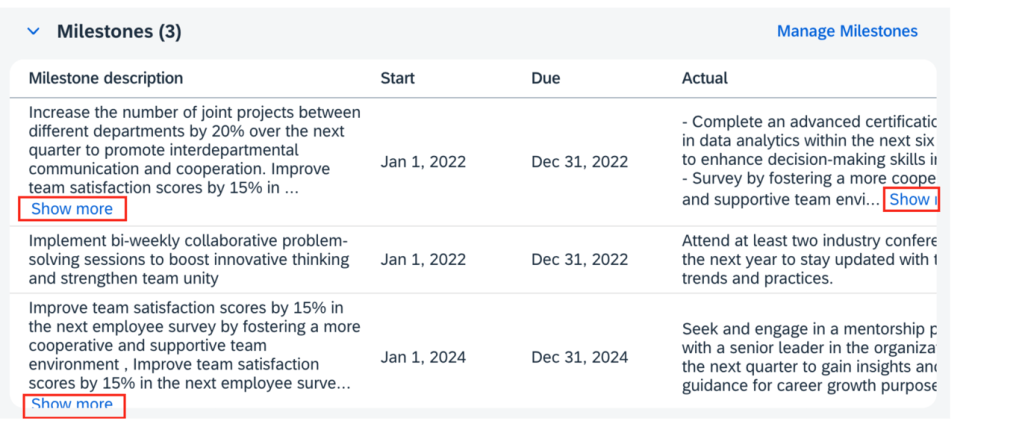
For milestones, the Show more button expands to display all of the content of the milestone fields that are configured as textarea type. This eliminates the need to click the Manage Milestones button to see all the text.
Show more for Milestones
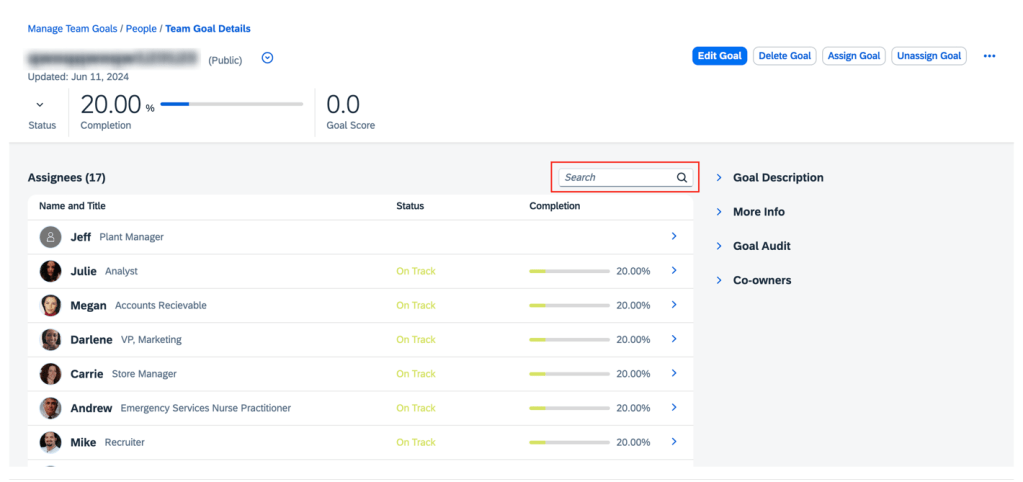
Users can now search for assignees on the Team Goal Details page.
Assignee Search on Team Goals Page
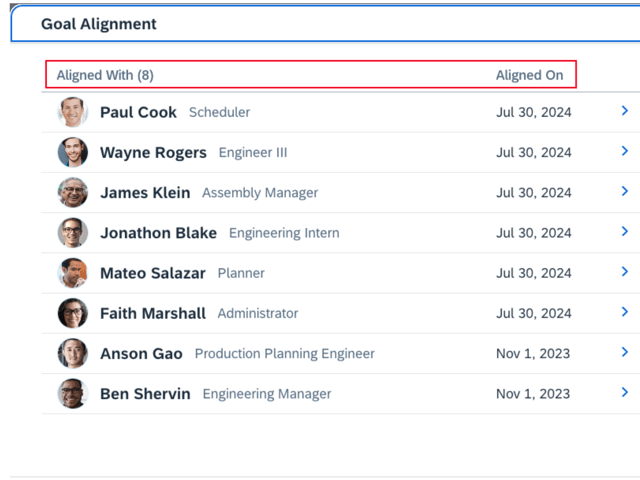
On the Goal Alignment pop up, headers have been updated to show Aligned With with a count and the aligned on date.
Goal Alignment Headers
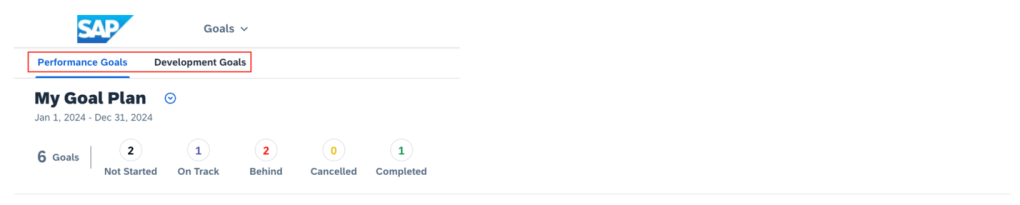
On the landing page, the tab names for Performance goals and Development goals now use the plural form.
Goal Tab Names
There is no limit to the number of goals that can be displayed in the personal and team goal list views.
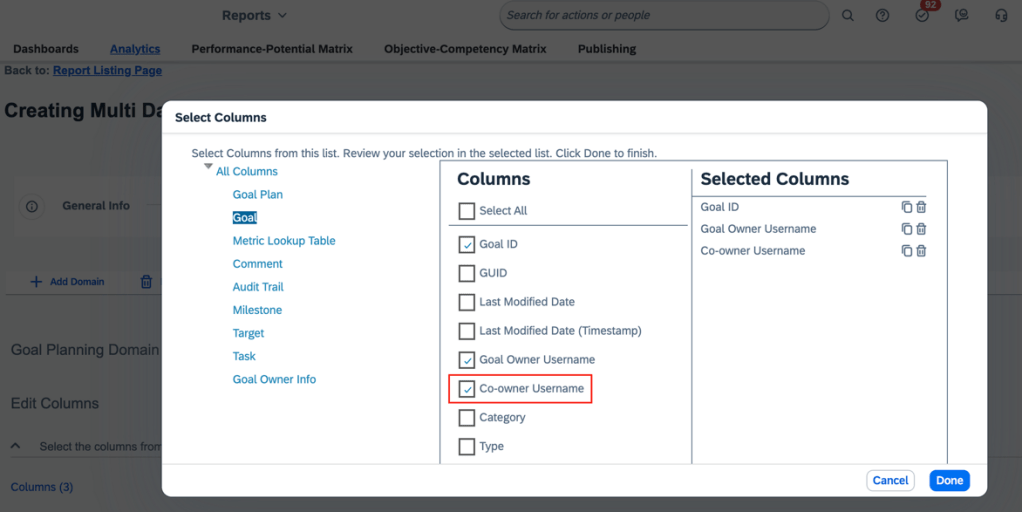
When creating reports for master team goals, there is a new Co-owner Username column. This is available in both Story reports and Table reports.
New Column for Reporting
In audit history, “Shared” and “Unshared” are now supported as new action types for team goals.
New Action Types for Team Goals
Roll-up Calculation for Cascaded and Linked Goals
Roll-up calculations can now be used for cascaded and linked goals in the latest Goal Management.
Bizx-actual, bizx-target, and bizx-pos fields can be set to average or sum using the rollup-calc-type attribute.The sum or average values for these fields are automatically calculated across cascaded and linked goals based on your configuration. These values are then reflected in source goal details.
When a parent goal is cascaded or linked, two audit records are generated for it, one record indicates the action type (“Cascaded” or “Linked,”) while the other record shows “Modified” due to changes in the roll-up fields.
AI-Assisted Goal Creation Enhancements
If you have purchased the AI units license, have enabled the latest Goal Management, and have assisted goal creation is enabled and properly configured, you will experience a more engaging AI-assisted goal creation experience.
Updates include:
Updated AI tag: On the goal creation page, the tag for fields with content generated by AI is now “AI-generated content”, replacing the previous “AI-enhanced content”.
Improved content comparison: the Compare Generated Content page has been eliminated. It is replaced by the AI-assisted writing tool to enhance content at the field level.
Enhanced prompt template: The prompt template automatically applies goal plan configurations, such as start, due, and maxlength, to AI-generated goals.
Custom fields: Custom fields of text and textarea types are now supported for performance goals. You specify the context by providing meaningful text for <field-description>. This allow AI to generate more better suggestions for your goals.
For tips on how to manage a release, check out our blog here.
Delegation Available for Performance Reviews
Managers can now delegate their performance review tasks to others for a specific time period. It also allows administrators to create delegations on behalf of managers.
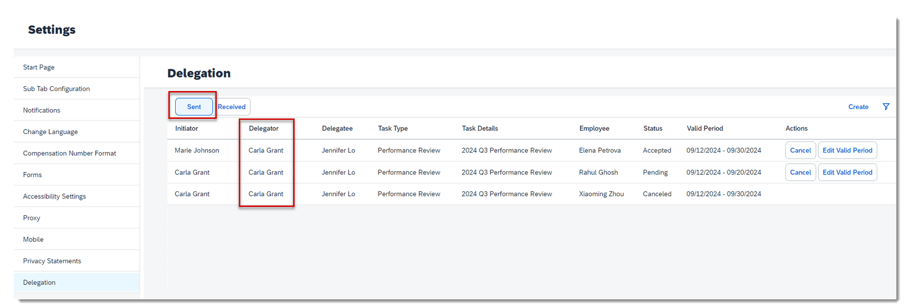
From Settings, go to the Delegation tab, this will display a Delegation page where a user can:
Create a delegation request for themselves
View and manage the delegations they created and those created by administrators on their behalf
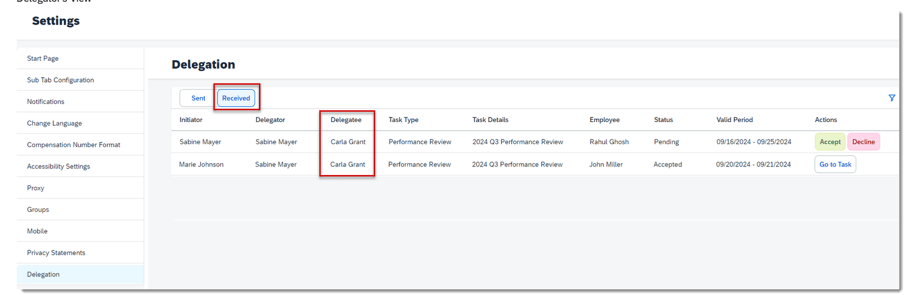
Accept or decline the delegation requests they received
Go to the delegated task they accepted
Delegation will not display on the side panel if the user does not have the permission to use it.
A Sent and Received tab will be visible.
Delegations Page
On the view for the delegatee, they can see any delegation requests and accept or decline requests.
Delegation Requests Received
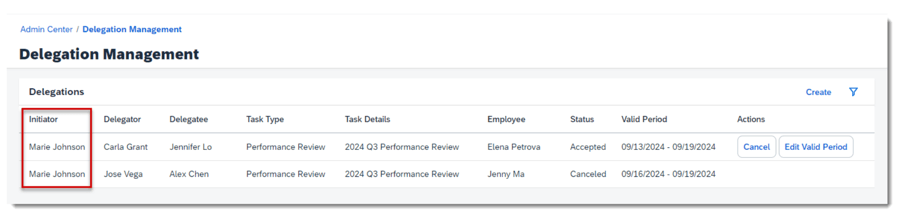
On the Admin Center Delegation Management page, an administrator can:
Create a delegation request for users
View and manage the delegations they created on others’ behalf
Admin Features
Delegation Steps
Create Delegation – a request to delegate is initiated by a manager or an admin. The validity period and form template must be identified in the request.
Respond to Delegation – the delegatee receives a notification to act as a delegate. Within Settings, clicking the Delegation tab, details about the request are shown and they may choose to accept or decline the request. The requestor is notified of their decision.
Perform Delegated Task – a Go to Task button is visible on the Delegation page during the validity period. The delegatee can perform the action on the form. The original manager sees the form in their inbox as read-only.
Edit or Cancel Delegation – The delegator may edit the validity period of the delegation or cancel the request.
Complete Delegated Task – The delegatee completes the task and the form moves to the next step in the route map.
Delegation Related Email Notifications
Email notifications are automatically generated in the following steps of the delegation process:
Delegation Created/Pending Action notification goes to the delegatee
Delegation Accepted or Declined notification goes to the delegator and delegatee
Delegation Canceled Manually notification goes to the delegator and delegatee
Delegation Request Auto-Canceled due to Inactivity notification goes to the delegator and delegatee
Delegation Expired notification goes to the delegator and delegatee
Requirements for Delegation
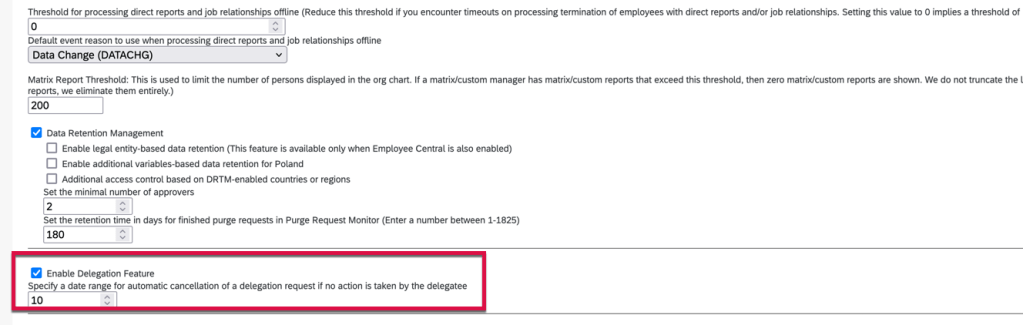
Delegation must be enabled within Company System and Logo Settings. A number of days to automatically cancel a delegation request if no action is taken by the delegatee must be set as well.
Enable Delegation in Company System and Logo Settings
Permissions for Delegating Performance Review Tasks
To allow all managers to delegate, permissions need to be added to their role. If you wish to allow administrators to delegate on manager’s behalf, the admin role will need additional permissions as well.
First let’s review the various roles in a delegation scenario.
Initiators: managers and administrators
Delegators: managers
Delegatees: managers’ peers and those directly above them
Employees: managers’ direct reports
Based on the roles, we will need to add delegation permissions to the various permission roles.
User Permissions >Delegation>Create Delegation Based on Form Templates
Delegators Role:
User Permissions >Delegation>Delegator-Delegatee Relationship, defines who can be selected as the delegatees of a delegator during the delegation creation process.
User Permissions >Delegation>Delegator-Employee Relationship, defines who can be selected as the delegatees of a delegator during the delegation creation process.
Create Performance Reviewer (Delegation) Role
A permission role needs to be created as well, this allows users can access the Performance Management forms delegated to them from the Delegation page. Do not assign the role. It’s expected to be inactive.
Required to allow access of forms from the delegation page:
User Permissions>General User Permission>User Login
User Permissions>Performance>Performance Management Access
Optional
To add, edit or delete goals on the PM form: User Permissions>Goals>Goal Plan Permissions
To view People Profile blocks through links on the form: User Permissions>Employee Data>View (identify the elements to view)
To restrict access to inactive users’ forms: User Permissions>Performance>Restrict Data Access of Inactive Users’ Forms
Delegation Role with Required Permissions
When the delegatee goes to their delegated form, the system automatically grants them the role’s permissions, with the form subject (employee) being the target population.
Enhancement to the Latest My Forms Page for PM Forms
If you are using the latest My Forms Page, there are some improvements for the user’s experience. The My Forms page has updates to form creation, form lists and filters.
Form Creation
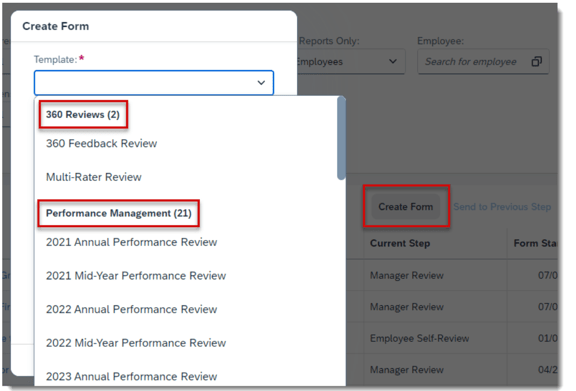
The Create Form button is now only visible for users that have permission to create at least one PM or 360 form.
The dropdown list of forms is now grouped by under 360 Reviews and Performance Management. Each heading lists the number of forms available for the category.
Create Form Templates
Form Lists
The number of forms is included in the forms list title.
Form List View with Number of Forms
Filters
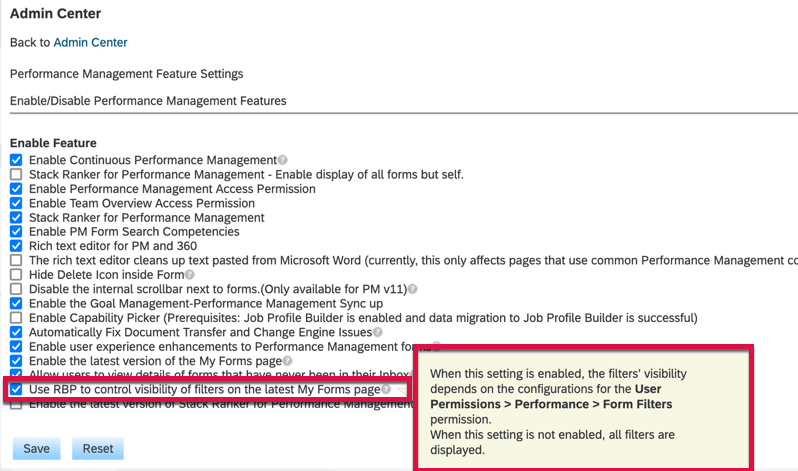
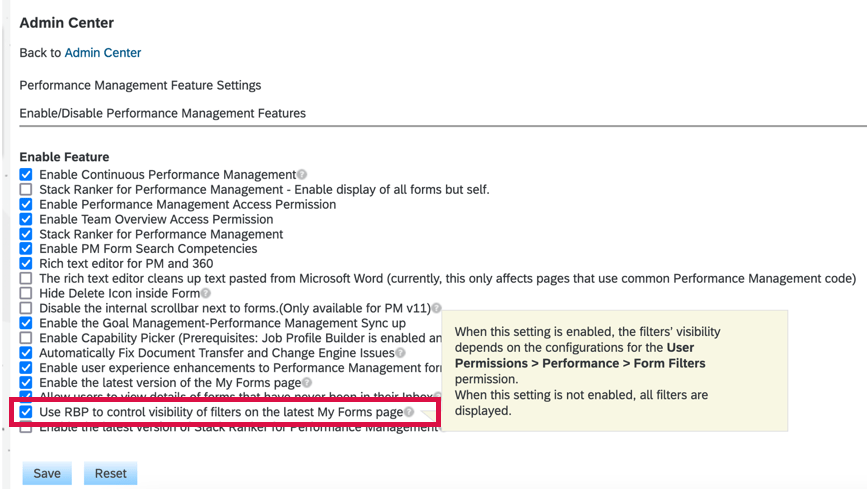
Standard and custom filter visibility can be controlled by role. All filters display by default but can be hidden using role based permissions. Enable Use RBP to control visibility of filters on the latest My Forms page in Performance Management Feature Settings.
Performance Management Feature Settings
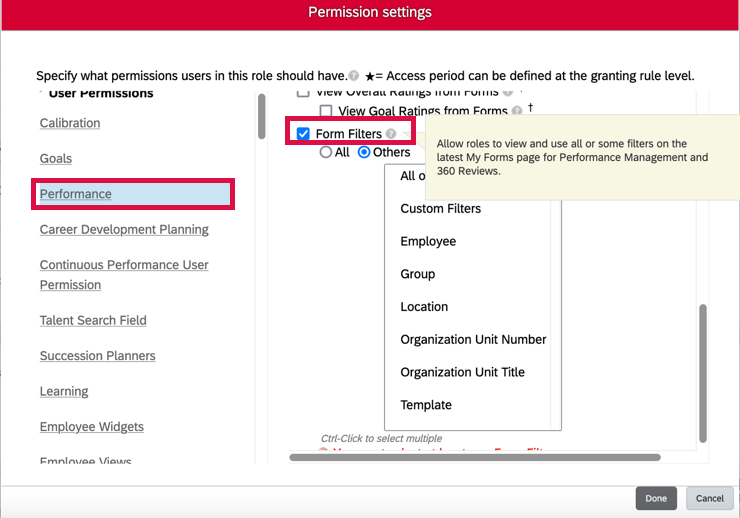
Then, grant users the User Permissions Performance Form Filters permission to show all or certain filters to them.
Form Filter Permissions
A All or Reports Only filter is available for users with direct reports, matrix reports or HR reports
The Template filter is now dynamic and changes based on templates of forms in a folder, previously all templates were listed
There is a reset button to clear filters
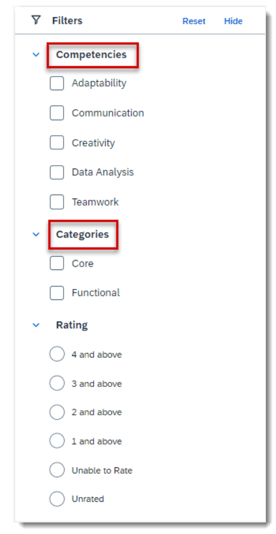
Filters
Performance Management Text Changes
If you aren’t using Talent Intelligence Hub, the filters have been renamed from Attributes to Competencies and Tags to Categories.
For tips on how to manage a release, check out our blog here.
Easier Experience of Nominating Talent Pool Members to a Position
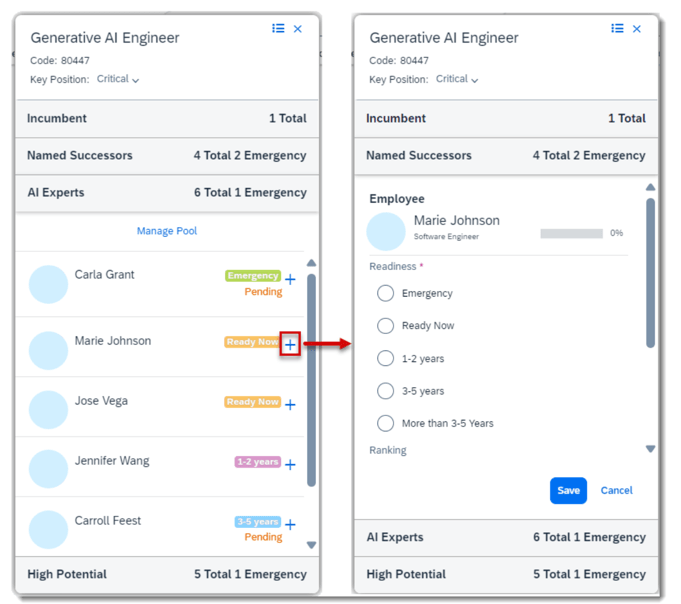
Succession planners can now add successors directly from the talent pool sections on the position card in the Succession Org Chart or in the Position Tile view. This applies to positions associated with talent pools.
Before the latest release, the user had to navigate to the employee’s talent card to begin the nomination process, including searching for the position. Now when the user selects the “Add as successor” button for a member of a talent pool, the Named Successors section expands to view more details before nominating the employee to the position.
Add a Successor from a Talent Card
Succession Text Changes
There are some minor visual changes for Succession. Previously the search box in Talent Search didn’t have a label. Now the search box is labeled Keywords: and the placeholder text has been changed to Enter your keywords.
Updated Talent Search
On the details page of a talent pool, the field to filter the talent pool nominees did not have a label and was in the same line as other filters. Now it is labeled Nominee with Search for nominee in the placeholder text.
Talent Pool Nominees Filter
Now, this field is labeled as Nominee and has placeholder text and it is now placed above other filters.
Succession Notification Card Available in Microsoft Teams
If you are using the integration of SAP SuccessFactors and Microsoft 365, there is a new notification card available for users to review and approve pending nominations to a talent pool.
For tips on how to manage a release, check out our blog here.
Enhancement to latest Development Goals
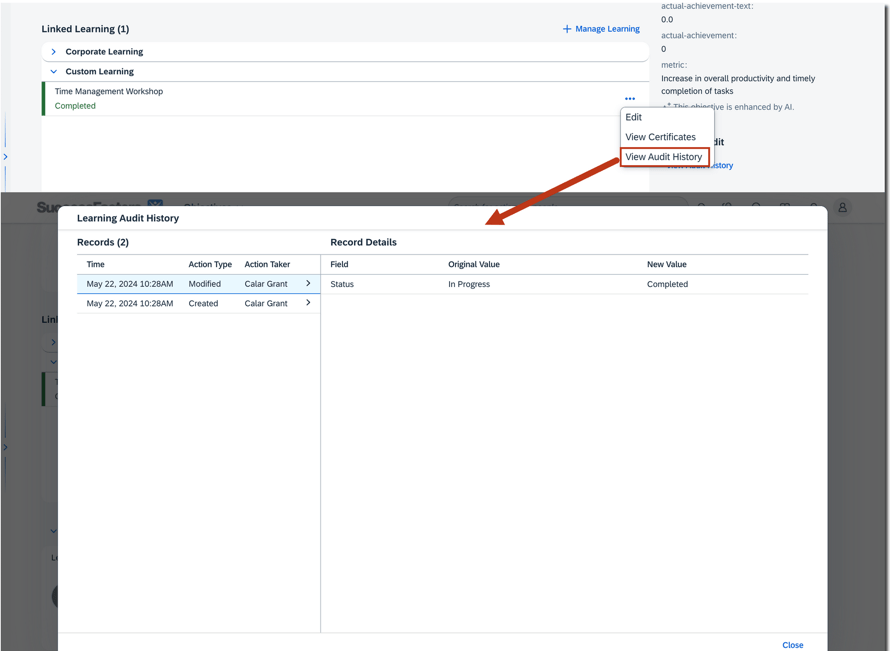
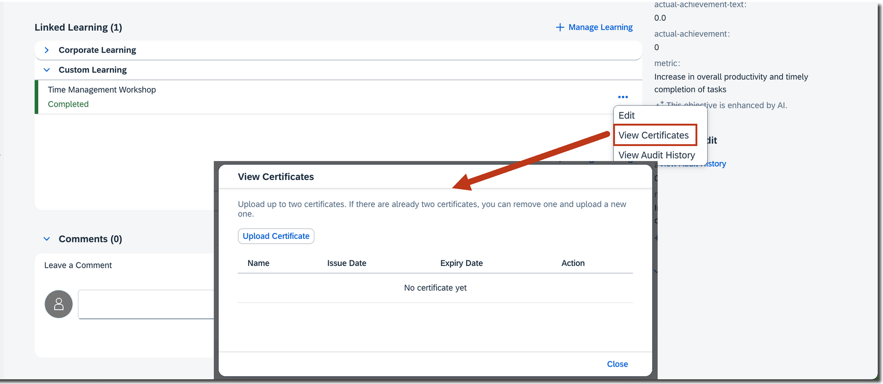
Users can now view audit history for custom learning activities linked to development goals. Certificates may be uploaded to custom learning activities as well.
Adding or editing a custom learning activity generates an audit history record. The learning activity history shows the type of change, the date of the change, the before and after values of any changed fields, and who made the change. However, a custom learning activity linked to a development goal is not logged in the learning activity’s audit history.
Linked Learning Activity History
Users can upload certificates to a completed custom learning activity, providing the Certifications field is configured in the learning activity template.
View and Upload Certificates
Prevent Removal of Learning Activities from completed Development Goals
In the latest version of Development Goals, it is now possible to prevent users from removing learning activities after their development goals are completed.
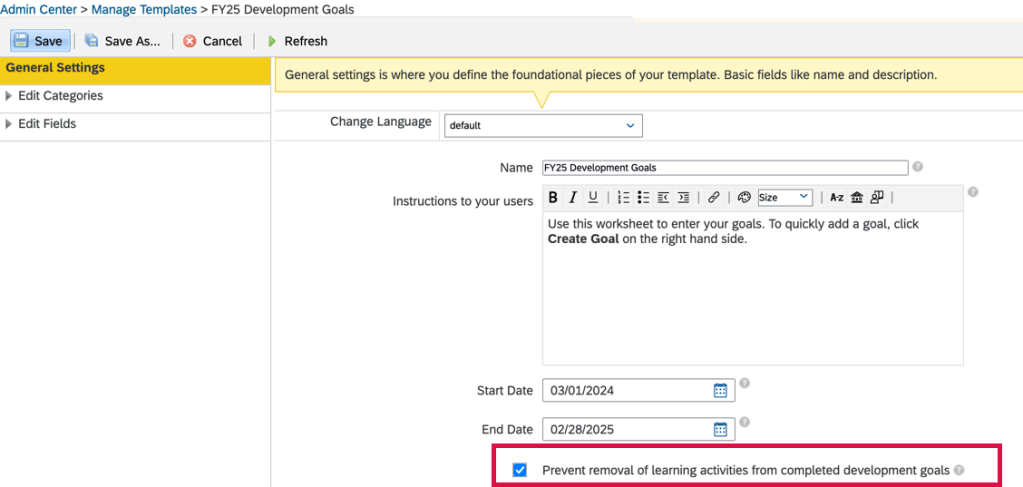
In the General Settings of the development goal plan templates in Manage Templates, you will now see an option to prevent the removal of learning activities from completed development goals.
Prevent Learning Activity Removal in Manage Templates
Updates for Career Worksheet
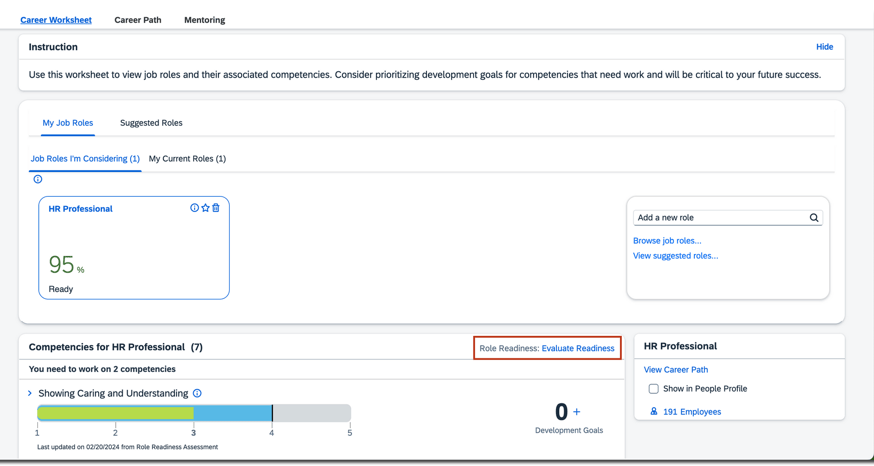
Allow More Roles to Launch Role Readiness Forms in Career Worksheet
If you are still using the legacy version of Career Worksheet, the template can now be configured to allow more roles to launch the Role Readiness form. Up until now, only an employee could launch the form for themselves.
Launching Role Readiness Form
The <permission for=”launch-assessment-form”> setting has to be added in the Career Worksheet template with the roles identified that can launch the Role Readiness form.
Minor Visual Changes for Career Explorer
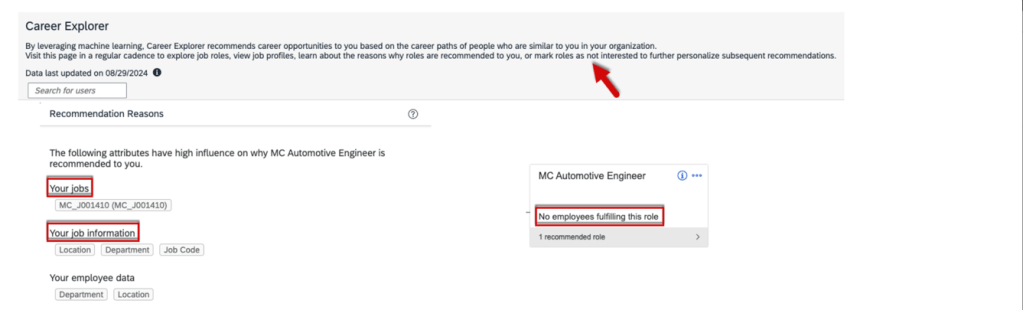
There are some visual updates made for Career Explorer that are shown below.
The messages on the page description has been enhanced.
Page Description Messages
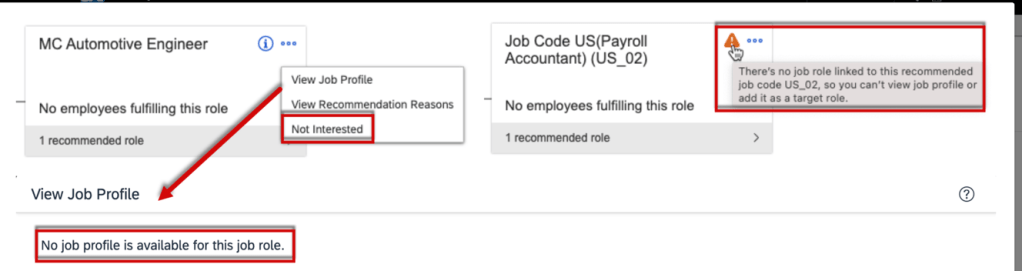
The Remove Role button is now labeled Not Interested and is now located in the more actions list on the role card.
If there is no job role linked to a job code, the info icon on the role card has been changed to a warning icon, and the tooltip has been changed to There’s no job role linked to this recommended job code, so you can’t view job profile or add it as a target role.
If there is no job profile defined for a job role, the message is: No job profile is available for this job role. However, users can still add the role as a target role in the View Job Profile dialog.
Text Changes for Career Explorer
Explore Recommended Roles in latest Career Worksheet
Users can now see recommended roles in both card and chart views.
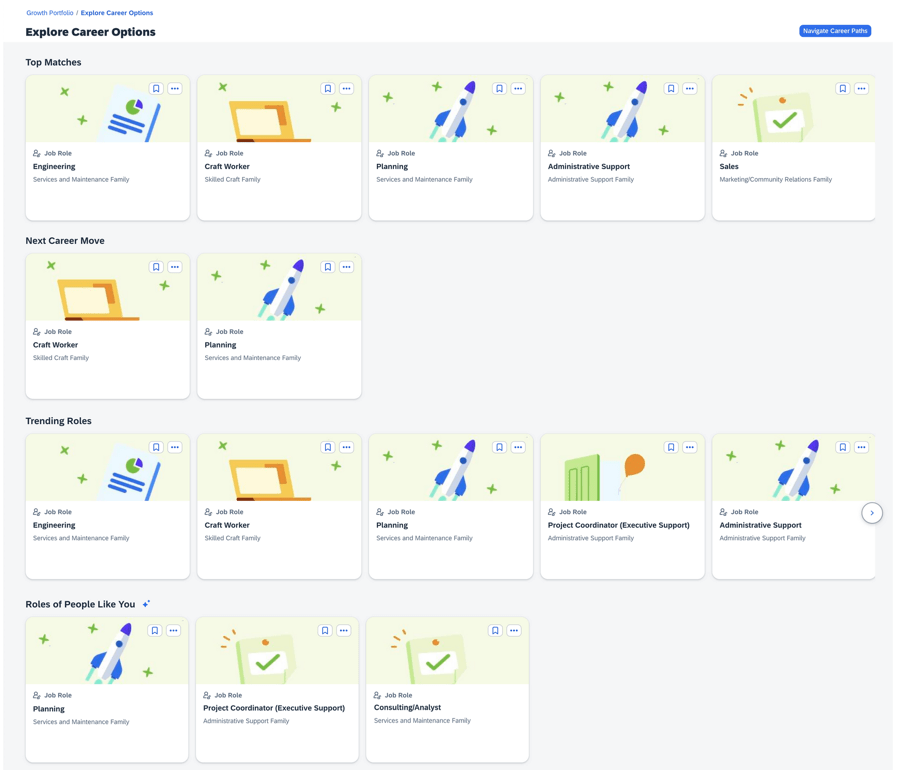
In Growth Portfolio, select Explore Career Options which opens a page of recommendations.
Career Explorer
The page has four sections which are shown below.
Top Matches – the systems suggests matches based on:
Skill and attribute ratings
Skills and attributes that are associated with a core or critical tag in Growth Portfolio or marked as Passionate
Next Career Move – displays the next role in the Career Path
Trending Roles – suggests roles with open positions
Roles of People Like You – suggests roles from Career Explorer, if enabled
View More Role Information in latest Career Worksheet
In the latest Career Worksheet, employees have greater visibility into their current, target and recommended roles. Information about job family, incumbents, and organizational career paths are now available.
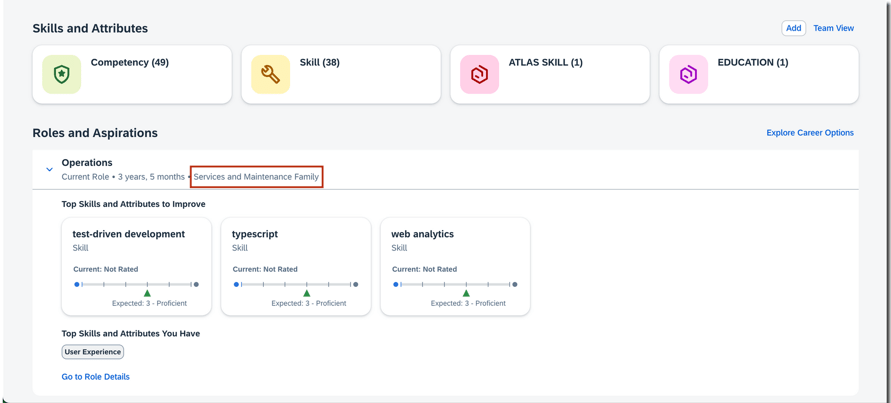
On the Growth Portfolio page, there is a Roles and Aspirations section where job family information is displayed.
Roles and Aspirations section of Growth Portfolio
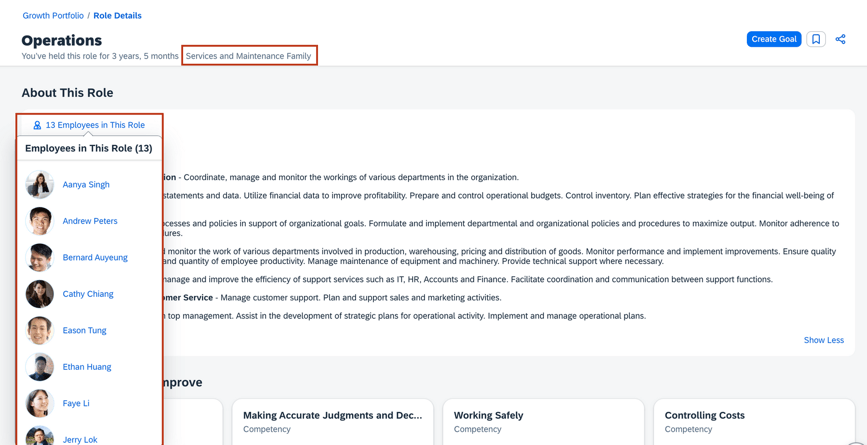
On the Role Details page, this information is also available. Here they can also view the number of current employees in the About This Role section. A list of employees in this role displays when the user clicks on the [Number] Employees in This Role. If there are more than 20 employees, users can choose A View All option that appears and the entire list is shown on the Directory Search page.
Role Details page
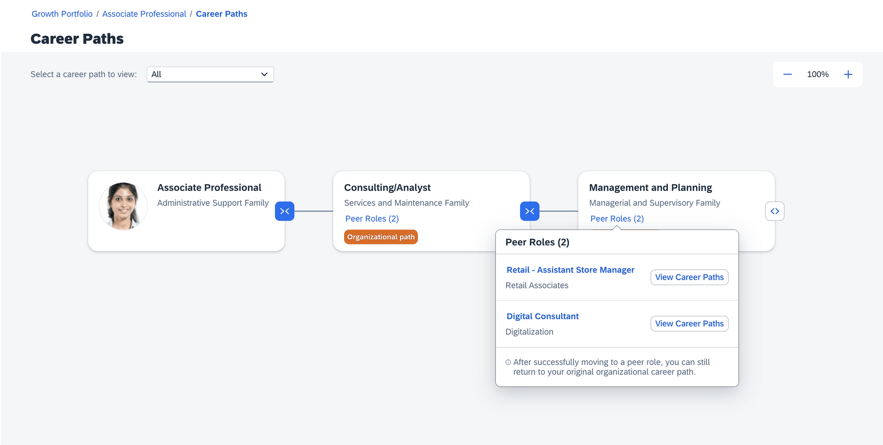
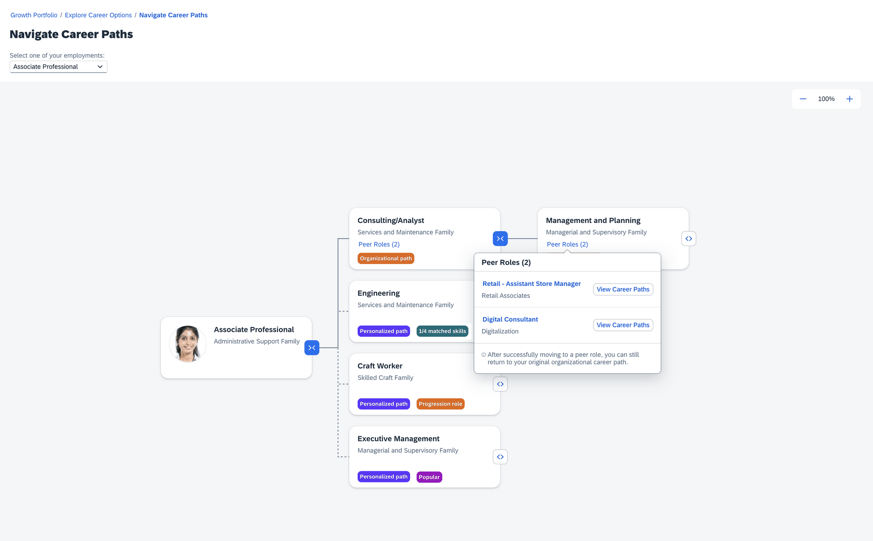
Similar to the legacy Career Worksheet, the latest version now also allows the user to choose a career path, select a role card and see the details page of the selected role. A role’s peer roles can also be seen through the role card.
Roles Cards in a Career Path
Navigate Career Path
A chart view of recommended roles can be seen by selecting Navigate Career Paths on the Explore Career Options page.
Navigate Career Paths
The employee’s current role is the starting point. Recommended roles include organizational path roles from organizational career paths and personalized path roles that are tightly match with the employee.
There are organizational path and personal path role cards. The organizational path role cards show details on peer roles. The personalized path cards show why certain roles were recommended for them. Recommendation reasons can include same job family, popular role, progression role or open position.
The view also allows switching between current roles. For employees with more than one current role, they may select any of those roles to see the recommendations for that role.
Updates for Mentoring
There are some new features for Mentoring as well.
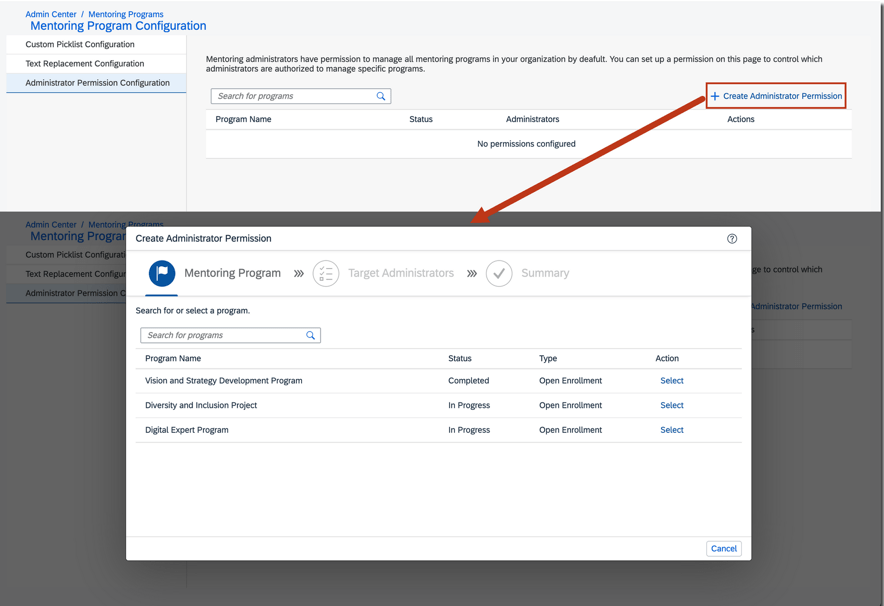
Manage Administrator Permissions for Mentoring Programs
It is now possible to limit which administrators can manage specific mentoring programs. Go to Manage Mentoring Programs. Within the Administrator Permission Configuration, select a mentoring program and the identify the target administrators who can manage it.
Mentoring Program Admin Permissions
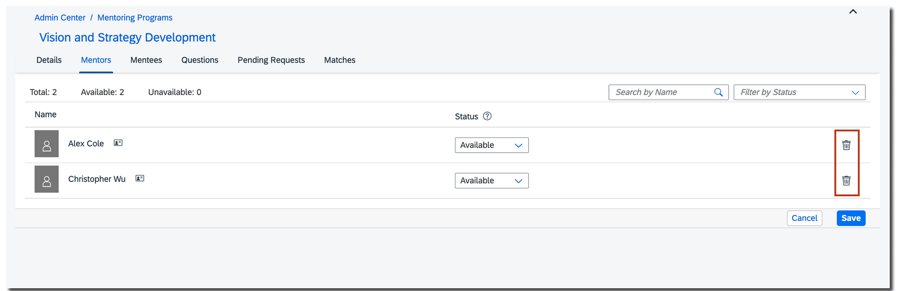
Change Participants in In-Progress Mentoring Programs
Program participants for in-progress open enrollment and unsupervised programs may now be added or removed by the mentoring admin or mentoring program owner.
Remove mentors from mentoring program
Mentors and mentees may also be added to in-progress unsupervised programs.
Mentoring Matched Date Now Available in Reporting
It is now possible to report on the matched date for mentors and mentees in mentoring programs in Table and Story reports. This is helpful to report on the duration of mentoring relationships.
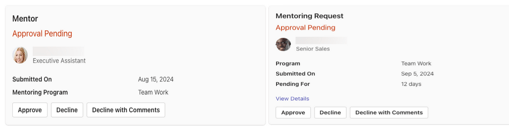
Mentoring Notification Cards Available in Microsoft Teams
If you are using the integration of SAP SuccessFactors and Microsoft 365, there are two new Mentoring notification card available for users.
Mentors are notified to approve or decline employee requests to be a mentor. Mentoring requests from a mentee can also received by a potential mentor.
Mentoring Notification Cards
Updates for AI
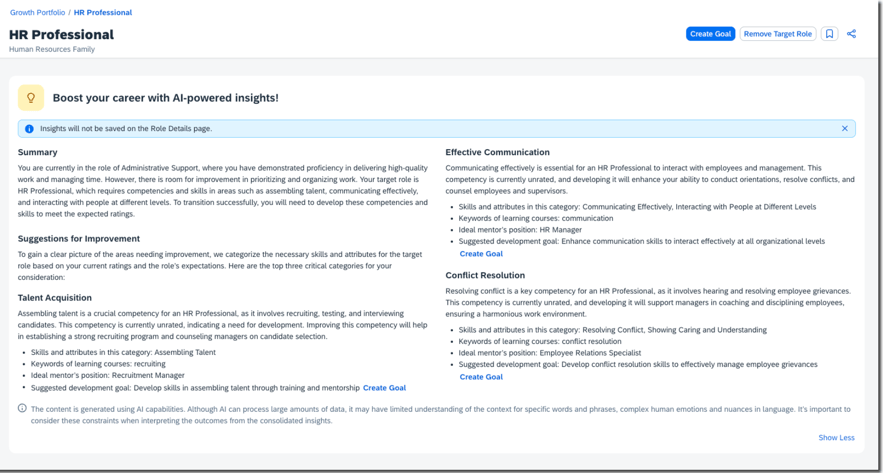
AI-Assisted Career Highlights
With the latest Development Goal and AI enabled, employees can see development actions they can take towards their target role.
Using the Generate button on the Boost your career with AI-powered insights! section of a target role’s details page you will see:
Summary which gives an overview of the employee’s current role and target role
Suggestions for Improvement which identifies three growth areas for skills and career development with suggestions for:
Skills and attributes in the category
Keywords of learning courses
Ideal mentor’s position
Suggested development goal with the ability to create a development goal
For tips on how to manage a release, check out our blog here.
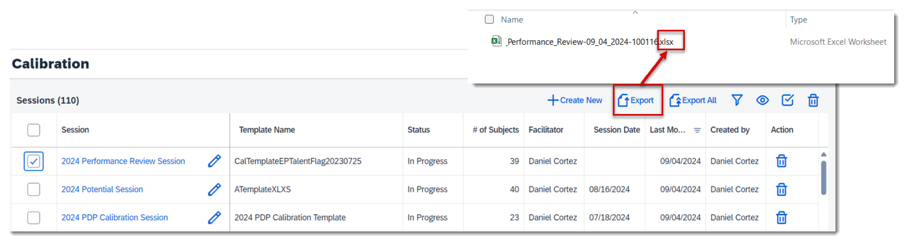
Export Calibration Sessions to an XLSX File
Before the latest release, a calibration sessions could only be exported to an XLS file with 256 columns. Now a session can be exported to a XLSX file which supports up to 16,384 columns.
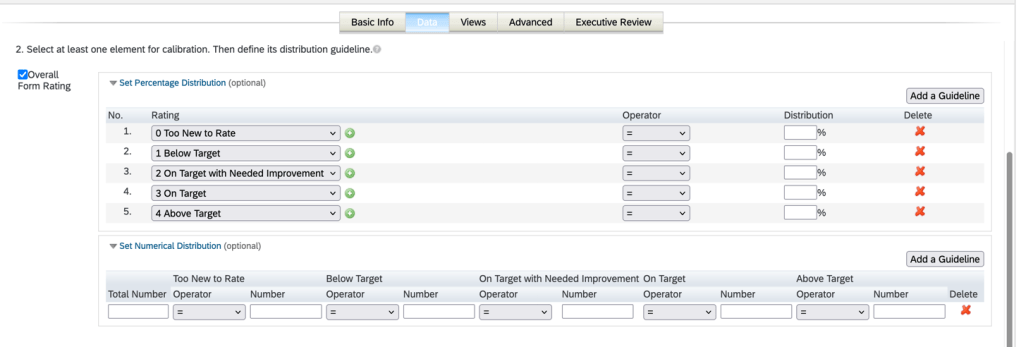
Set Numerical Distribution for Calibration Templates
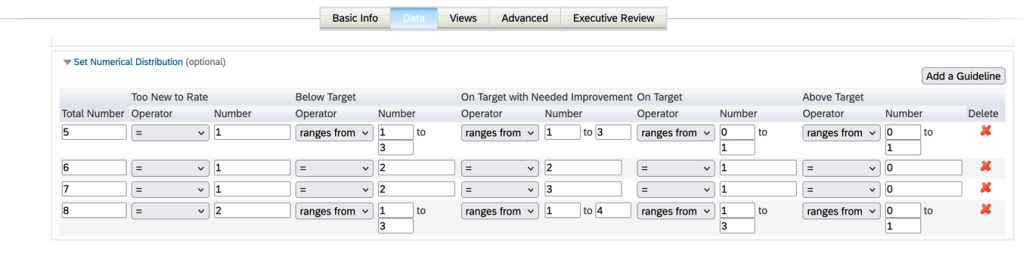
Previously, distribution guidelines for ratings were percentage-based only. Now numerical distribution rating guidelines can also be set up in Calibration templates. A target number of subjects may be specified for each rating.
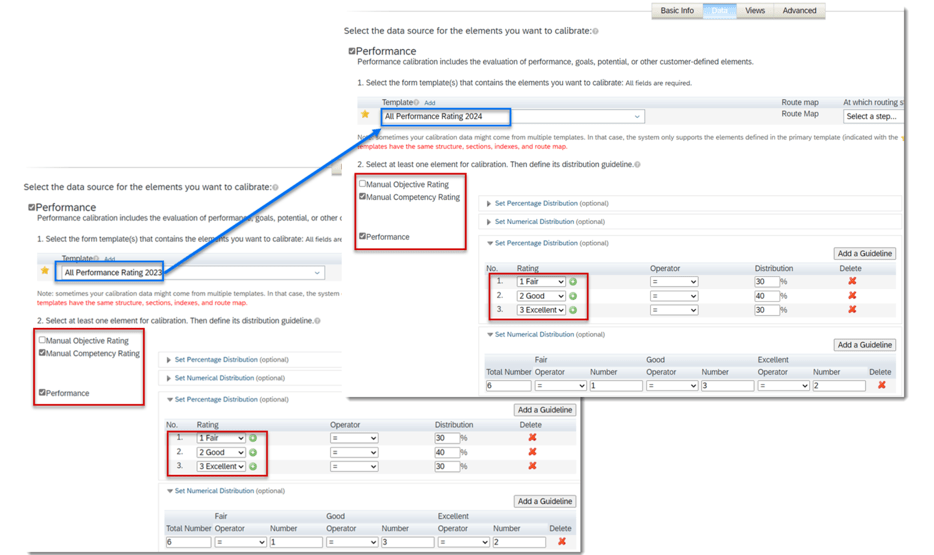
Numerical and percentage distribution guidelines in the Data tab of the calibration template under Admin Center >Manage Calibration Templates.
Setting Distribution Guidelines
Things to note about numerical guidelines:
Numerical and percentage-based guidelines can be set for the same rating with the numerical guideline taking priority.
Several numerical distribution guidelines can be set for a rating, but for the same total number of subjects, you can have only one guideline.
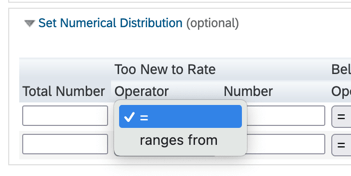
In each numeric guideline, a range may be set or the “equal” operator may be used
Numerical Distribution OperatorsNumerical Distribution Guidelines
When templates have identical rating types and scales, the configured distribution guidelines can be retained during template switching.
New Setting for Configuring Autosave
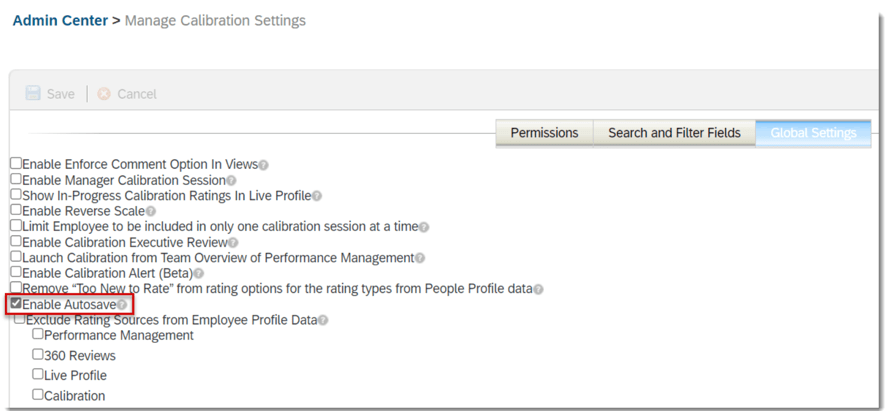
There is a new setting in the Manage Calibration Settings admin tool called Enable Autosave.
Enable Autosave
Changes made in a Calibration session are automatically saved after 30 seconds of inactivity. If this feature is disabled, users need to manually save any unsaved changes.
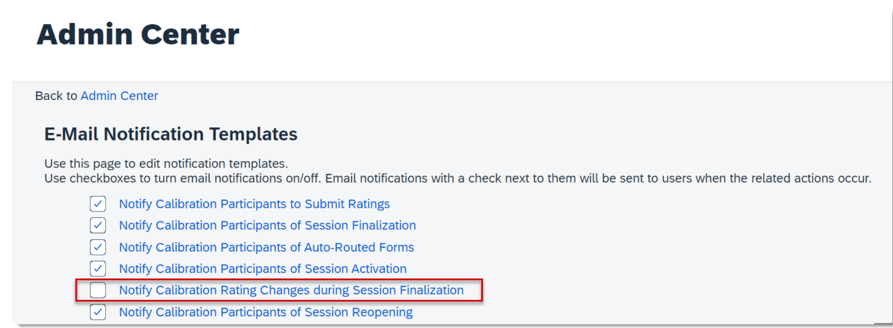
Turn Off Email Notification for Rating Changes during Session Finalization
It is now possible to turn off an the email notification Notify Calibration Rating Changes during Session Finalization.
When disabled, managers will no longer receive emails about changes to their employees’ ratings after sessions are finalized.
This setting is found under Admin Center>Email Notification Templates Settings.
Disable Rating Change Notification
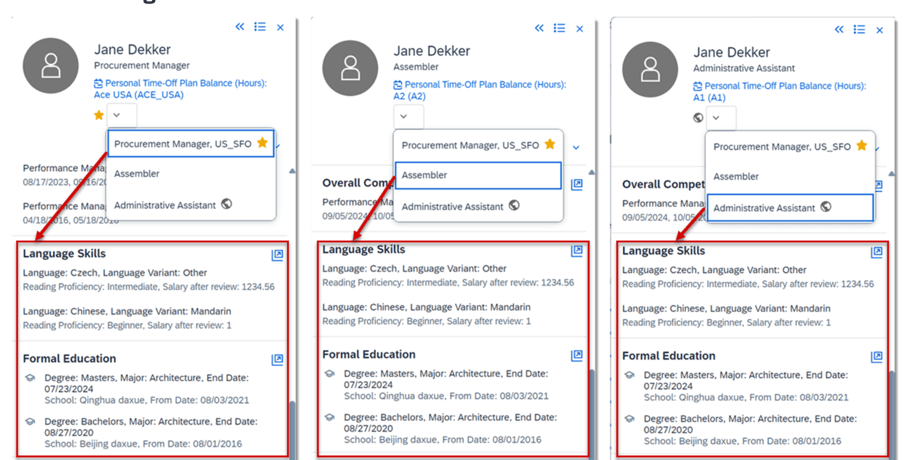
Background Information Displayed for Concurrent Employment in Talent Card
Previously in a calibration session when viewing the talent card for employees with concurrent employments, only background information related to the corresponding user ID was shown. The background information was displayed based on persons for global assignment, but based on users for concurrent employment.
Now the background information is displayed based on persons for both concurrent employment and global assignment. The talent card now displays all records of background information about a person under each employment.
For tips on how to manage a release, check out our blog here.
Enhancements to the latest My Forms Page for 360 Reviews
There are some improvements for the user’s experience when using the latest My Forms page. The My Forms page has updates to form creation, form lists and filters which is also applicable to PM forms.
Form Creation
The Create Form button is now only visible for users that have permission to create at least one PM or 360 form.
The template dropdown list of forms is now grouped by two categories: 360 Reviews and Performance Management. Each heading lists the number of forms available for the category.
Create Form Template List
Form Lists
The number of forms is included in the forms list title.
Number of Forms
Filters
There are a few changes to the filters available on the My Forms page.
Limit Filter Visibility by Role
The standard and custom filters that are seen can be limited based on the user’s role. By default all the filters are shown but can be role based permissions can limit their visibility. To do this , enable Use RBP to control visibility of filters on the latest My Forms page in Performance Management Feature Settings.
Setting to Control Filters
Then by role, grant User Permissions>Performance>Form Filters permission to show all or specific filters.
Permission for Filters
All or Reports Only filter
This filter is only available for users with direct reports, matrix reports or HR reports.
The Template filter is now dynamic
Options for the Template filter are based on templates of forms in a folder.
Reset button to clear filters
The user can reset filters at any time.
These new features are shown below.
Filter Options
Custom Learning in 360 Review Forms
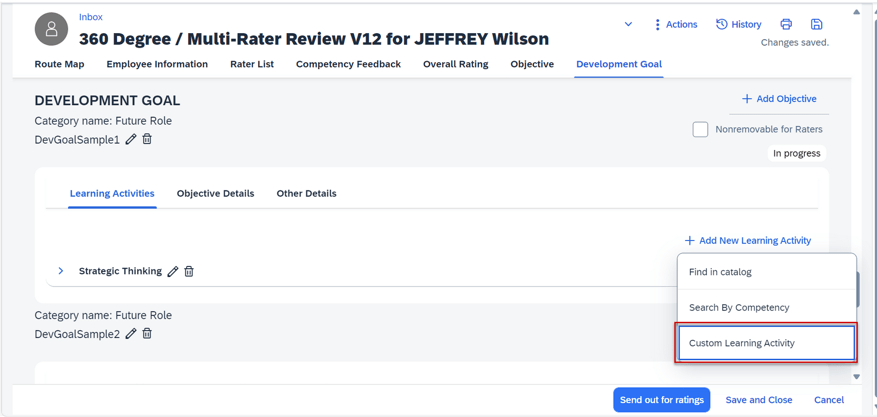
In conjunction with the latest Goal Management, custom learning activities can now be added, edited, or deleted on 360 Reviews forms.
Add custom learning activity
You must ensure that a development goal plan is linked to the form and the plan contains a learning activity template with custom learning activities.
Enhanced AI-Assisted Writing in 360 Reviews
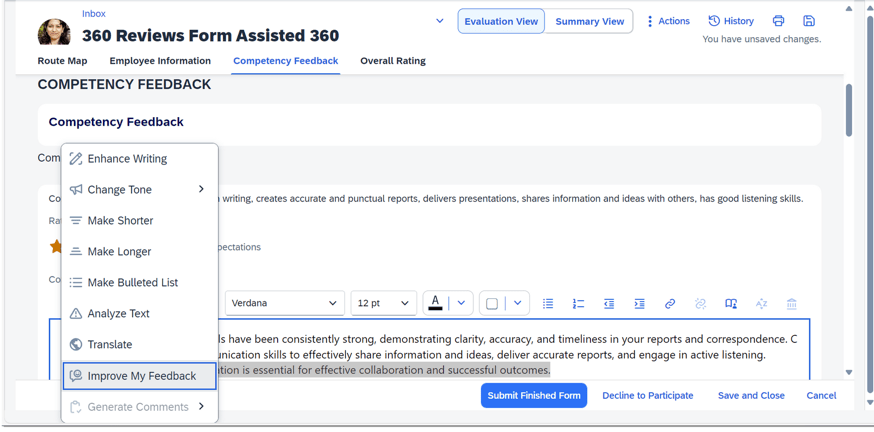
There is a AI-assisted writing tool to help generate comments and improve feedback. Both use the context menu of the tool.
To use this the following requirements must be met:
AI-Units license has been purchased
AI Services Administration Assisted Writing with Text Analyzer has been enabled in Admin Center
Consent given for the AI Usage Acknowledgment Statement
Improve My Feedback
When comments are entered, feedback can be provided in a more concise manner and is related to a competency rating or skill. The user can go through multiple iterations of the updated feedback to find the comments with the best fit.
Generate Comments
When there are no comments entered for a competency or skill, six topics are dynamically generated. The user can select one of the topics and have detailed competency or skill related comments created.
Improve My Feedback
AI-Assisted Insights into Detailed 360 Reports
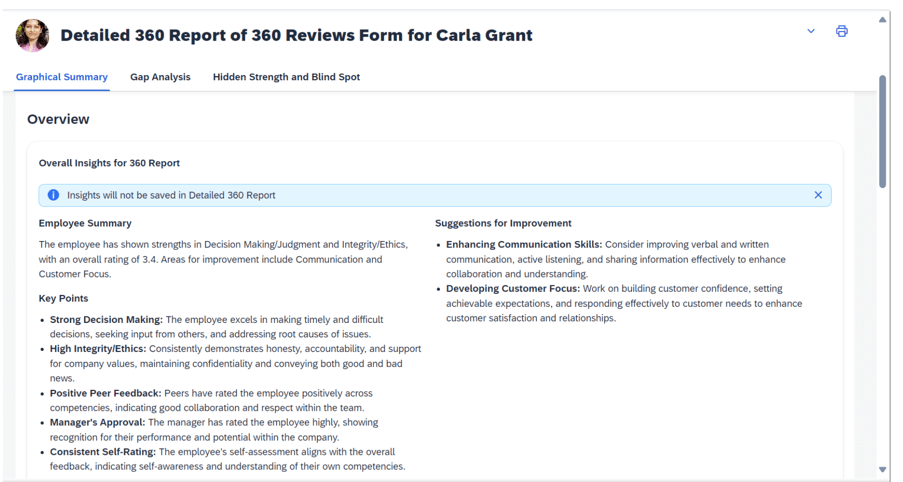
An additional feature when using AI is related to the Detailed 360 reports. A new Overall Insights for 360 Report section has been created. Here you will find a Generate Insights button. The insights relate to the overall form feedback as well as comments for specific competencies or skills.
Overall Insights
The overall insights contain the following:
Employee Summary which provides a high-level overview of the employee’s performance
Key Points to identify strengths and weaknesses of the employee
Suggestions for Improvement
Overall Insights
Analysis of Skills or Competencies
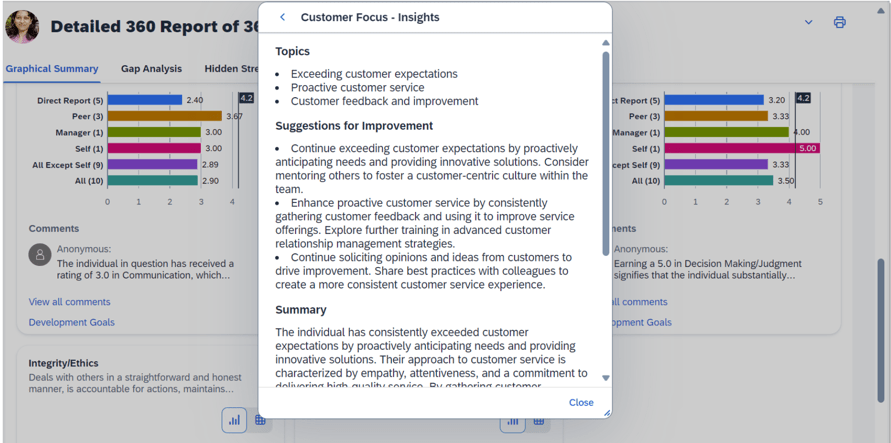
There is a View All Comments link which provides a summarized analysis for a skill or competency.
Sections include:
Key Topics
Growth Area Suggestions
Summary of performance based on ratings and comments
Skill or Competency Insight
This view provides more detail about a specific skill or competency and provides guidance for areas of growth.
For tips on how to manage a release, check out our blog here.
Automatic Channel Creation for Matrix Relationships
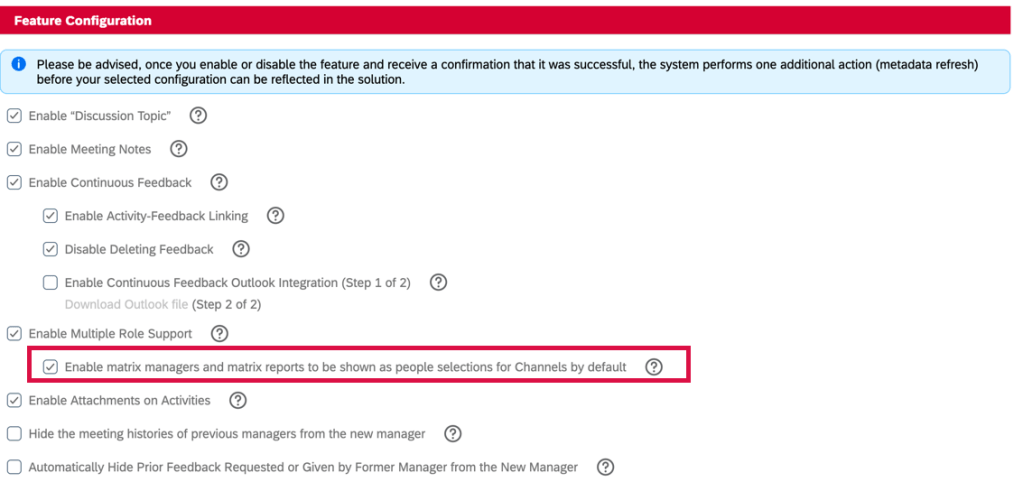
There is a new option on the Continuous Performance Management Configuration admin page, Enable matrix managers and matrix reports to be shown as people selections for Channels by default. When enabled, users identified as matrix managers or matrix reports are automatically added to the Channels list in Continuous Performance Management for the user.
Configuration Required
Each matrix manager/matrix report will have a 1:1 channel automatically created. On the Continuous Performance page, these channels will be grouped into two new categories: Matrix Managers and Matrix Reports.
Previously these channels were not automatically created nor categorized into groups. This enhancement reduces manual work and makes matrix relationships easy to see and manage.
Channel List
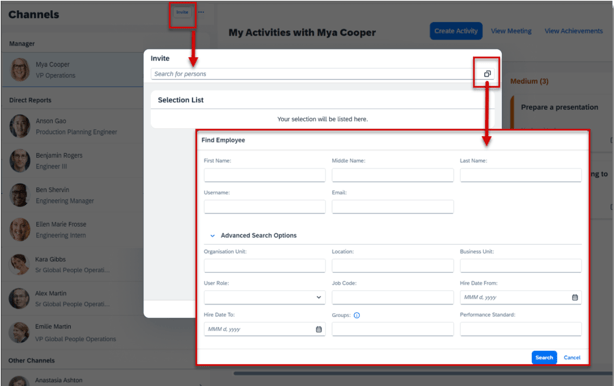
Bulk Channel Invitations
Users can now send bulk invitations for 1:1 meeting channels on the Continuous Performance page.
The feedback requestor may use the basic search and now the advanced search to find and select multiple employees as invitation recipients, without a limit on the total number of selections. Previously, only certain basic search criteria were available and users could select only one feedback provider at a time.
Advanced Search Options
For this to work, the option Enable Multiple Role Support must be enabled in the Continuous Performance Management Configuration admin tool.
There is also a new email notification, Delivery Status of Multiple Roles 1:1 Meeting Invitations, to update on the delivery status of each invitation. The feedback requestor receives the follow-up email if the results of the mass delivery can’t be immediately displayed in a pop-up message or if any delivery fails. This notification is enabled by default.
Delete Channels
Users and administrators are now able to delete channels as needed. There are new delete channel related email notifications are well.
Users can now delete the channels that they own. However, channels involving a user’s current direct reports and matrix reports can’t be deleted.
There are two options:
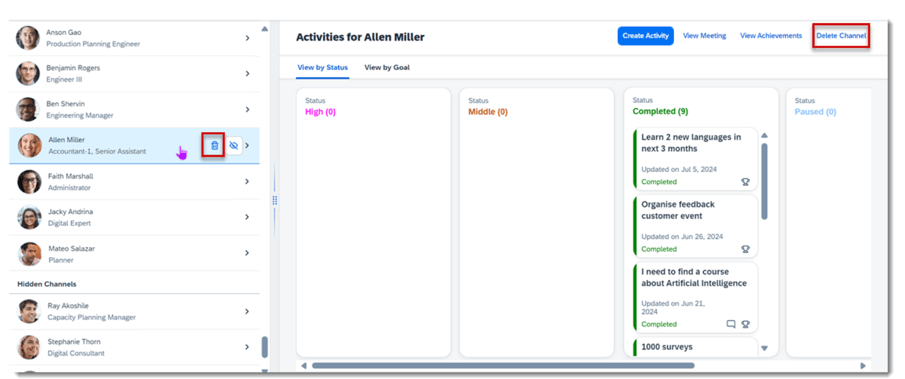
Single deletion: select the trash bin icon which appears when hovering over a channel item in the list, or select the Delete Channel button in the channel details page.
Delete Channels
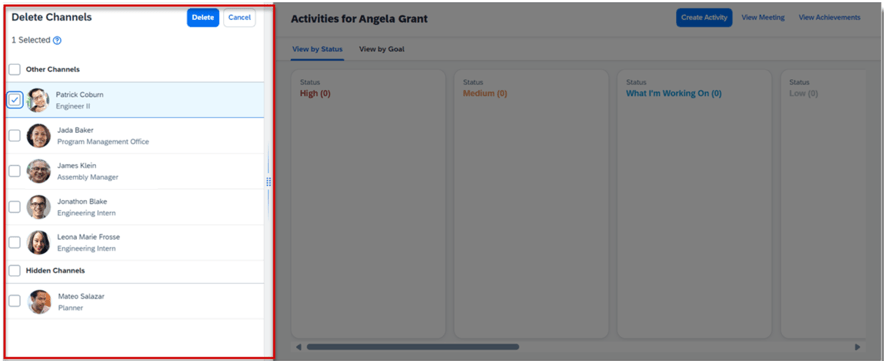
Bulk deletion: Choose Select and then the Delete Channels button on the header of the channel list. In the Delete Channels page, select and delete up to 50 channels in one time. Declined channel invitations can also be deleted.
Bulk Deletion
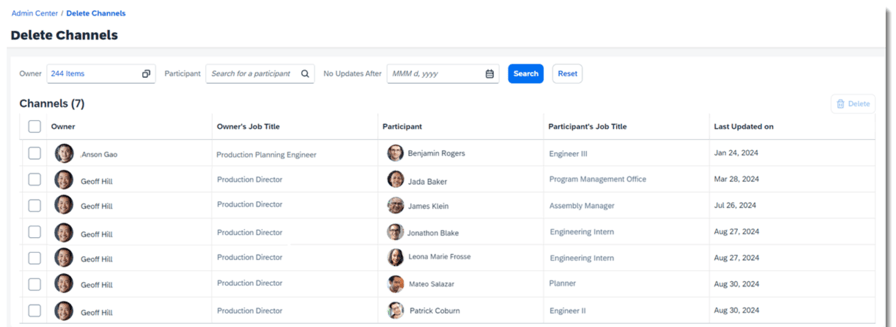
An administrator can now search and delete the channels and declined channel invitations in the new Delete Channels admin tool. However, the employee-manager and employee-matrix manager relationships cannot be deleted.
Admin Delete Channels Tool
New Email Notifications for Deleted Channels
There are new deleted channel email notifications now available and are enabled by default.
Channel Deletion Notification to Owners: channel owners are notified when the administrator deletes a channel for them.
Channel Deletion or Move Notification to Participants: channel participants are notified when a channel is deleted or moved to Hidden Channels.
Channel Deletion Notification to Administrators: administrators are notified of the deletion result of each channel. A deletion job will run in Provisioning when more than 50 channels need to be deleted at once. If an administrator chooses to delete 50 or fewer, the result immediately pops up in a message, then the system won’t send the email.
User Experience Enhancements
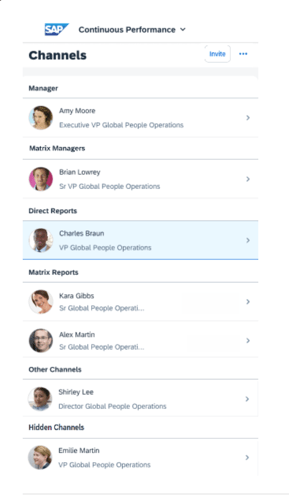
The Channel list now has a header with up to six categories:
Manager
Matrix Managers
Direct Reports
Matrix Reports
Other Channels
Hidden Channels
Channel List
This allows users to easily locate channels based on different job relationships.
A more consistent avatar experience
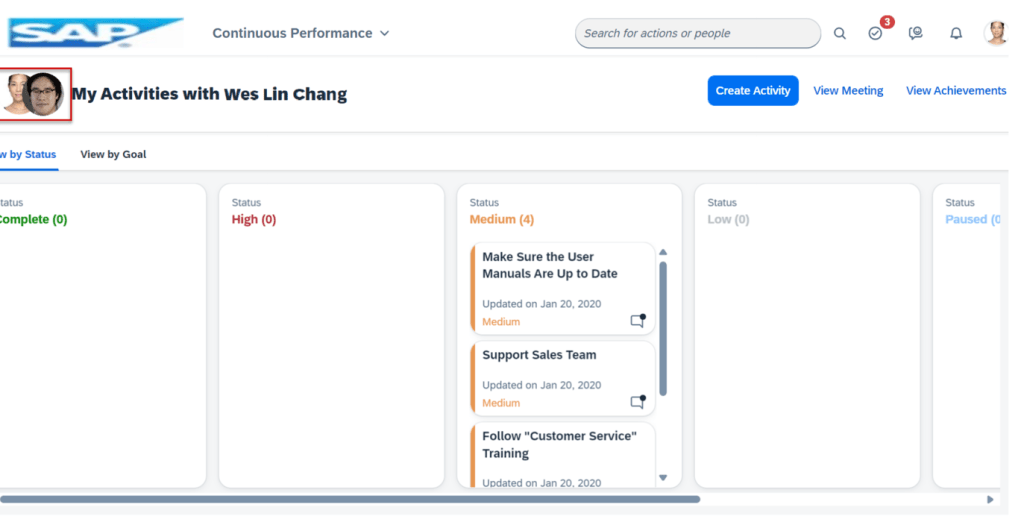
Users who have no access to the channel list can see their manager’s avatar on the header of Activities view, together with their own one.
View of Manager Avatar
Streamlined Navigation
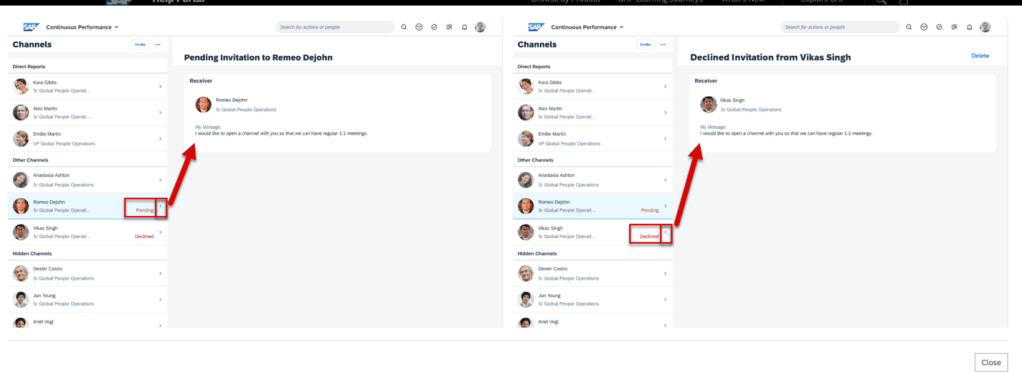
All items on the Channels list are clickable which provides a more consistent experience. There is a chevron icon on each item for navigation to the right-side panel, where the invitation messages are displayed.
Channel List Navigation
Text and Icon Changes
The icon for deletion of the Declined channel invitations is now a trash bin which is visible when a user hovers on the channel list items.
The channel invitation icon button is replaced by the text button Invite.
Channel List Features
View Received Feedback from the Redesigned Activity Details Screen in Mobile Apps
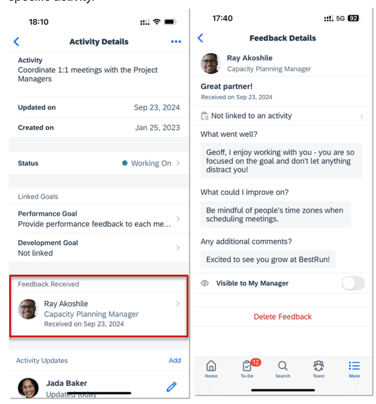
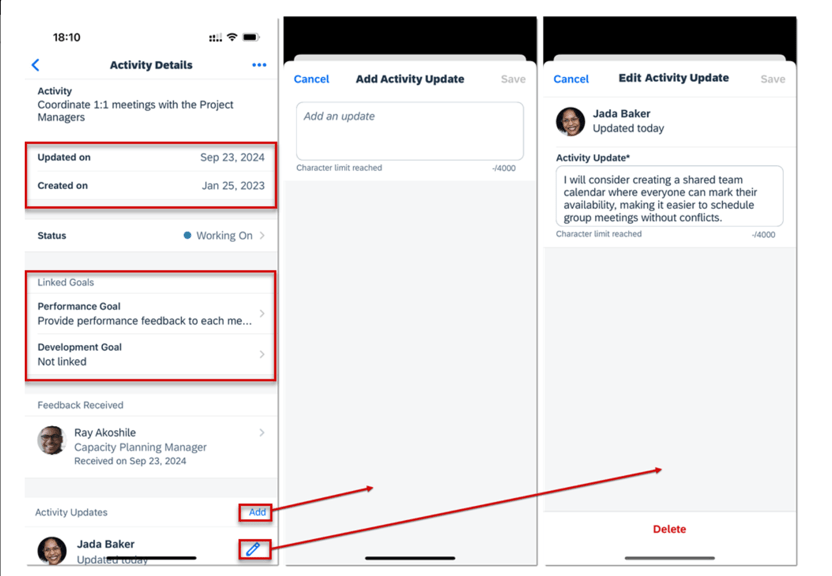
Users can view and access the feedback they received about an activity from the Activity Details screen, now in improved detail.
Here users can access details of each activity related feedback message in the Feedback Received list. Details include the name, profile photo, and job title of a feedback sender, and the date when the feedback was received.
Selecting a row takes the user to the associated Feedback Details screen. Previously users could only see the count of feedback messages received for an activity. And when choosing a number, the users saw a screen that listed all feedback they received instead of the feedback related to the specific activity.
Feedback Details
Further Enhancements to the Activity Detail Screen
The Activity Details screen has been enhanced with new sections to provide at a glance details.
Activity start date and modification dates are in the section.
There is a new section for linked goals
Activity updates- there is now a separate screen to add activities. The Edit Update screen was renamed Edit Activity Update.
Performance review periods can extend over several months, and during this time, organizational changes such as reassignments or department shifts may occur. One common scenario involves a manager transition: a situation where an employee’s manager moves to a different department or role. This raises an important question: What happens to the employee’s in-progress performance form? Should the form remain with the original manager, or should it transfer to the new manager?
This article explores the impact of manager changes on performance forms and the system settings that determine which manager will have access to these forms. We will first outline the various trigger events that can cause a manager change, and then discuss the settings within the Performance Management (PM) form template that govern the transfer process.
Manager changes can be triggered by several actions, each of which can prompt a document transfer based on predefined rules. These trigger events include:
Manual Change: Executed via Admin tools under Manage Users > Documents Transfer.
Automated FTP Employee File Import: Transfers are configured during the initial setup of the FTP process and remain unchanged unless manually adjusted.
Manual Employee File Import: This option allows for different settings with each import, potentially leading to varied results.
Employee Change Engine: Beyond standard manager changes, this engine can trigger document transfers based on other criteria such as job code or location changes.
We will examine these trigger events in greater detail later. For now, we turn to the advanced settings within the PM form template that control the outcomes of such changes.
PM Form Template Advanced Settings
The advanced settings within a performance form template provide several options to manage what occurs when a manager change takes place during the review process.
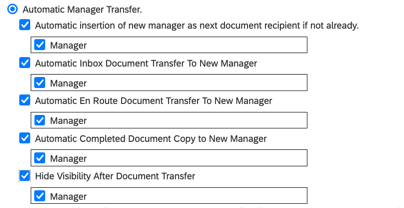
Automatic Manager Transfer Options
These settings are designed to ensure a seamless transition and appropriate document handling. The following are key settings available:
Automatic Insertion of new manager as next document recipient if not already: This option automatically inserts the new manager as the next document recipient, ensuring continuity in the review process. The original manager is removed from future steps.
Automatic Inbox Document Transfer to New Manager: If the form is in the original manager’s inbox at the time of the change, it will be transferred to the new manager’s inbox. The original manager retains a copy, which will not be updated with new information.
Automatic En Route Document Transfer to New Manager: Similar to the inbox transfer, this setting moves the form from the original manager’s En Route folder to the new manager’s folder, again leaving a static copy with the original manager.
Automatic Completed Document Copy to New Manager: This option ensures that all completed documents are copied to the new manager’s Completed folder, providing them with a comprehensive view of the employee’s review history.
Hide Visibility After Manager Transfer: When enabled, this setting removes the original manager’s visibility of the form once it has been transferred, thereby restricting access to only the new manager.
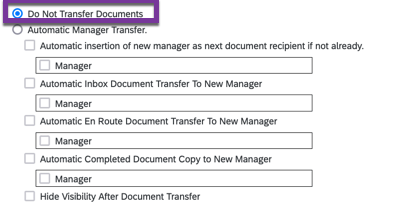
Do Not Transfer Documents
Also found in the form template advanced settings, selecting this option means forms will not transfer when the manager changes regardless of any other settings configured elsewhere.
Document Transfer Tools
Once the appropriate settings have been enabled within the form template, several tools are available to trigger the document transfer upon a manager change. These include:
Employee Import: The employee import function allows for manager updates and works in conjunction with the automatic transfer settings to ensure smooth transitions.
HRIS Sync: This tool updates the manager on the effective date of the Job Info record and synchronizes the change to the appropriate user data.
Manage User: For one-off situations, this tool enables the manual update of an individual employee’s data, prompting a document transfer as needed.
Best Practices and Considerations
Handling manager changes during performance reviews requires careful consideration to maintain the integrity of the review process. It is crucial to align the system settings and transfer tools with your organization’s specific needs and workflows. For instance, the Employee Change Engine can be used to ensure that forms remain with the original manager until the review is completed, avoiding disruptions during critical evaluation periods.
Additionally, enabling the Automatic Fixing of Document Transfer and Change Engine Issues feature can help mitigate risks associated with RBP refresh failures, ensuring that document transfers are not blocked due to system errors.
Conclusion
Manager changes during performance reviews can present challenges, but with the appropriate settings and tools, organizations can effectively manage these transitions. By ensuring that performance forms are properly transferred and that review processes are uninterrupted, businesses can maintain consistency and fairness in employee evaluations.
For assistance in implementing or supporting your SAP SuccessFactors system, please contact us at info@worklogix.com. You can also download our support services brochure or visit our implementation page for more information.
SAP has announced the latest updates and changes for SuccessFactors for the first half of 2023.
Preview release is available on April 28 with the production release scheduled for June 2. You can view the full set of documentation in the What’s New Viewer here. For full details on the release cycle, check out the SAP SuccessFactors official product updates blog.
For tips on how to manage a release, check out our blog here.
Latest Goal Management
General Availability – Universal
Latest Goal Management Now Generally Available
The latest Goal Management is now generally available. It does require an upgrade which cannot be undone. It is best to familiarize yourself with the latest features available and limitations before doing the upgrade.
Latest Goal Management
Once enabled, the latest version is automatically applied to the modules that are integrated with Goal Management. This includes as Performance Management, 360 Reviews,Continuous Performance Management, Career Development and the latest home page.
In prior releases, there were several limitations to the features available in the latest Goal Management. The 1H 2023 release addresses several these restrictions. We will review the most important updates.
Copy goals or create goals from a goal library.
Use milestones in goal plans
Use Advanced People Search to Assign or Cascade Goals using the latest Goal Management
View audit history for goals
Use legal scan
Dynamic Teams Integration with latest Goal Management
Latest Goal Management Updates for iOS and Android Mobile Apps
Create Goals from a Goal Library using the latest Goal Management
One of the best new features of the latest version of Goal Management is the ability to use goal libraries when creating goals. Previously, goals could only be created from scratch or copied from another goal plan.
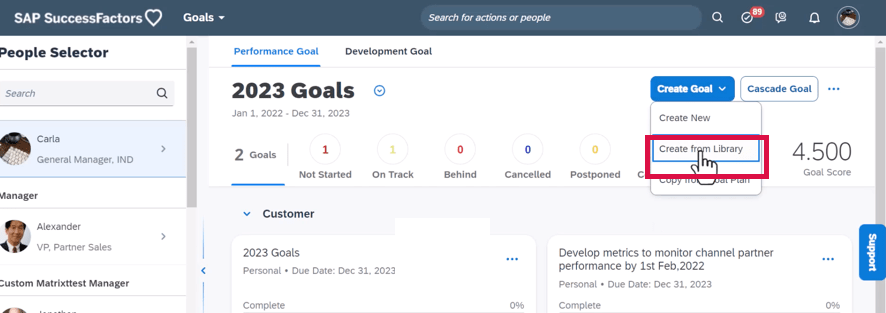
With proper permissions, when clicking the Create Goal button, the user can now select the “Create from Library” option.
Create Goals from Goal Library
A users can select up to 10 personal goals from a predefined goal library at once.
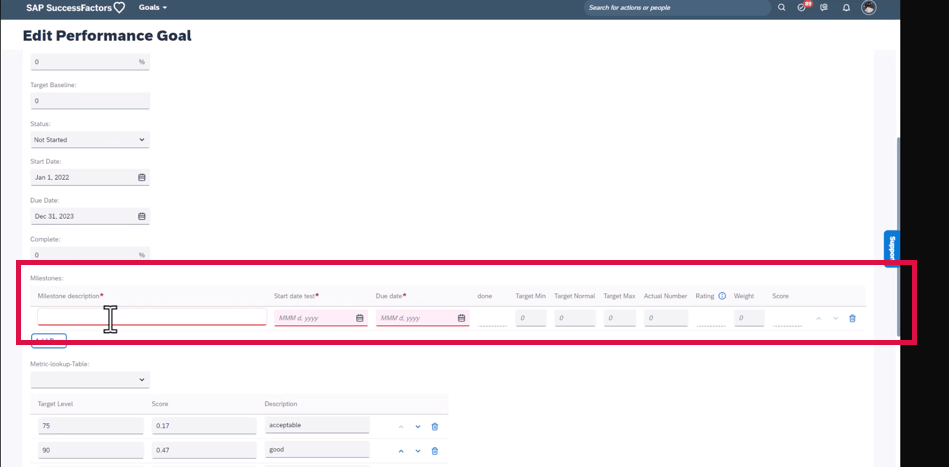
Manage Milestones for Goals
It is now possible to use milestones (sub-goals) on goal plans. Milestones can be used for personal and team goals.
Milestones on Goal Plans
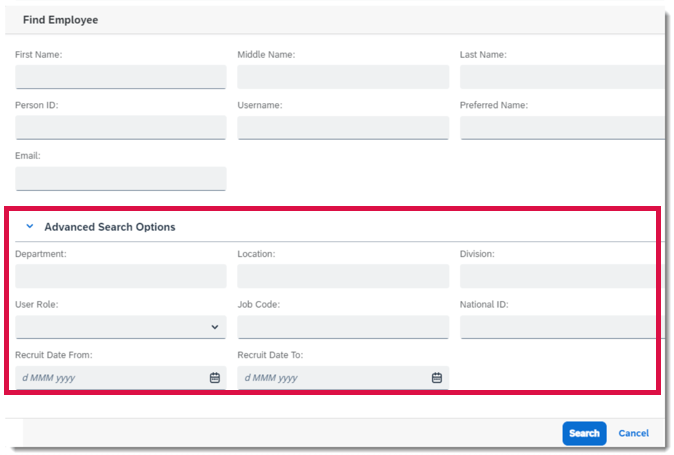
Use Advanced People Search to Assign or Cascade Goals using the latest Goal Management
When assigning a team goal or cascading a personal goal, the people search was limited to Name. Now an advanced people search is now available. The search now includes department, location, and division.
Advanced Search to Cascade Goals
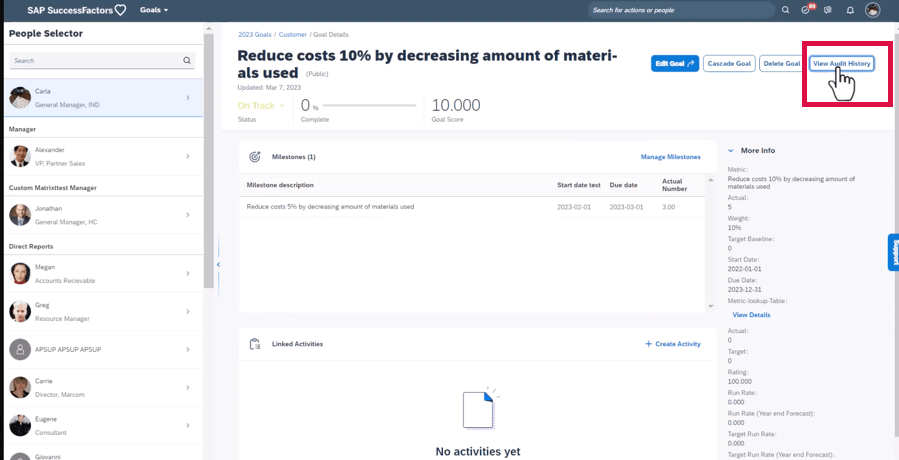
View Audit History for Goals
When read permission for goal fields is granted, users can now keep track of goal changes. Anytime a goal is created, copied, cascaded, assigned, modified, deleted, or replaced, an audit record is created.
Audit Goal History
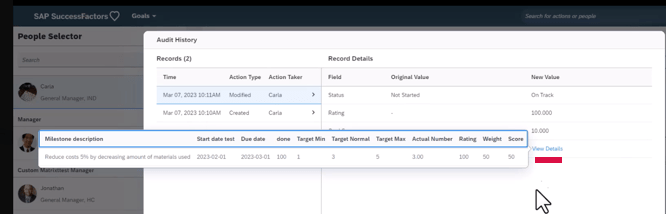
Users will be able to see a list of any changes were made. This includes identify who made the changes, and when. A before/after comparison for modified or replaced goals will display previous values and the new values for changed fields.
Details on Audit History
Comments, activities, and learning activities changes are not captured in the Audit History.
Use Legal Scan in the Latest Goal Management
The Legal Scan feature is now available and allows users to check whether their inputs for text and textarea goal fields are in compliance with legal requirements. Comment field are not included.
Dynamic Teams Integration with latest Goal Management
A new major feature integrates Dynamic Teams with Goal Management. This allows team members to link the their dynamic team’s objectives to their performance goals. Dynamic Teams has to be configured and the Enable Linking to Performance Goals setting turned on.
Team members identified as contributors to one key result (ORK) can link a dynamic team’s objective to personal goals.
Contributors may
Use the “display more actions” menu to open the Link to Goals side panel, where you can see linked goals or add a new one.
Use the ‘ Link to goals’ icon to open the Link Goals dialog to select a goal plan and the goals you to link to the objective.
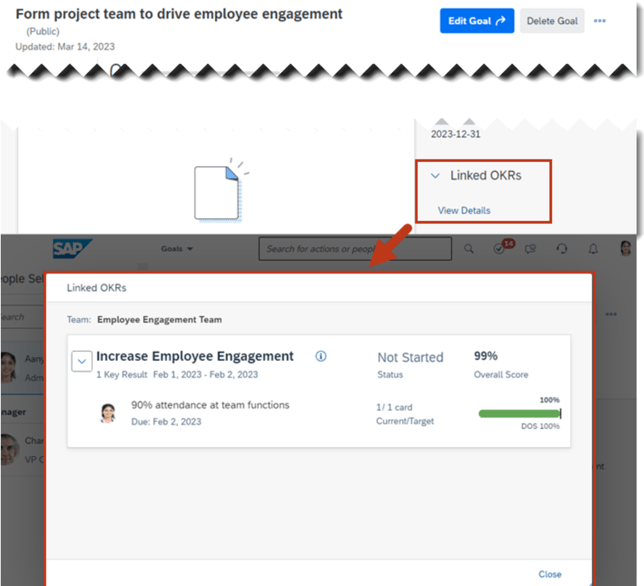
A Linked OKRs section in the goal details has an option to View Details about the linked OKRs in a dialog.
Linked OKRs in Goal Plan
Additional requirements to use this feature include:
Being a member of a dynamic team that has defined its objectives and key results.
Being as a contributor to at least one of the key results for the objective you want to link.
Have permission to view the goal plan that includes the goal you want to link the objective to.
Latest Goal Management Updates for iOS and Android Mobile Apps
Many of the capabilities in the latest Goal Management had not been available for mobile users. The latest release address many of these limitations:
Create Goals from a Goal Library in iOS and Android Mobile Apps
Copy Goals from Goal Plans in iOS and Android Mobile Apps
Leave Comments on Goals in iOS and Android Mobile Apps
Manage Milestones for Goals in iOS and Android Mobile Apps
Performance Management
Updates to performance forms are minimal. We will look at a few of these.
User Experience Enhancements to Performance Management Forms
There have been enhancements to the user experience for PM forms which we will discuss.
Goal Section Updates
In the goal section some enhancements have been made:
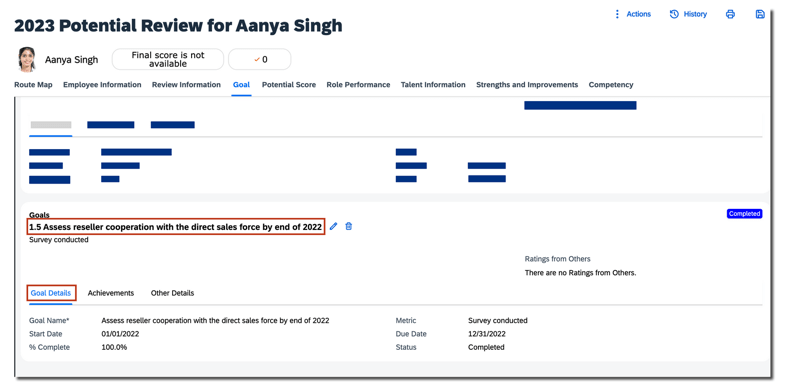
Goal Details tab now appears first among all available tabs for a goal. Previously, the first tab was Achievements.
The Goal Name is now in bold font.
Goals on performance form
Page Anchoring
Previously, when the PM form page refreshed, users were anchored to the top of the page. Now when users perform an action on the form page, they’re now anchored to the location where the action was performed.
Toast Messages
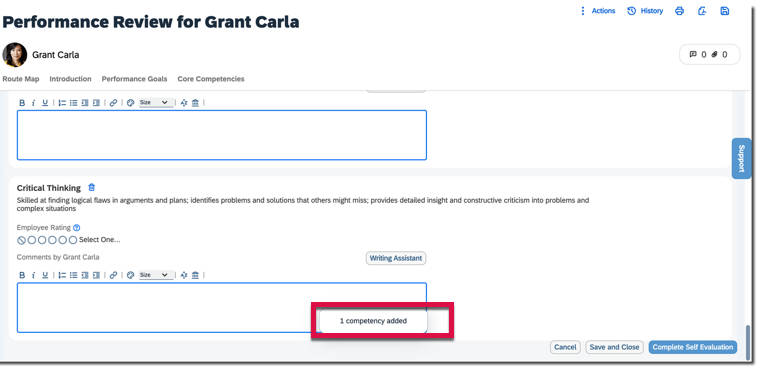
Toast Messages provide feedback to users about an action they have taken.
For example, adding or deleting a goal, competency, or learning activity on the form page, a toast message will display confirming the action was performed.
Toast Message
Automatically Fix Document Transfer and Change Engine Issues Caused by RBP Refresh Failures
The Document Transfer and Change Engine issues caused by a RBP refresh failures can now be fixed automatically on a daily basis.
To enable the automatic fixing, select Automatically Fix Document Transfer and Change Engine Issues under Admin Center Performance Management Feature Settings.
Continuous Performance Management
General Availability – Universal
Hide Prior Feedback from the New Manager That Was Requested or Given By the Former Manager
A major update for Employee Central (EC-enabled) instances allows the admin to automatically hide feedback from former managers in Continuous Performance Management (CPM).
Previously, when an employee inherits a new manager, or a manager provides feedback to the employee and leaves the company, the employee had the option to manually hide or delete that feedback from their new manager.
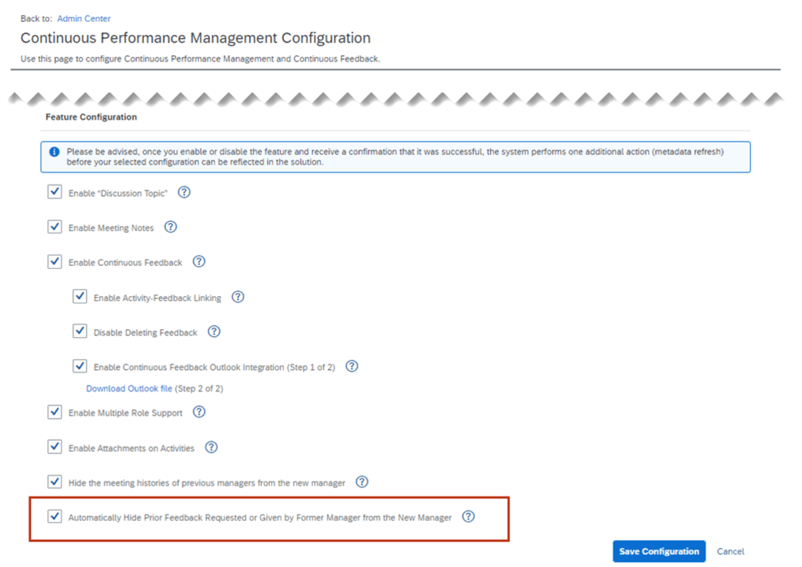
The feature automates the process of hiding feedback given or requested by the prior manager when a manager transfer occurs. The admin will now have the option on the CPM configuration page to automatically hide prior feedback requested.
CPM Configuration
Visibility of Edit and Delete Actions for Continuous Performance Goal Cards Based on User Permissions
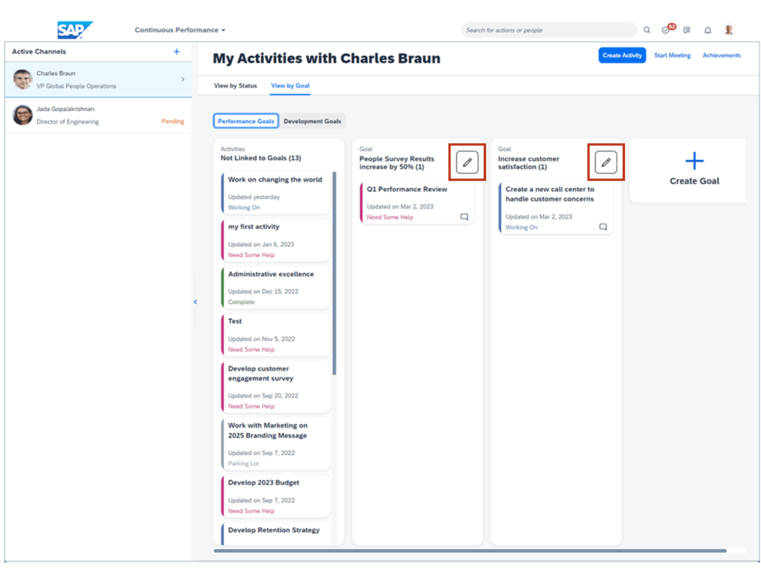
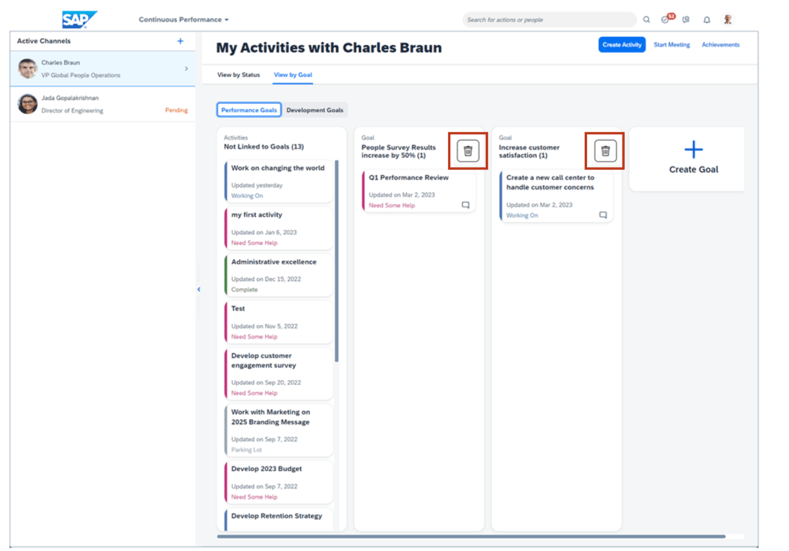
Continuous Performance Management goal actions are aligned with Goal Plan action permissions for Goal Management. Employees now have more control over their Performance Goals by creating, editing, or deleting directly in Continuous Performance Management (CPM). When integrated with Goal Management, changes to Performance Goals by the CPM user are reflected in the user’s Goal Plan.
The permissions for available actions on a goal in Continuous Performance Management experience respect Goal Plan configuration. In the previous version of CPM, users were shown both Edit and Delete options for goals. Now employees see actions for edit, delete or edit and delete for Goal cards based on their granted permissions.
There are three different access views of the Goal card: Edit, Delete, Edit and Delete. With this release, the user is only shown the options that they have permissions to use. Previously, Goal cards shown in My Activities view of Continuous Performance allowed all users access to edit or delete actions for the goal.
Now on the My Activities view with the employee’s permission to only edit goals, the Edit icon is what they will see on the Goal cards.
Edit Goals
When an employee’s permission only allows to delete a goal, the delete icon is the only action available on the Goal cards on the My Activities view.
Delete Goals
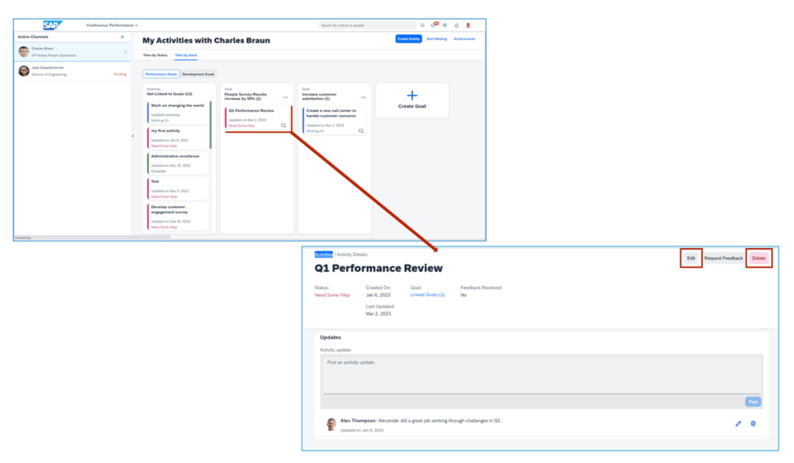
To modify an Activity linked to a Goal, select that Activity. This opens a new view with Activity Details. Separate Edit and Delete options are available for the selected Activity.
Activity Link to Goal
Use Continuous Feedback in the SAP SuccessFactors App in Microsoft Teams
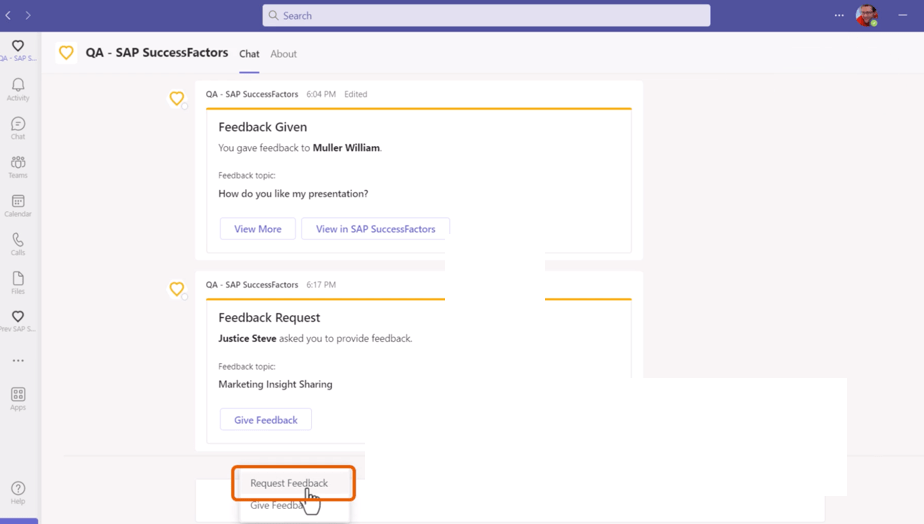
When SAP SuccessFactors and Microsoft 365 are integrated, a new feature enables allows Continuous Feedback of the latest Continuous Performance Management within Microsoft Teams.
Within Teams, users can enter the SAP SuccessFactors app from the app bar or the compose message area of any chat and perform these tasks:
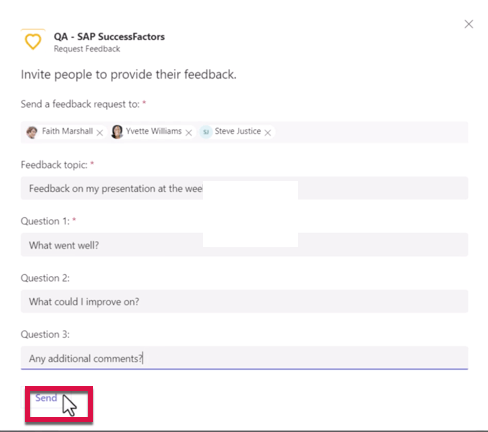
Request feedback: users can send a feedback request to others to ask for feedback on their performance at work
Give feedback: users who receive a feedback request can provide their feedback and send it back to the requester
Continuous Feedback from Microsoft Teams
Then find and select the person to collect feedback from. Fill in the questions to ask.
Questions for Feedback Provider
Receiver is then notified and can reply in the SF app.
Replacement of Continuous Performance Management Legacy Version with the Continuous Performance Management Latest Version
The legacy version of Continuous Performance Management (CPM) reached end of maintenance on May 20, 2022 and will be deleted as of May 24, 2024.
The replacement is the latest version of CPM is currently available in the Upgrade Center. If no action is taken, your company will be automatically upgraded to the latest version after the deletion date.General Availability – Admin Opt-Ins
Calibration
General Availability – Universal
New Filter Options in Calibration Session
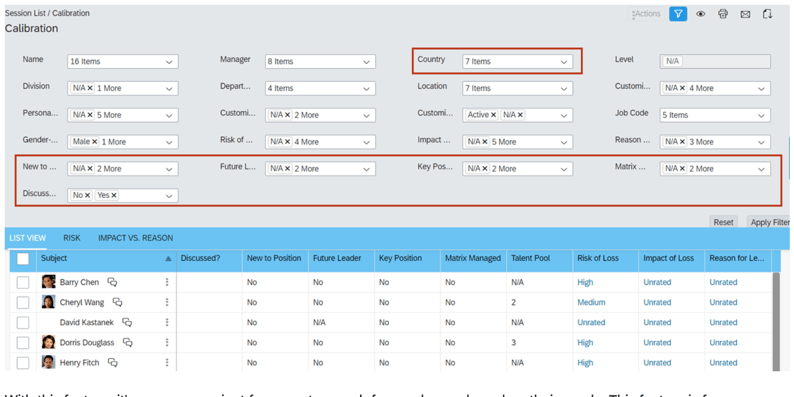
There are now six more filter options to narrow down employees to be displayed in a calibration session.
The new filter options are:
Discussed
Country
New to Position
Future Leader
Key Position,
Matrix Managed
Additional Filters for Calibration Session Employee Search
Discussed is predefined as a default filter. To use the other five filters, enable in Filter Fields from Admin Center >Manage Calibration Settings>Search and Filter Fields.
Calculated Performance Management Ratings Available in List View
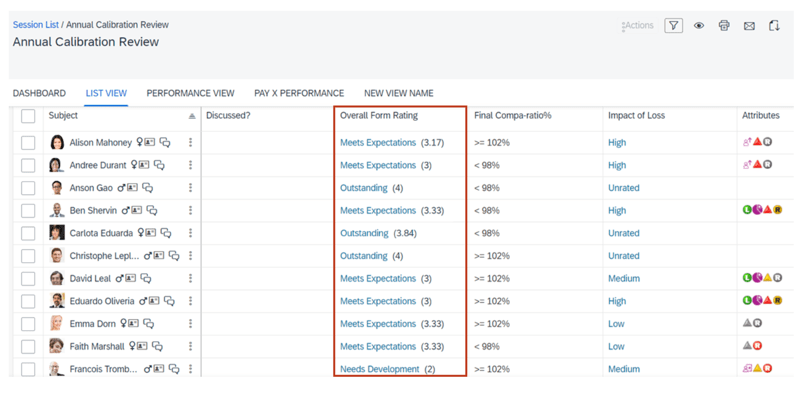
You can now view calculated ratings of employees for all performance rating elements in the List view of a calibration session.
By enabling the new admin option Show Calculated Rating from Performance Management in List View at Admin Center >Manage Calibration Templates>Views>List View, calculated ratings of employees can be shown in the List view.
When manual rating for performance elements are enabled, calculated ratings display in the same column as manual ratings. Previously, only manual ratings were shown for the rating element.
When calculated rating for performance elements is enabled, calculated ratings display in the same column as rating labels. Previously, calculated ratings were shown as rating labels defined in rating scales.
Calculated Ratings in Calibration List View
Improved Format of E-mail Notifications Regarding Calibration Rating Changes
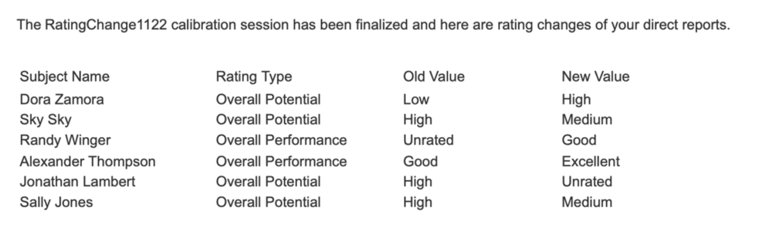
Next is a minor update generally available. Columns are left-aligned in e-mail notifications about rating changes in finalized calibration sessions. This update is easier to read. Previously the header and data were not aligned.
Updated Calibration Rating Changes Email
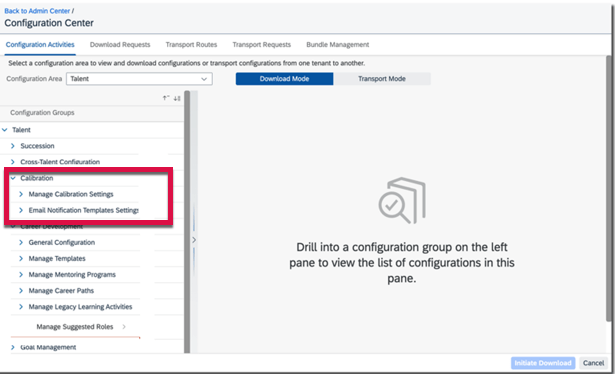
Calibration Configuration Available in Configuration Center
You can now view, download, and transport parts of Calibration configurations using Configuration Center.
Configuration Center
360 Reviews
There are very minor 360 Review updates. Highlights are described below.
Participants are now loaded on demand in the Evaluation Summary section of 360 Reviews forms.
Previously when a 360 form was opened, all participants were all loaded at once. In rare cases where a form had a great number of participants, there was potential to cause performance issues.
With the latest release, if a form has fewer than 100 participants, all the participants are loaded when the form is opened. If the form has more than 100 participants, the first 100 are loaded but users can scroll down to the bottom of the list to trigger further loading.
Deprecation of 360 Reviews v11 Version
The 360 Reviews v11 version will reach the end of maintenance on May 19, 2023 and will be deleted on November 17, 2023.
If you’re using 360 Reviews v11 Version, you should migrate to 360 Reviews – SAP Fiori Version.
For tips on how to manage a release, check out our blog here.
For your convenience, we’ve summarized the highlights of 1H 2023 minor visual enhancements for Performance Management and Career Development.
Visual Enhancements
There were several minor visual enhancements in this release. The visual enhancements for this release provide a more user friendly and consistent experience.
There are four types of changes:
Text changes (labels, error messages, or roll-over texts)
Iconography (new or changed icons)
Interaction pattern (new position of interaction, new order of list, new or changed buttons)
Styling (layout, spacing, or other design changes)
We will review some of the more notable visual enhancements for Performance Management, 360 Reviews, Continuous Performance Management, Calibration and Mentoring.
Performance Management
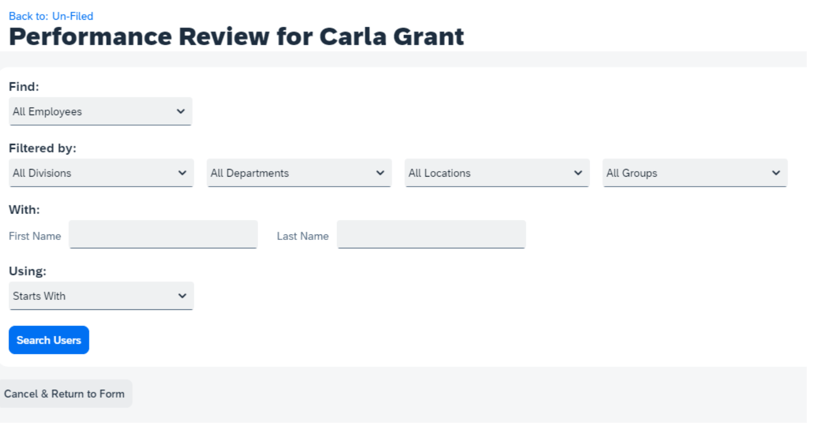
Search for users to send completed form to
Each set of filters is now below its category name
The Search Users button is below all the filters
Search Users
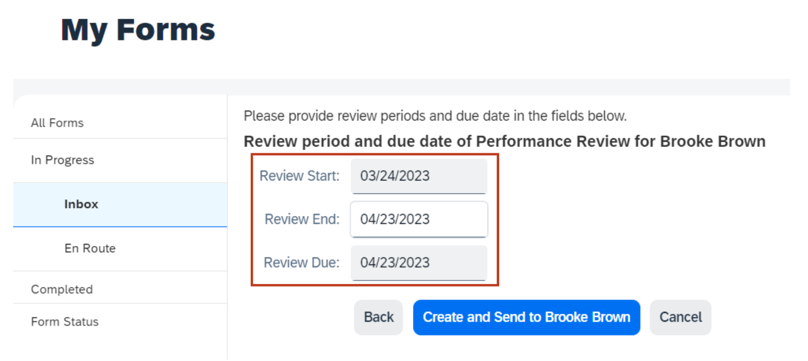
Create New Form from Performance Inbox
When launching a performance form from a user’s inbox, the date fields are now indented and right aligned.
Form Launch
Form Inbox Tooltips
In the Performance inbox, the tooltip for the icon in the Employee column is “View more information about <employee name>”,
Employee Info Tooltip
The tooltip for the icon in the Action column is “Add <form title> to Outlook”.
ActionTooltip
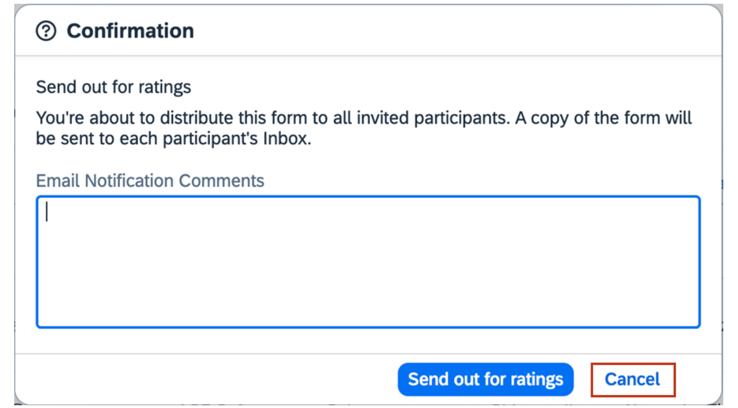
Cancel button placement updated
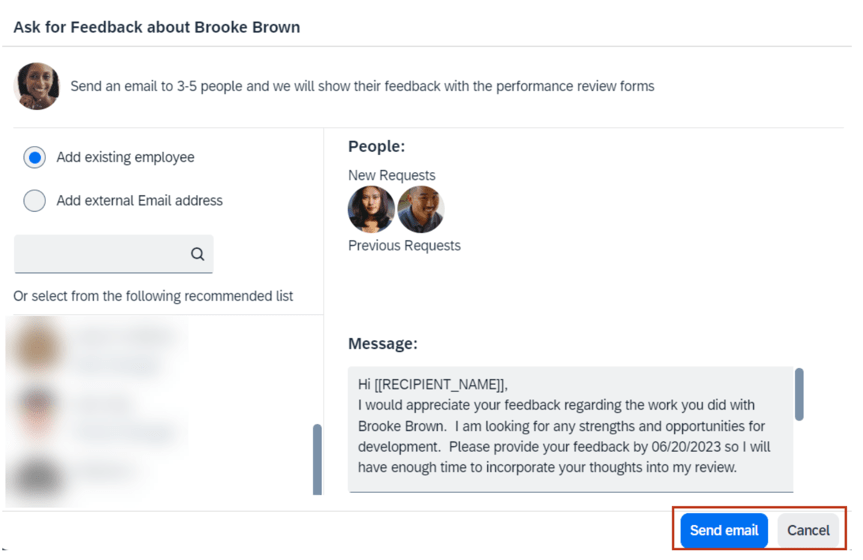
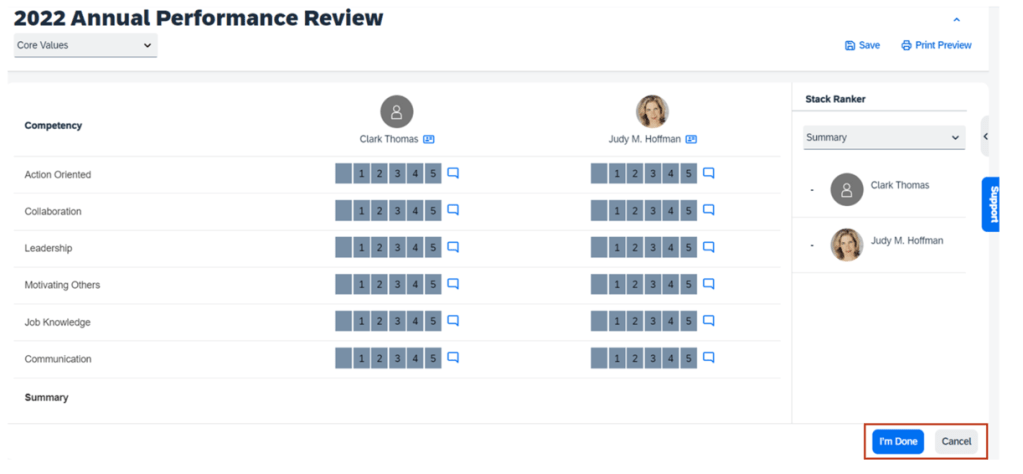
The button to cancel an action has been moved to the right.
This change applies to almost all user interfaces in Performance Management, including: Add Objectives from Objective Plans dialog, Send to Next Step page, Ask for Feedback dialog, Stack Ranker page, Comment dialog, Legal Scan dialog, and Print Setup dialog.
Here are some examples.
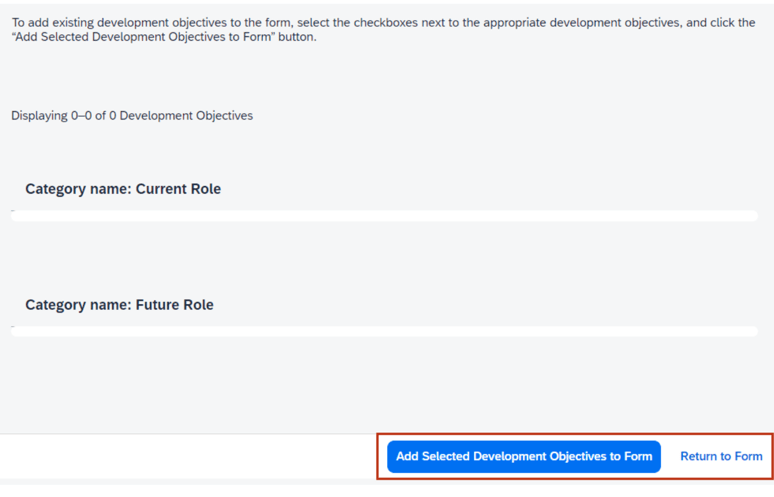
Adding objectives tot a PM form.
Return to Form button placement
Ask for Feedback dialog
Ask for Feedback Cancel button placement
Stack Ranker
Stack Ranker Cancel button placement
Goal in the goal section or Competency in the competency section
The first column header is Goal in the goal section orCompetencyin the competency section of a performance form. Previously Expand All and Collapse All were inthe first column table header
The Expand All and Collapse All options now appear in the top-left corner above the table
Goal section layout
360 Reviews
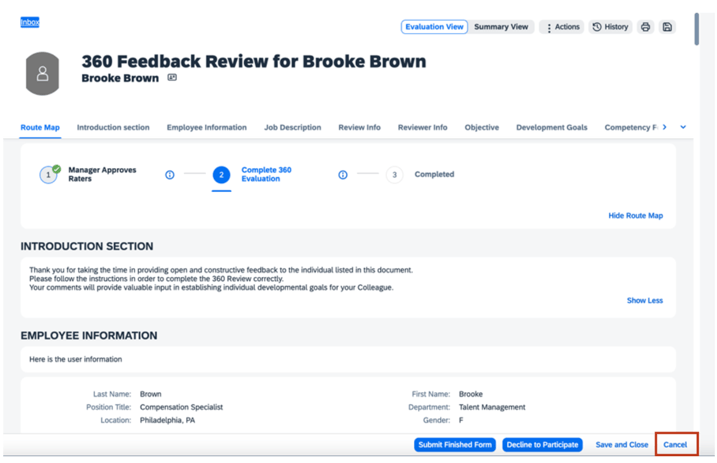
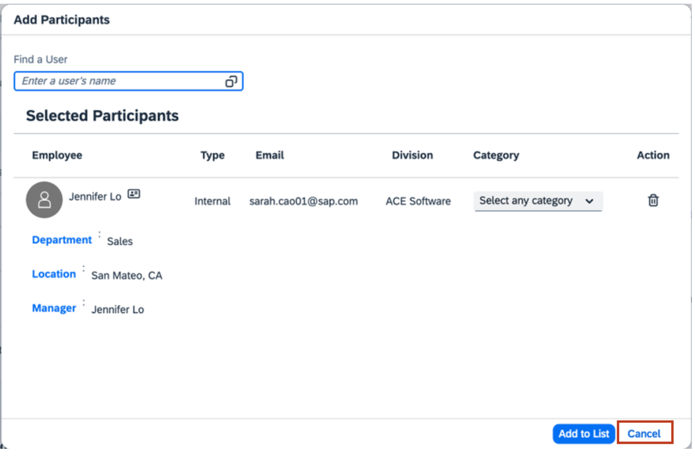
Cancel button placement updated for 360 Reviews
The Cancel button has been moved to the right for 360 Reviews.
Changes include opened 360 Reviews form, Goal Weights dialog, Add Participants dialog, Send Back dialog, Find Employee dialog, and Add Competencies dialog.
Here are some examples.
Canceling an opened 360 Reviews form
Cancel button placement on 360 Review
Canceling a participant search
Cancel confirmation to next step
Cancel button on Confirmation
Continuous Performance Management
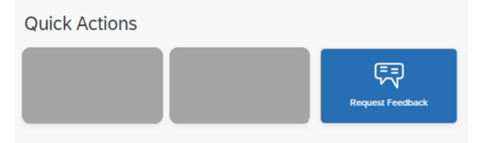
The icon for the Request Feedback on the latest home page has two intersecting talk balloons.
Request Feedback Quick Action
Previously the icon had talk balloons that included a question mark and an exclamation mark.
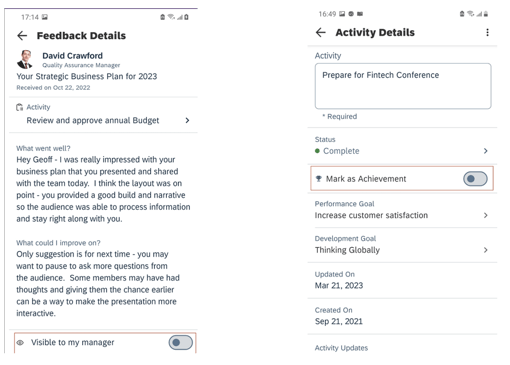
Achievements on Mobile Device
On the Android app, the Visible to my manager switch and the Mark as Achievement switch have wider tracks, and new color mappings.
Achievements on Android
Career Development – Mentoring
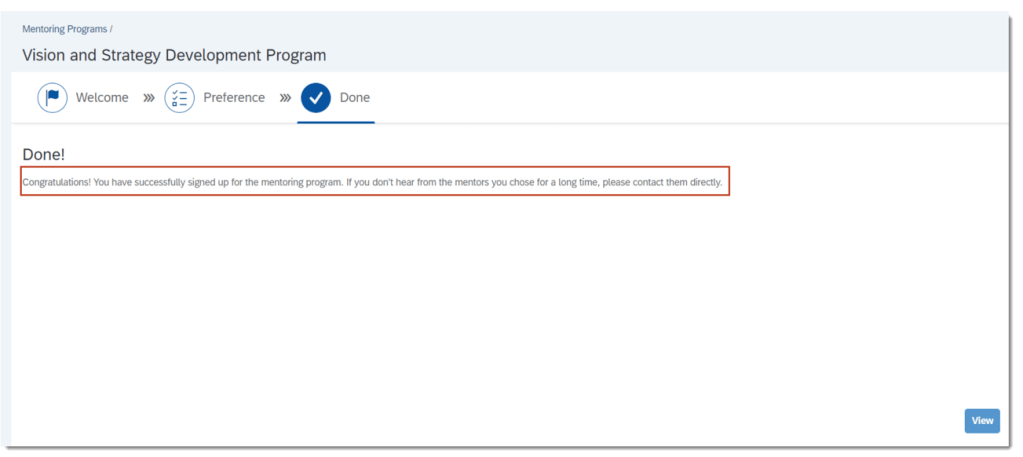
Successful Enrollment Message
When users sign up for an open enrollment or unsupervised program as a mentee there is a “success” message. The message has been enhanced to now include a reminder for the user that they can contact preferred mentors directly if they don’t hear from the mentors for an extended period of time.
Mentoring Enrollment Message
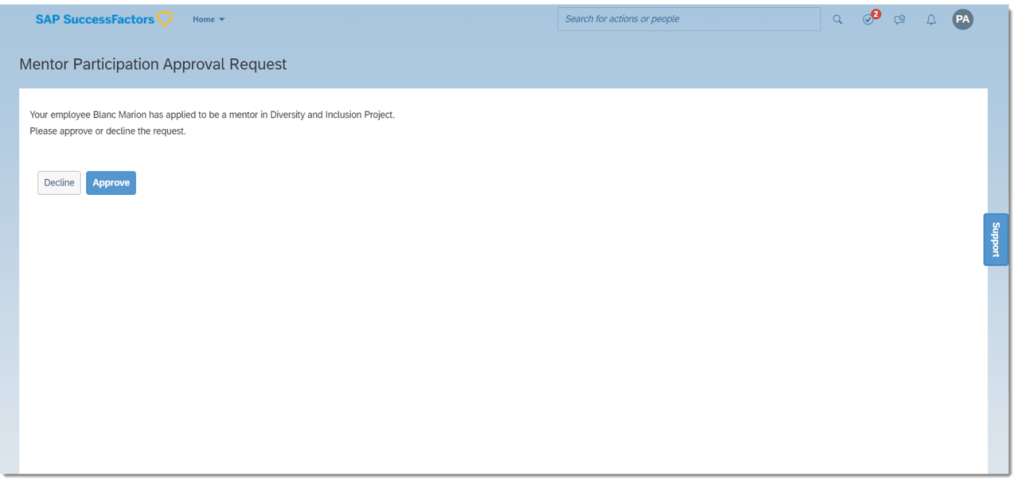
Mentor Participation Approval Request
The Mentor Participation Approval Requests have been updated.
The Approve and Decline buttons are now closer to the message text. The buttons used to be at the bottom of the page.
Mentor Participation Request
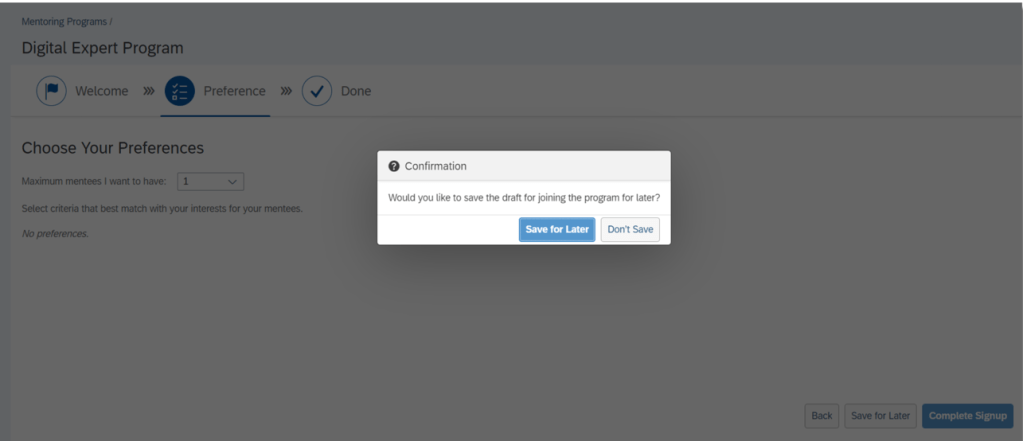
Confirmation for Joining Mentoring Program
When signing up for a mentoring program and a user decides to Save for Later, there is now a confirmation message pop up for them to confirm if they want to save the draft for joining the program for later.
























 Worklogix Blog