SAP SuccessFactors released its 2H 2025 Delta Update with the introduction of a fresh wave of innovations and improvements across Employee Central. This release has focused majorly on data quality, workflow flexibility, localization expansion, position management clarity, and document generation enhancements—in order to strengthen HR operations and elevate the experience for employees, managers, and HR administrators.
In this blog, we run through the most impactful enhancements from the Employee Central (EC) 2H 2025 Delta Release.
🔍 1. Position Management Enhancements
Position Management remains as one of the most enhanced area in the 2H 2025 release, with several new ability that improve accuracy in workforce planning.
⭐ Key Highlights
✔ Expanded fields in the “To Be Hired” status change use case
The following fields are now supported when changing a position to “To Be Hired”:
multipleIncumbentsAllowed
standardHours
incumbent
company
targetFTE
This gives admins more precise control and ensures alignment between job, position, and hiring processes.
✔ Improved synchronization between Position and Job Info
Data consistency is strengthened through better propagation and validation rules.
✔ Cleaner audit trails
Event tracking for position changes is more transparent, improving governance.
👤 2. Employee Data & Employment Information Improvements
The 2H 2025 release intensify HR data reliability with several backend and UI upgrades.
⭐ What’s New
More accurate validation frameworks across Personal & Global Information sections
Enhancements in Employment Information to support changing labour regulations
Refined error-handling messages to minimise admin rework
Smarter country-specific rules for identifiers, addresses, and eligibility fields
Together, these updates improves global HR master data accuracy.
⏱️ 3. Time Management Enhancements
Time Management continues to progress with performance improvements and richer rule-based automation.
⭐ Key Enhancements
Improved absence request validations across multiple countries
Faster loading of daily, weekly, and monthly timesheet views
Strengthened calculation logic for overtime, breaks, and premiums
Better work schedule and public holiday configuration capabilities
These changes improve payroll readiness and simplify the daily experience for time-dependent roles.
🌏 4. Localization & Compliance Updates
Localization continues to be a core pillar of SuccessFactors strategy, and the 2H 2025 release extends this further.
⭐ Updates Include
New statutory fields across multiple countries
Country-specific data formats, regulation updates, and identification rules
Localization improvements in hire, termination, and job event workflows
Improved document templates for certain regions
This makes sure global companies stay compliant without relying on custom development.
📄 5. Document Generation Enhancements
Document Generation receives remarkable upgrades in this release and is one of the most prominent improvements.
⭐ New Capabilities
Support for expanded dynamic placeholders
Enhanced stability and formatting control
Greater compatibility with multilingual templates
Optimized merge performance for large document batches
This is specifically useful for generating contracts, letters, onboarding packs, and compliance forms at scale.
The 2H 2025 release sharpens EC’s integration framework, ensuring ideal connectivity across SAP and non-SAP systems.
⭐ Improvements Include
More resilient OData APIs
Enhanced support for future-dated events
Better coordination with SAP HCM Payroll and SAP ERP
More descriptive integration error messages
The improved event-handling logic makes downstream systems more consistent and reduces integration failures.
🎨 7. User Experience (UX) Enhancements
A modern UI remains central to SuccessFactors’ roadmap. This release introduces indefinite but impactful improvements.
⭐ UX Refinements
Clearer field grouping and section headers
Streamlined workflows with simplified approval screens
Better mobile responsiveness
Faster portlet rendering performance
These improvements provide a cleaner, more available experience for all users.
📌 Summary – Why the 2H 2025 Release Matters
The SAP SuccessFactors Employee Central 2H 2025 Delta Release is designed to help organizations:
✔ Intensify data quality and governance ✔ Enhance hiring alignment with enhanced Position Management ✔ Elevate efficiency through Time Management improvements ✔ Stay globally pilable with localization updates ✔ Deliver documents faster and with greater precision ✔ Achieve seemless system integrations ✔ Improve employee and HR admin experience
This release is not just an incremental update—it’s a strategic step toward a more rationalized and future-ready HR core system.
For tips on how to manage a release, check out our blog here.
Of major note, Profile Preview and Spotlight are now universally available as part of the latest People Profile experience. They are now standard without any opt-ins needed providing the latest People Profile is enabled.
Keep reading to discover more of what is now available.
Enhancements to Profile Preview and Spotlight of the Latest People Profile
Updates to the Home Page Experience
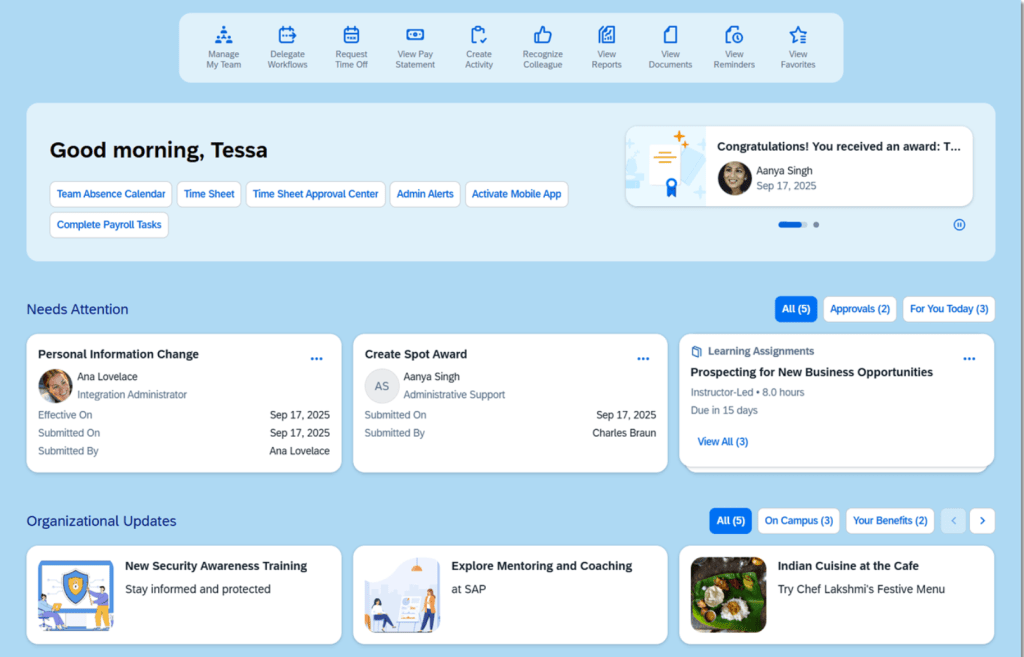
The Home Page has been enhanced with better use of space, less scrolling, with a consolidated list of tasks. There are new options, such as banner cards,analytic cards and personalization settings. There is improved design of custom content.
New Home Page
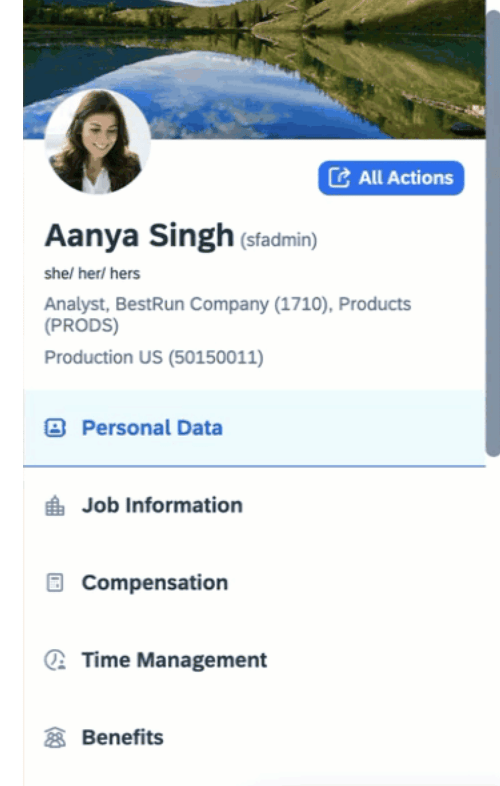
Profile Header Updated
The category list has been updated and the profile header automatically collapses as you scrolled down the categories
Header Collapsed and Pinned
Only the employee’s photo, display name, login name, and job title remain visible at the top of the page when the categories are collapsed,
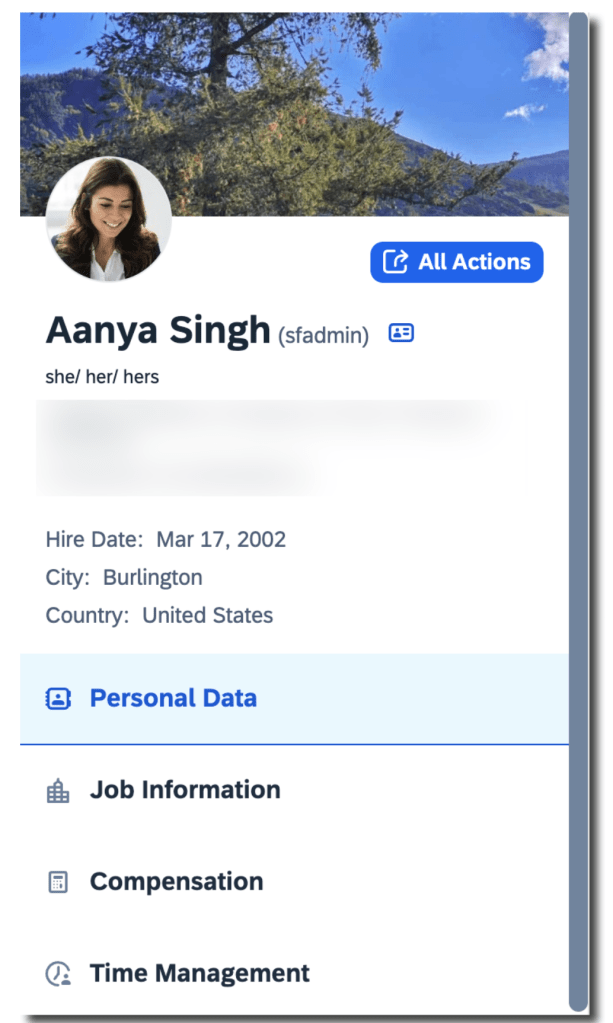
Three Additional Fields May be Added to the Profile Header
It is now possible to add 3 fields in the header of the full profile, such as gender pronouns, or alternate name. These additional fields will be read-only. The fields to select from are the same as those available for the Employee Information card in Full Profile.
Additional Fields Added to Profile Header
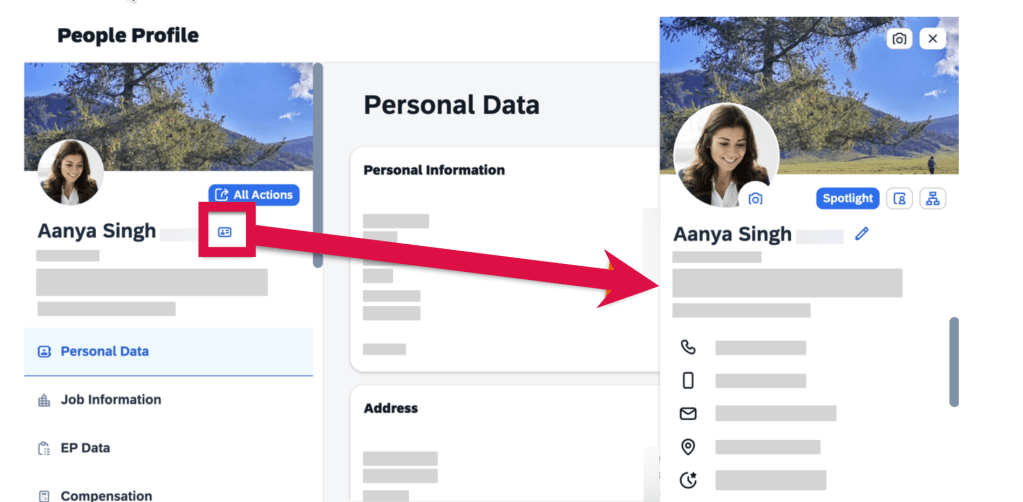
Quick Access to Profile Preview
To easily get to the Profile Preview from the Full Profile page or any card’s details page, click the “Show employee details” icon next to the user name.
Access to Profile Preview using Icon
Upload Background Images
Employees may upload their own background images, not just from the image library.
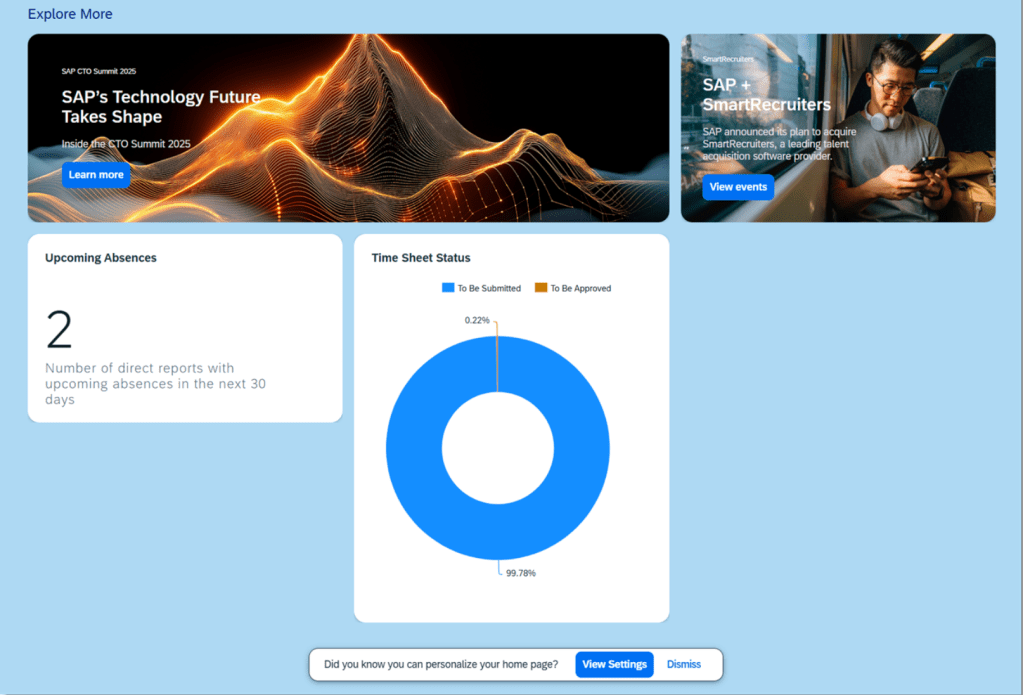
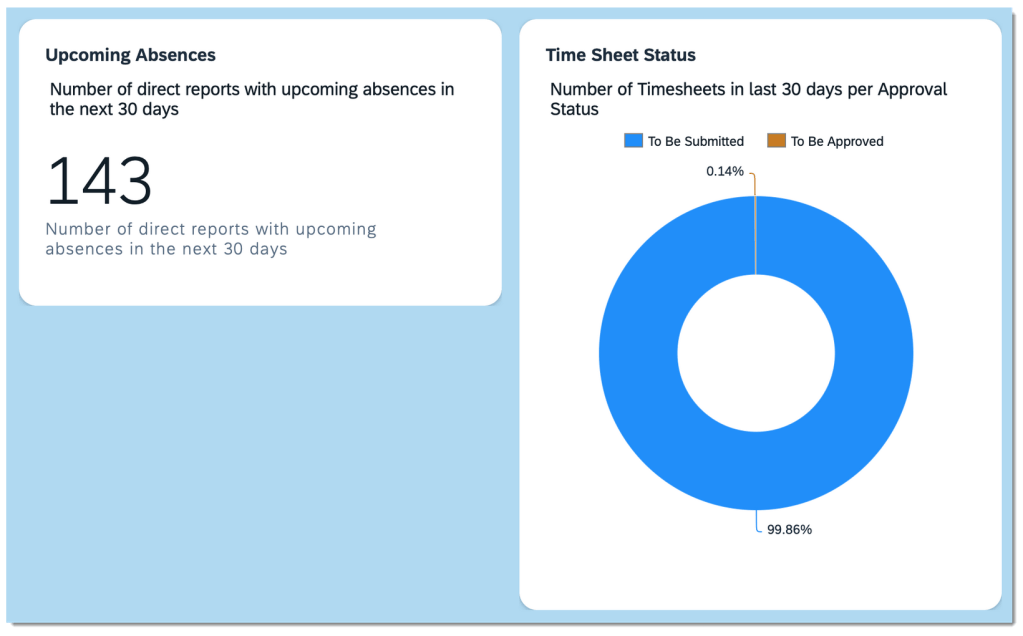
Analytic Cards on the Home Page
There are now 2 analytic cards available that may be displayed on the Home Page: Upcoming Absences and Time Sheet Status. These display charts may be enabled and would appear in the Explore More section on the latest home page.
Analytic Cards on the Home Page
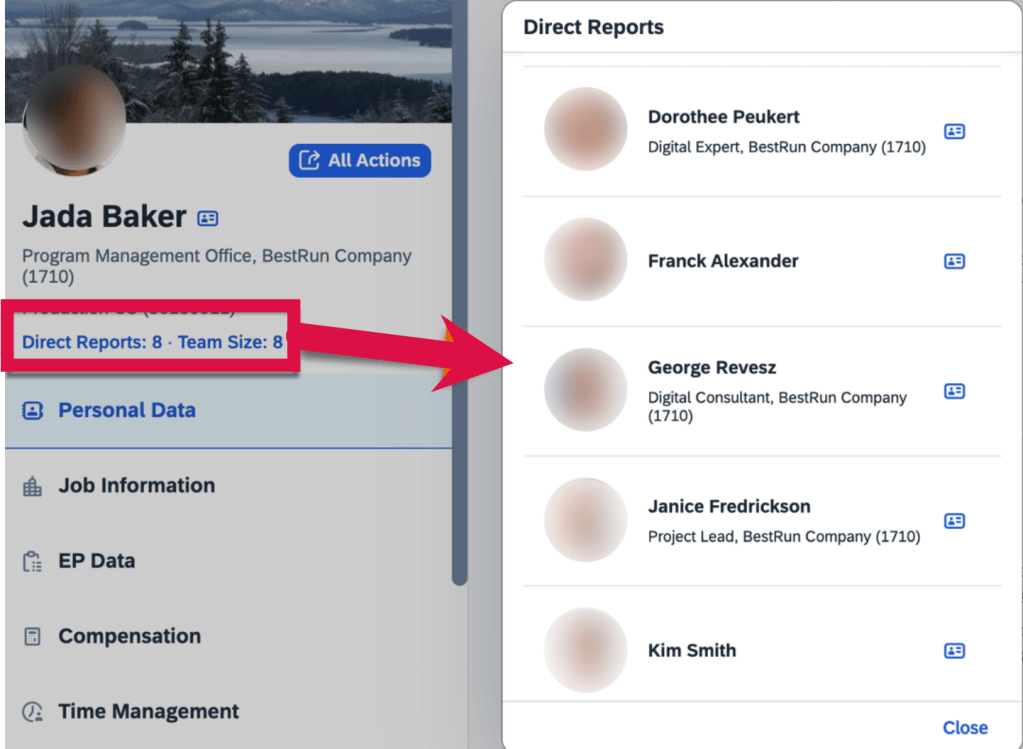
Manager’s Full Profile Contains Direct Report Count and Team Size
Direct reports view include photos, names and titles.
Manager’s Full Profile View with Direct Reports and Team Size
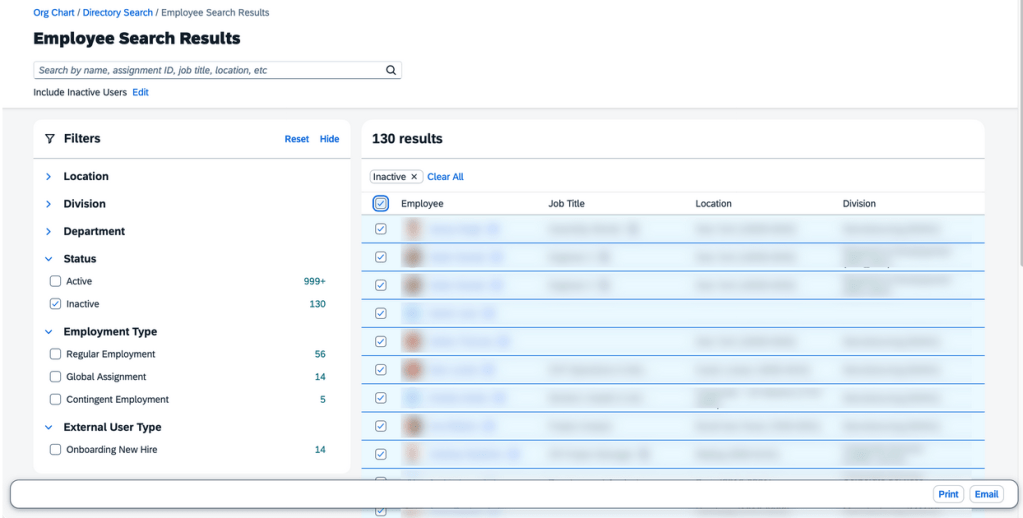
Advanced People Search
Enhanced People Search features now apply to the global header and Directory Search. The experience includes facets, filters and more searchable fields.
The Global Header People Search uses the enhanced Autocomplete Search.
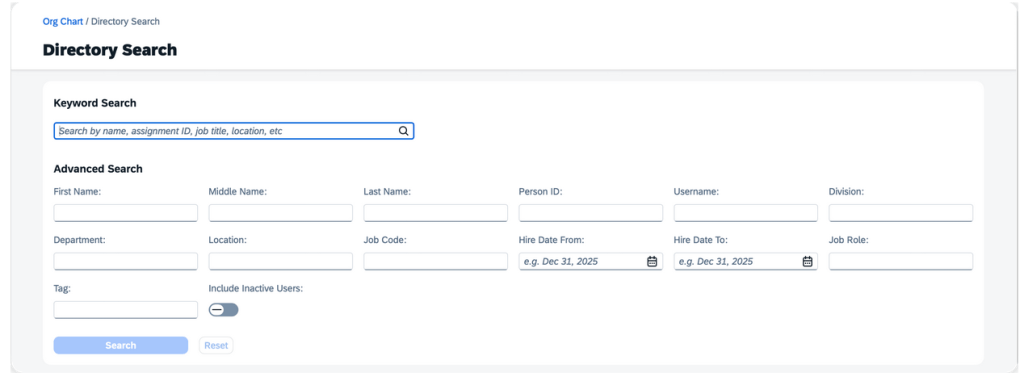
Directory Search incorporates the enhanced Advanced Search, allowing users to search for employees with specific criteria.
Directory Search
On the search criteria page, users can search for employees using keywords like name, assignment ID, job title, and location. Alternatively, they can use the search widget for more advanced search criteria.
User Search
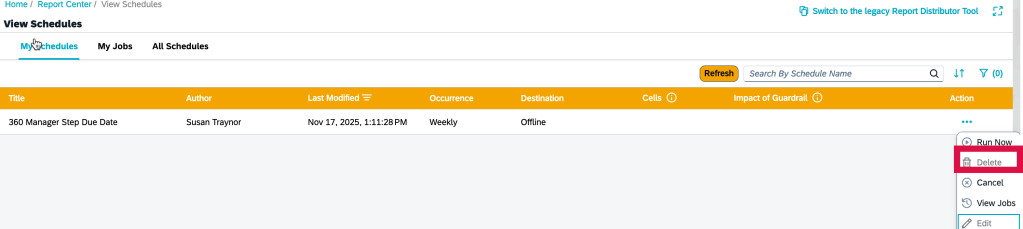
Option to Delete Scheduled Job on My Jobs Page
Scheduled jobs for all report types, except Canvas reports, can be deleted directly from the My Jobs page. Simply choose the ellipses button under the “Action” column and then select “Delete”.
Delete Scheduled Job
Visual Changes Across the Platform
Throughout the system there are text, icon and label changes. Here are just a few of the updates.
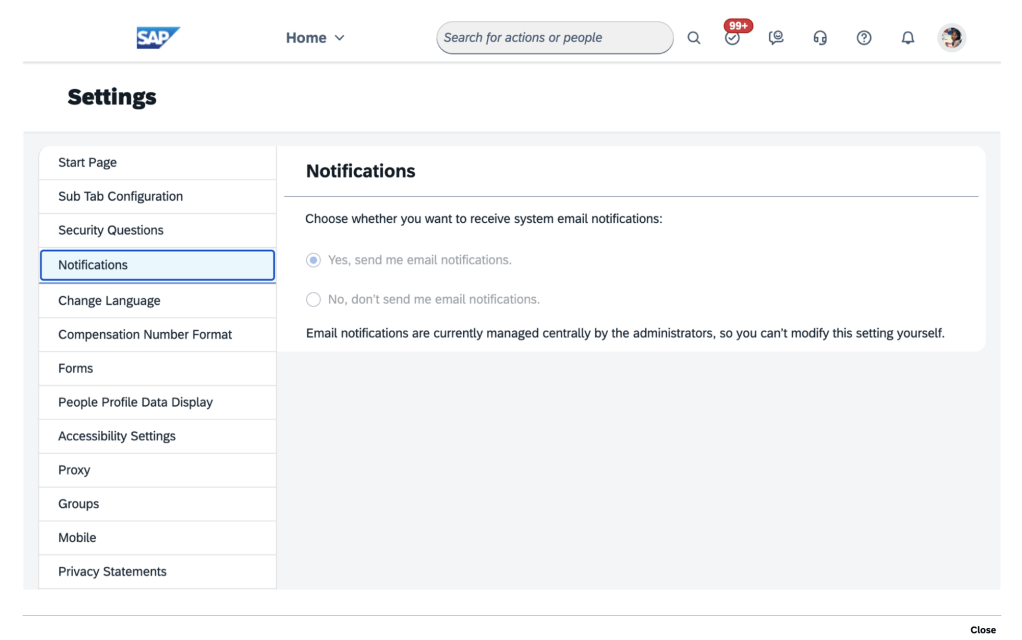
More clear label for admin Settings page to identify when using system email notifications
System Email Notifications
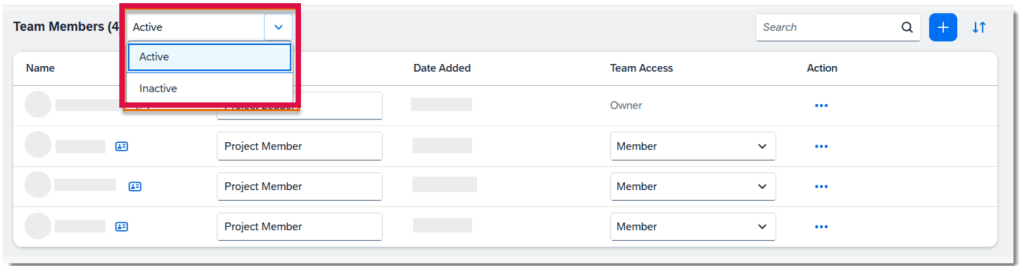
Team Members can be displayed for Active or Inactive employees
Team Member Selection
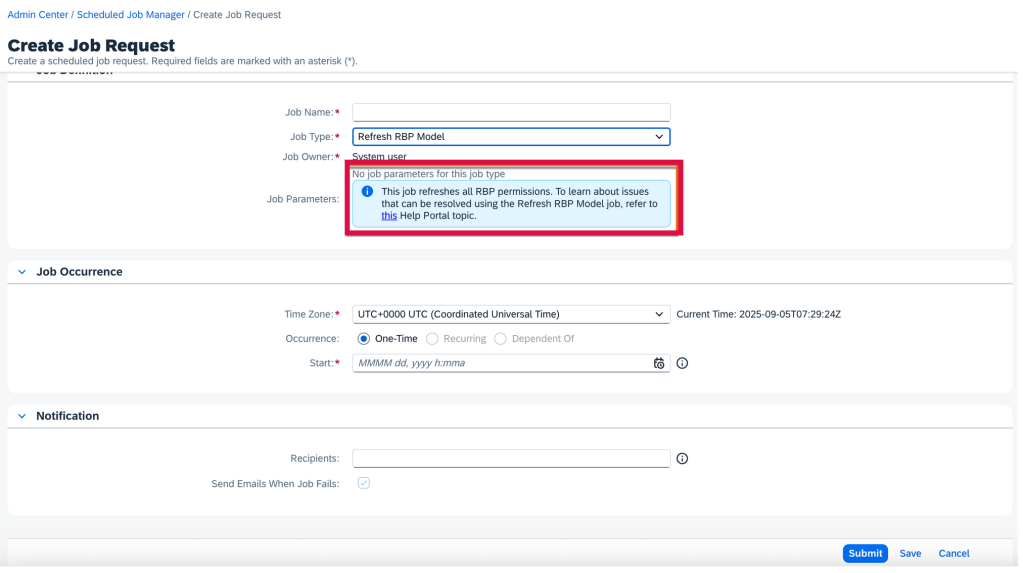
Creating a Refresh RBP Model job request now has helpful information that this job will refresh all RBP permissions
Job Request Information
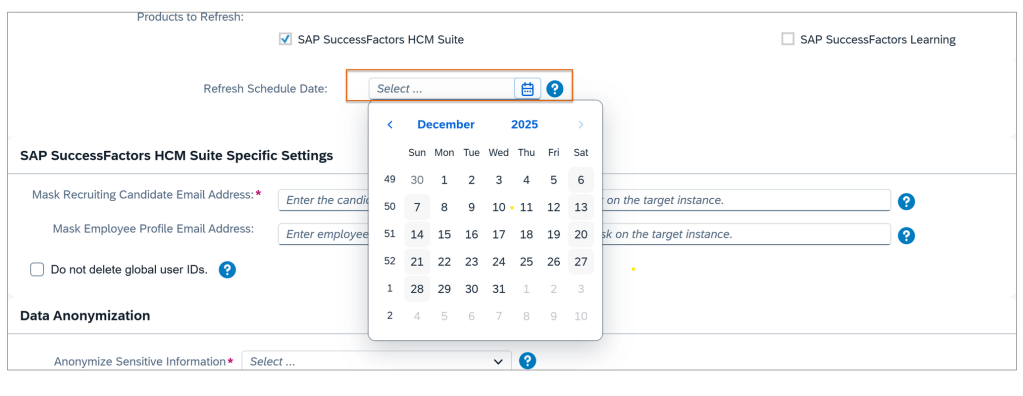
Using the Instance Refresh Tool, the instance refresh can now only be scheduled 3 months in advance, down from 6 months
System Refresh 3 Months in Advance
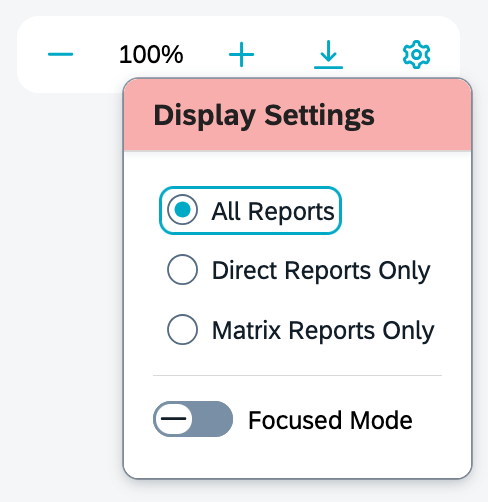
When viewing the Org Chart, the gear icon pop up now is labeled “Display Settings“. Previously it was labeled “Display Options“
New Label for Gear Icon
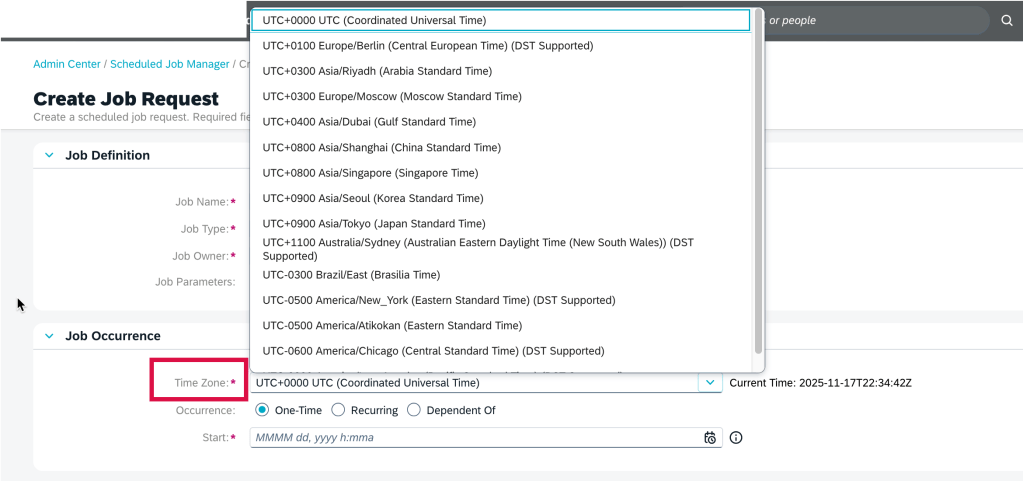
Scheduled Job Manager Supports Time Zones
A time zone may be selected when creating a job request in the Scheduled Job Manager admin tool. A new field, Time Zone, has been added to the Job Occurrence section on the Create Job Request page.
Time Zone Selection when Scheduling Job
New Deeplink Parameters for Full Profile Navigation
There are more parameters in deep links to directly access the Full Profile cards.
cardId=<card Id>: link to go directly to a card’s detail page
mdfObjectType=<custom MDF object type, to access a custom MDF object card
backgroundElementId=<custom Background Element Id>to go to a Background Information card’s details page
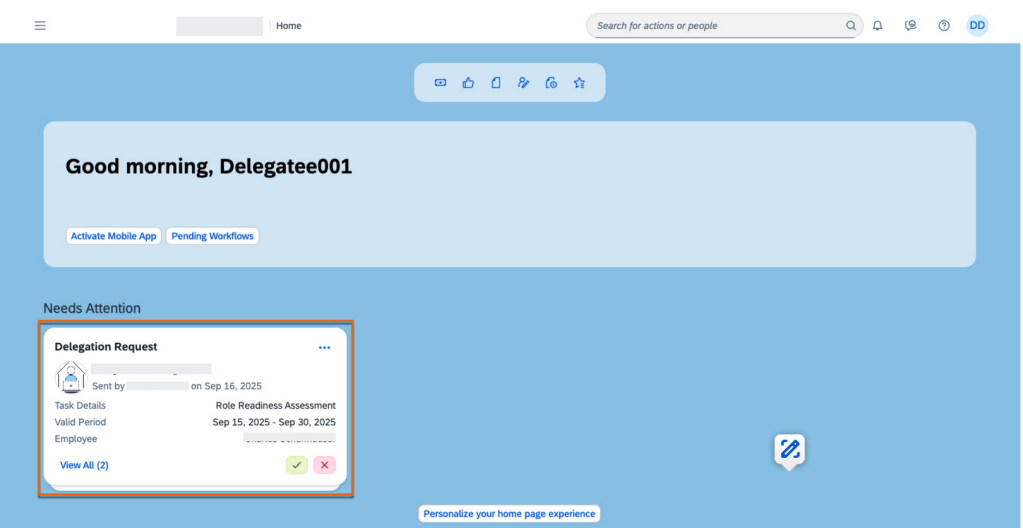
Delegation Request Card on Home Page
When using the latest home page experience, delegatees can now manage delegation requests directly from the Home Page with a new to-do card feature.
Delegation Requests on Home Page
The Delegation Request card contains details of the delegation request, including the delegator’s profile picture, the name of the performance form, the valid period of the task, and the employee’s name whose form needs review. A request can be accepted or rejected directly from the card.
To learn more and get more details about the updates, see the full set of documentation in the What’s New Viewer here.
For tips on how to manage a release, check out our blog here.
Check out what’s new for Career Development.
Enhancements to the Employee View in the latest Career Worksheet
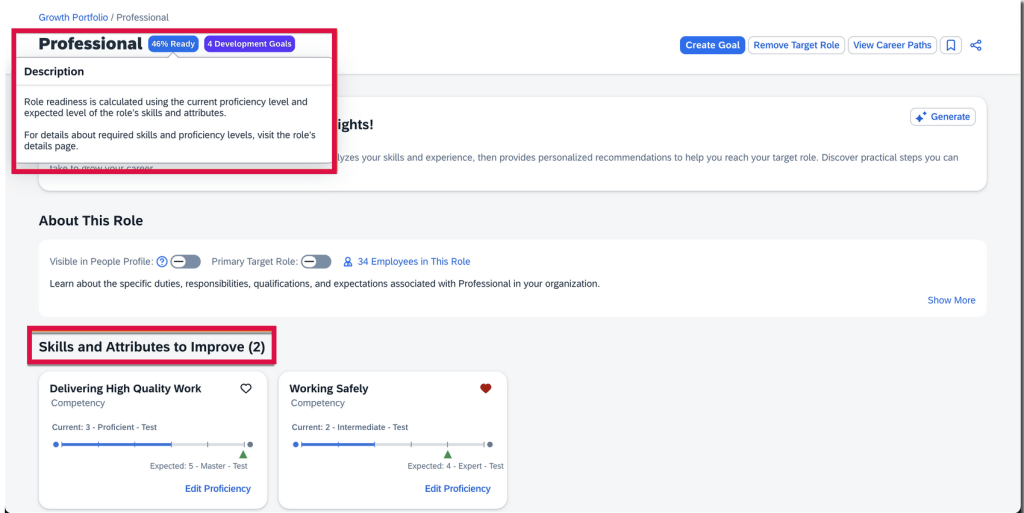
Employees will see more information on the Role Details page when using the latest Career Worksheet.
Highlights include:
The titles for the Skills and Attributes to Improve and Skills and Attributes You Have sections now include counts
The explanation of how role readiness is calculated displays when selecting the role readiness of a target role
Employee View of Role Readiness
Enhancements to Manager View in Latest Career Worksheet
Managers can also enjoy an enhanced experience when using the latest Career Worksheet.
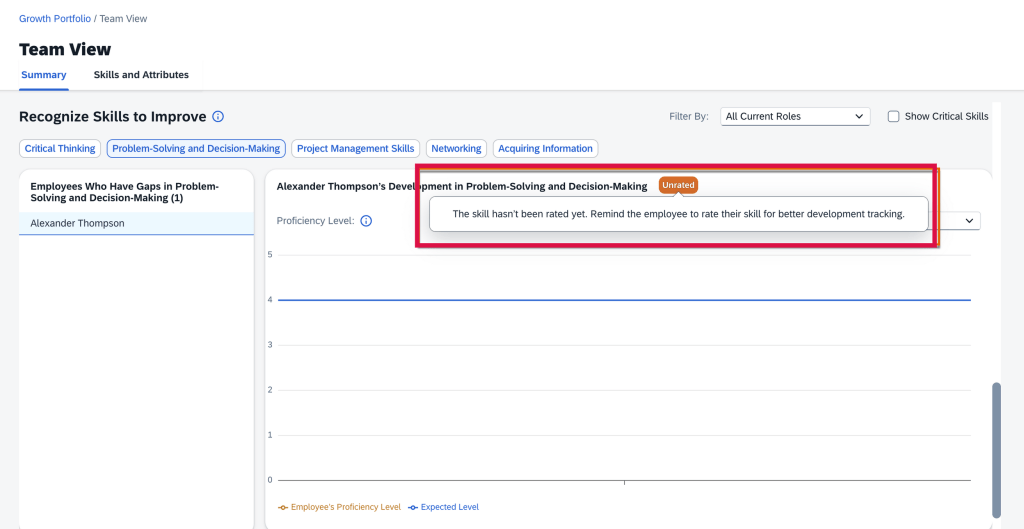
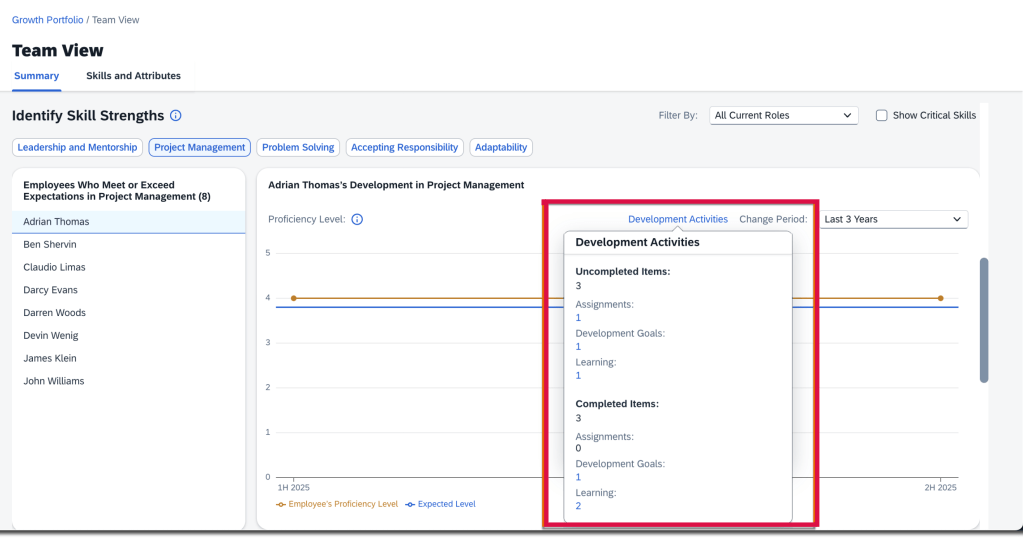
On the Summary tab of the Team View page in Growth Portfolio, managers have better visibility into employees’ career development, including:
View employees’ unrated skills and attributes
Unrated Skills and Attributes
View employees’ development activities linked to specific skills and attributes
Development Activities linked to Skills and Attributes
View their team’s target roles when granted the private-access permission in the Career Worksheet template.
Option to Disable Legacy Career Worksheet
Once the latest Career Worksheet is enabled, the legacy version may be disabled. Please note, when the legacy version is disabled, the Career Worksheet tab isn’t available in the Development module. If you aren’t using Career Path, Career Explorer or Mentoring, the Development module will not be available in the main navigation menu.
View Development Goals in Latest Career Worksheet
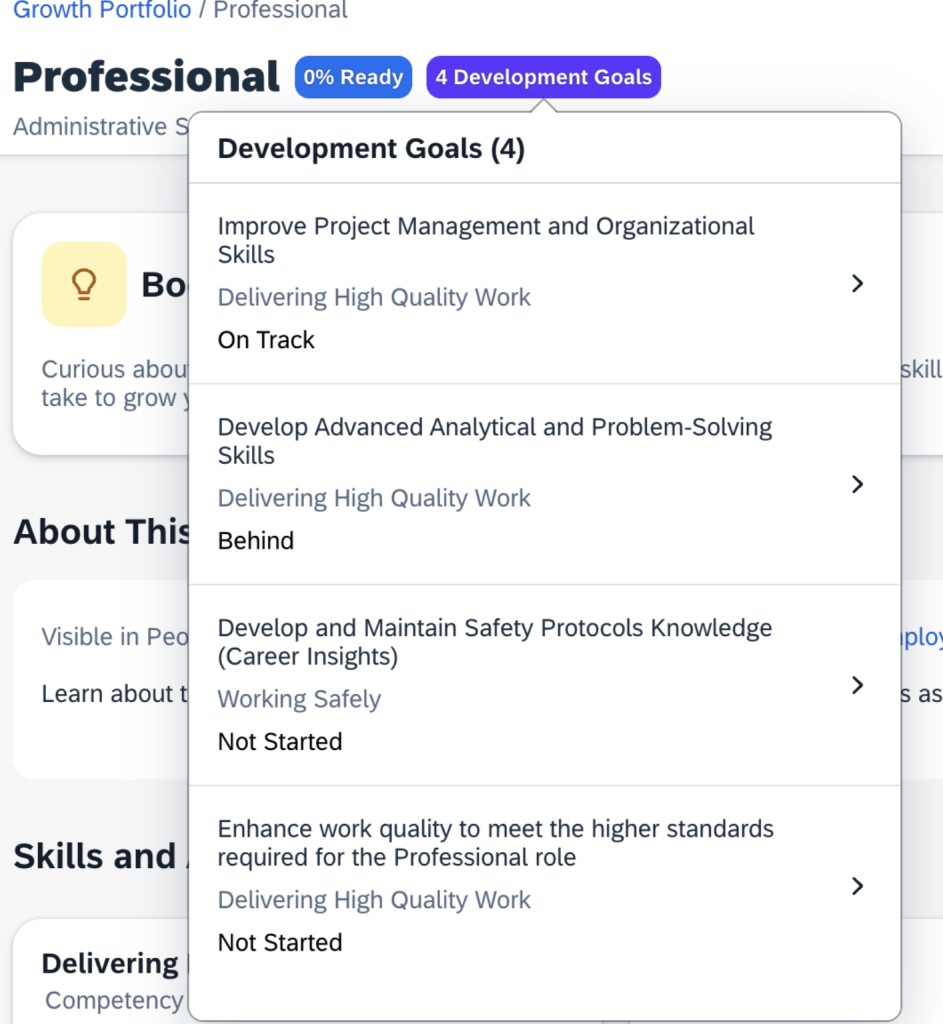
Development goals now appear on a role’s details page in the latest Career Worksheet. However, only development goals from the default development goal plan that have skills or attributes associated with the selected role will be displayed.
The Goal name, associated skills or attributes, and status for each development goal display.
Development Goals on Role Details page
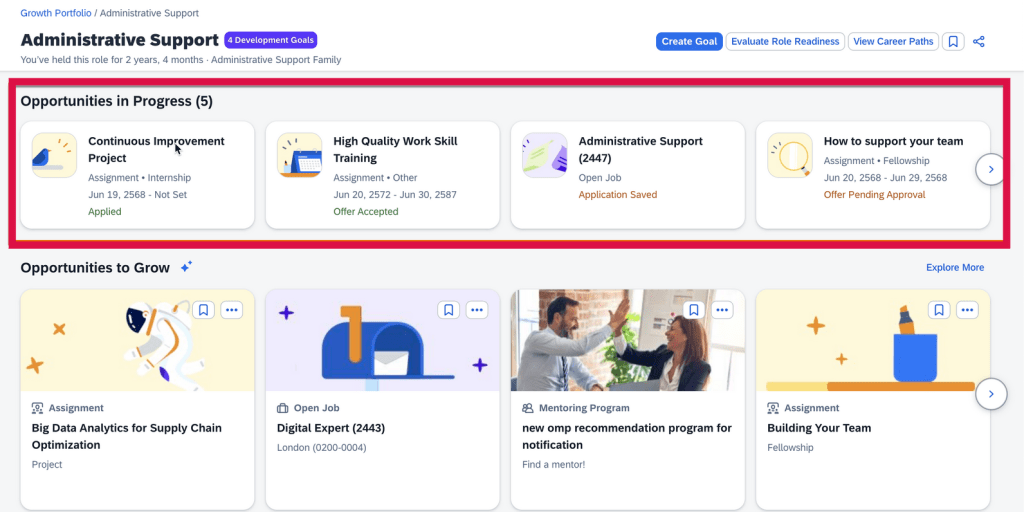
View In-Progress Opportunities in Latest Career Worksheet
Actions and progress that users have made in developing their current or target roles will be viewable.
These in-progress opportunities with skills or attributes associated with the selected role appear in the Opportunities in Progress section. Once an opportunity card is selected, the user is directed to its details page.
In-progress opportunities on role detail page
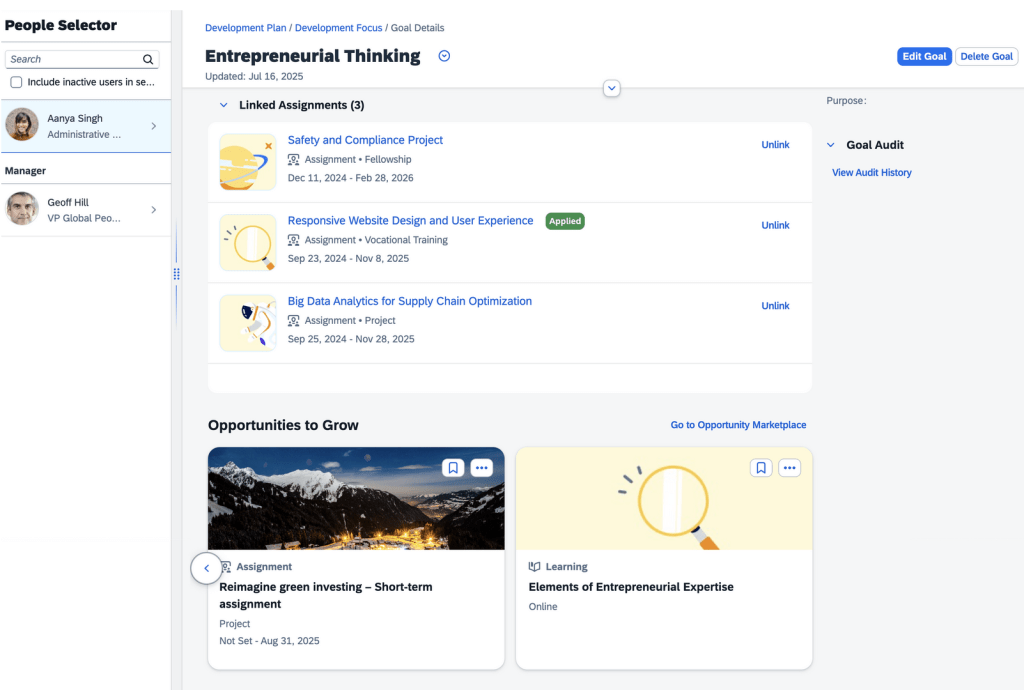
View Recommended Assignments and Learning Opportunities for Development Goals
The assignments and learning opportunities that match skills and attributes selected for a user’s development goals are now viewable. Users can also link assignments of interest to their development goals.
This feature is available on a user’s own goal details page.
Users can view learning activities not linked to development goals. These activities and learning opportunities can be be added/linked through the Linked Learning section on the goal details page. Assignments then appear in the Linked Assignments section.
Users can bookmark recommended assignments and learning opportunities.
Linked Assignments
Features Now Available with AI units license
With the purchase of the AI units license, there are some additional features available.
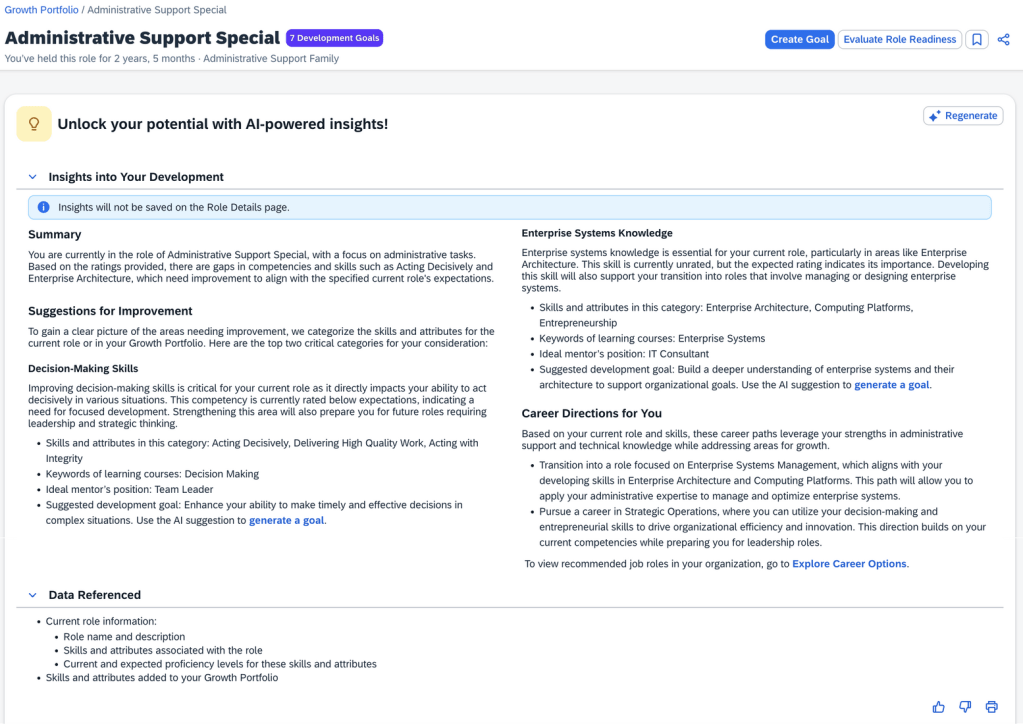
AI-Assisted Career Insights for Current Role
Previously available for target roles only, now employees can gain insights into development actions that help them progress in their current role.
There is a new Unlock your potential with AI-powered insights! section on a current role’s details page which includes:
Role name and description
Skills and attributes associated with the role
Current and expected proficiency levels for these skills and attributes
Skills and attributes added to the employee’s Growth Portfolio
AI Career Insights
The insights are grouped into sections:
Summary which is a high-level overview of the employee’s current role
Suggestions for Improvement which identifies two growth areas for upskilling and career development with achievable suggestions for skills and attributes in the category, learning courses keywords, ideal mentor’s position, suggested development goal
Career Directions which are tailored career paths with a link to view recommended job roles
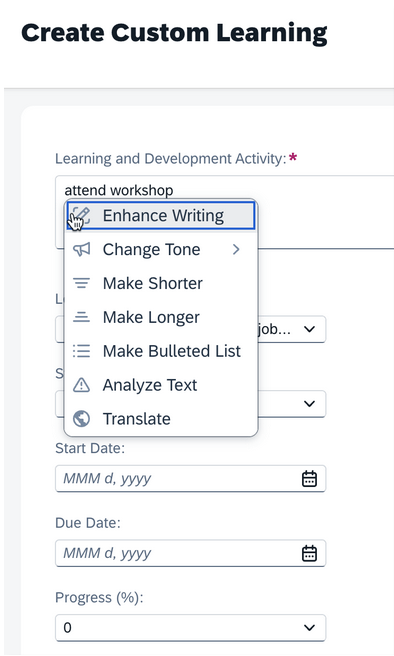
AI-Assisted Writing Available in Custom Learning Activities
Text and Textarea fields for custom learning activities now have AI-assisted writing available.
AI-Assisted Writing
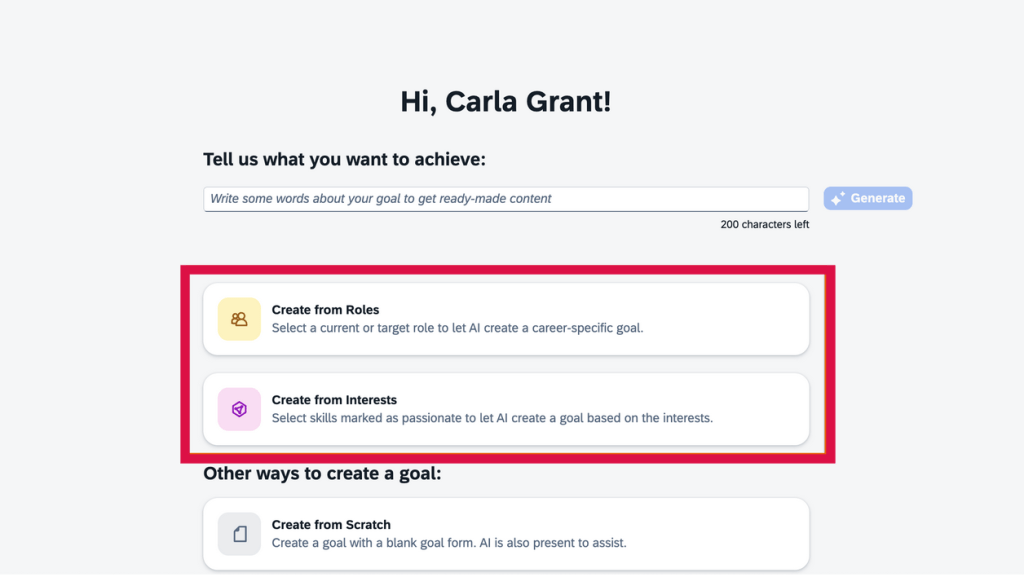
Create Development Goals with AI Based on Roles and Interests
Using AI, users can create personalized goals aligning with specific career roles or skill interests. With the AI-assisted goal creation feature enabled, AI can be used to create development goals based on a current role, target role, or skills and attributes.
Create goals from roles
Create goals from interests
New personalized goal creation options using AI
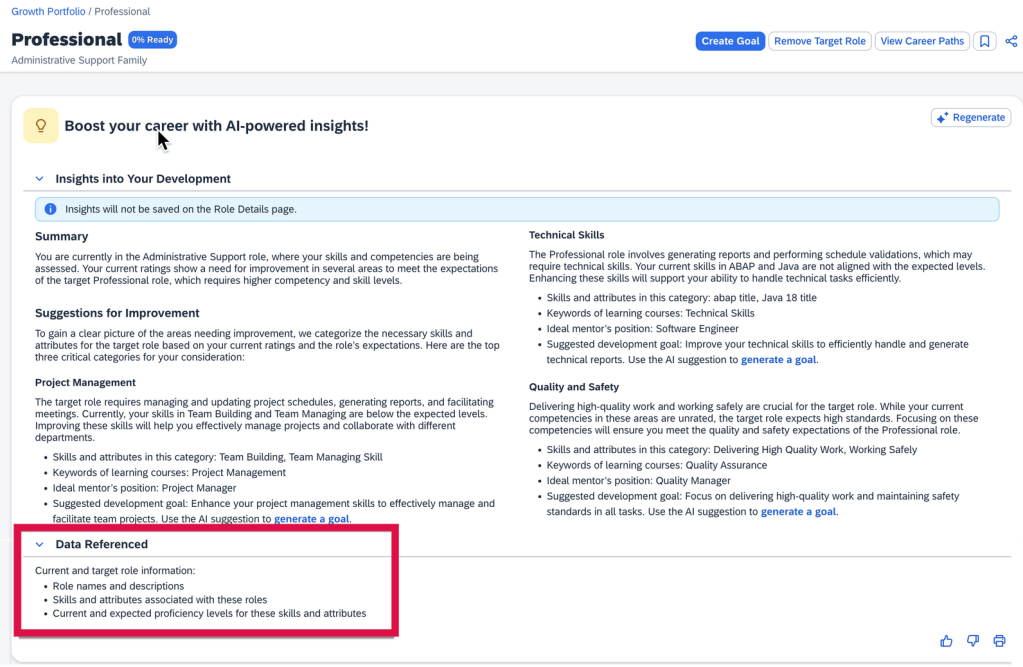
Data Referenced Section Available in AI-Assisted Career Insights
Using AI, can view information being considered on the Data Referenced section on a target role’s details page in the latest Career Worksheet.
Data Referenced section of target role’s detail page
To learn more and get more details, see the full set of documentation in the What’s New Viewer here.
For tips on how to manage a release, check out our blog here.
Calibration
Auto Activate Calibration Sessions
You may now create job requests to automatically activate Calibration sessions. There is a new setting to enable in Admin Center>>Manage Calibration Templates on the Advanced tab.
A new setting, “Enforce session activation“, has been added under “Auto-activate sessions”. When enabled, if validation errors are found for certain subjects, those subjects will be removed from the corresponding session, allowing the sessions to be activated.
Previously, sessions could not be activated if errors were found for subjects during validation.
Once the Auto-activate sessions option for a template is enabled, set your desired activation date. Next, create the job request at Admin Center>Scheduled Job Manager to auto-activate sessions that use this template. A new job type, Auto-Activate Calibration Sessions on Planned Date, is now available.
Sessions can be auto-activated at the template or session level. If you set an activation date only in the template and do not specify a different date for individual sessions, the sessions will be auto-activated on the date defined in the template.
If you assign a different activation date to individual sessions, that date will take priority. If no activation date is set for either the template or the sessions, the sessions based on the template will not be auto-activated, even if the option is enabled.
When the auto-activation job is completed, you will receive email notifications detailing the results of the activation process. However, if the job runs but finds no sessions to activate, no email notifications will be sent.
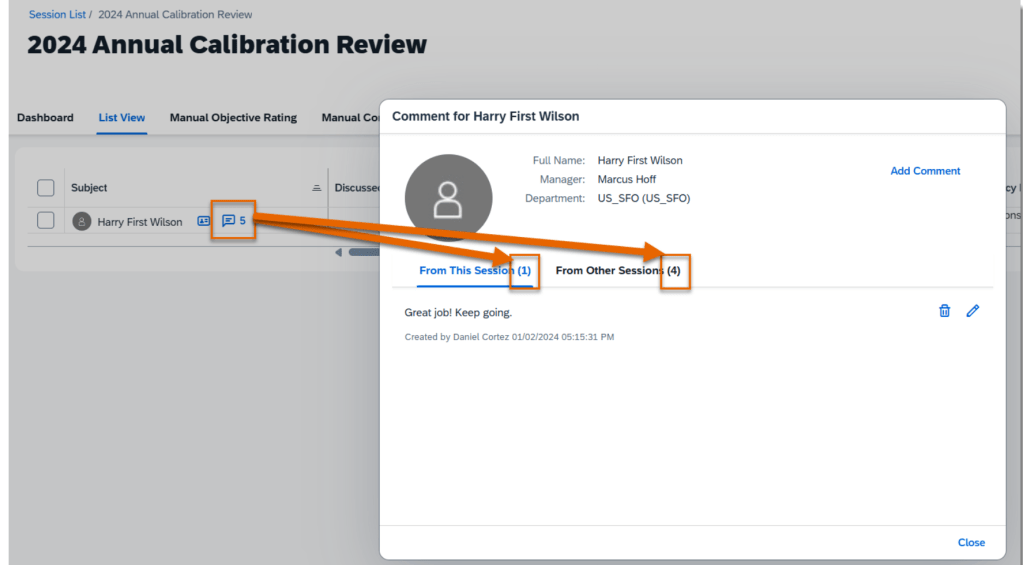
Comments from Other Calibration Sessions
In the subject list of a calibration session, the comment icon next to each subject now shows a total count of comments from the current session and other sessions that are based on the same template. When you viewing the comment dialog box,there are separate counts and comments on the From This Session and From Other Sessions tabs.
The counts update automatically when comments are added or deleted from any session.
Comments from this session and other sessions
In order to see this, using Manage Calibration Templates, go the to Advanced tab and select “Enable Roll up comments from the other sessions based on the same template“.
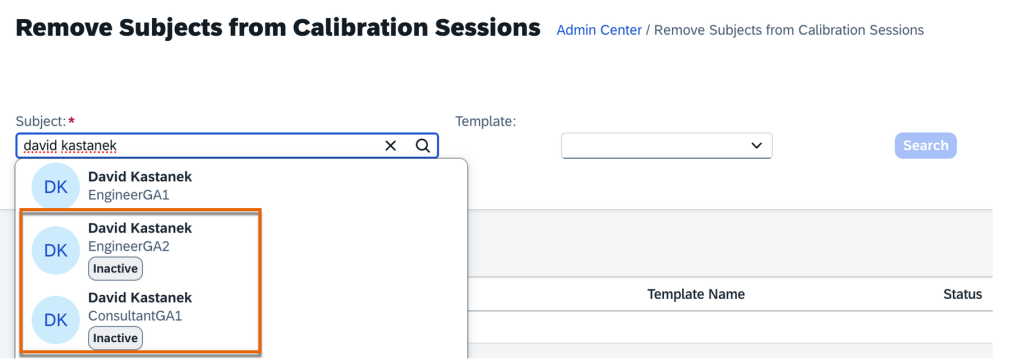
Remove Inactive Subjects from Calibration Sessions
Inactive subjects may now be removed from all calibration sessions using the Remove Subjects from Calibration Sessionsadmin tool. Previously, only active users could be searched for and removed.
Inactive Subjects Removal from Calibration Session
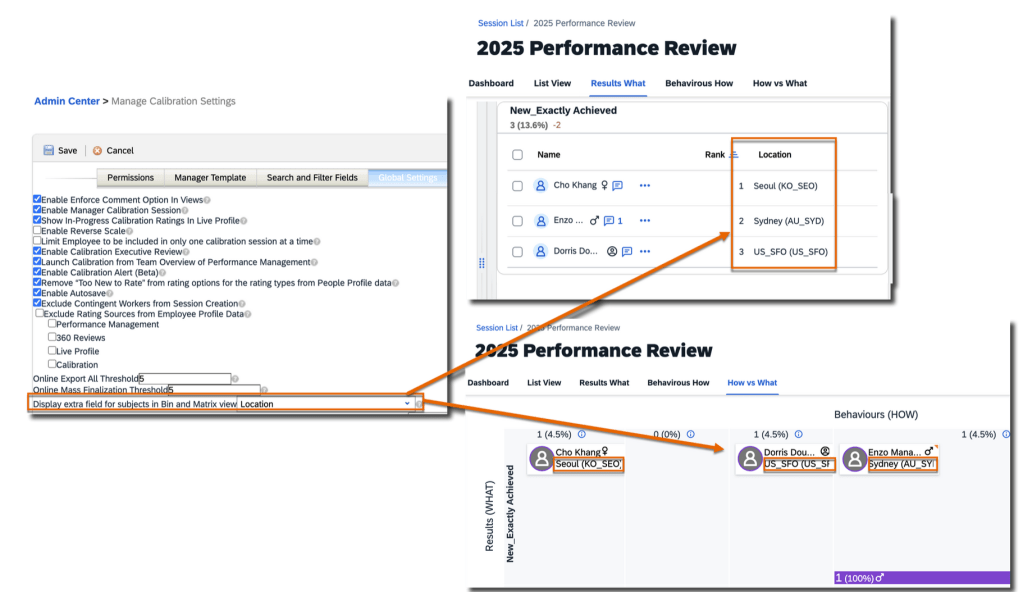
Display Extra Fields in Bin and Matrix Views
The setting “Add an extra field to people card shown in 9-box view” has been updated to “Display extra field for subjects in Bin and Matrix view“. Found under Admin Center>>Manage Calibration Settings >>Global Settings, you can now enable this option and select an extra field to display for subjects in both Bin and Matrix views. Any field that was previously selected for display in the Matrix view will now automatically be visible in the Bin view.
Impact of Using Extra Fields for Views
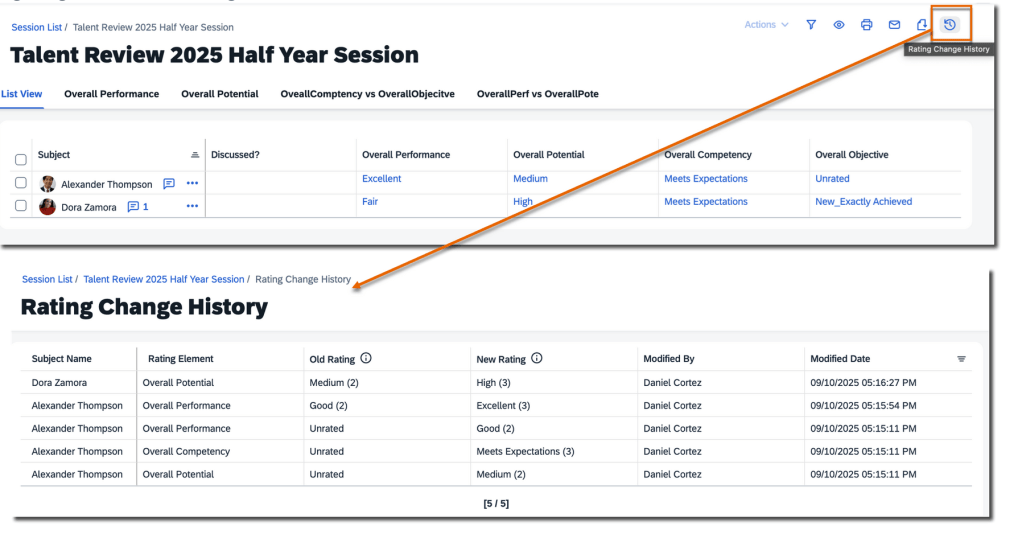
Track Rating Changes in Calibration Sessions
Rating changes can now be tracked within a calibration session. The update makes it easier to track the rating changes and maintain a record of all adjustments made.
There is a new Rating Change History icon in the upper-right corner of a calibration session. Clicking the icon opens a Rating Change History page.
Here all rating modifications made to subjects within that session are listed. The Old Rating and New Rating columns display the rating label and also includes the corresponding rating value. The user who made the change as well as the modify date/time are noted as well.
View Rating Change History
Bin width adjustments automatically saved
In the Bin view of a calibration session, any adjustments made to the width of each bin are now saved automatically. When accessing the Bin view the next time, the saved widths will be applied. In the past, bin width changes were not saved, and each bin would revert to its default width upon reopening the view.
Changes Auto Saved
Exclude Contingent Workers when Creating Calibration Sessions
Contingent workers can now be automatically removed when you create calibration sessions.
A new setting, Exclude Contingent Workers from Session Creation, is available under Admin Center>Manage Calibration Settings>Global Settings.
Once enabled, contingent workers are automatically removed from the list of participants and subjects when you create sessions using:
Manage Calibration Sessions tool. After searching for users through the org chart or advanced search and then adding the selected users as participants and subjects, a warning message will appear if any contingent workers are included. Message will include which contingent workers been removed
Manager created sessions on the Calibration landing page
Sessions created via a CSV file
For learn more, you can view the full set of documentation in the What’s New Viewer here.
For tips on how to manage a release, check out our blog here.
Here are some of the highlights of the release for Succession.
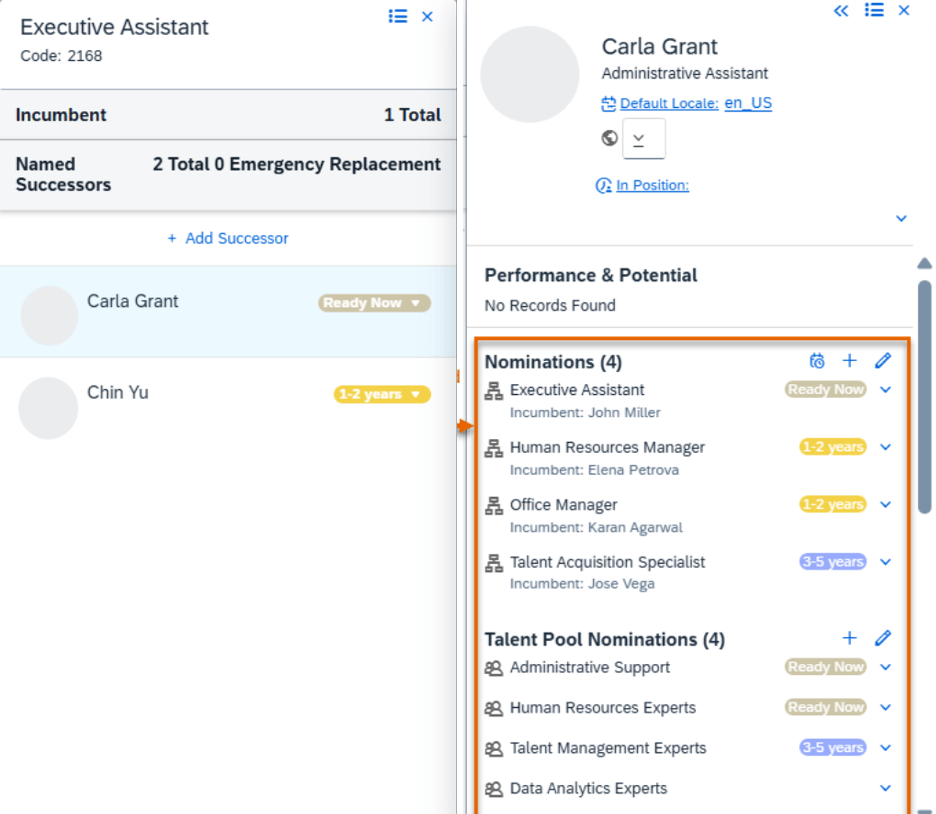
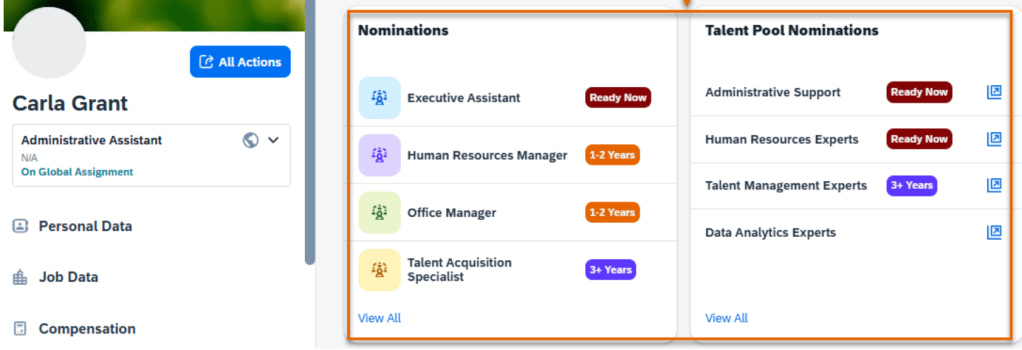
Show Person-Based Nominations on Talent Card and People Profile
An employee’s nominations from all their employments, including nominations to positions and talent pool nominations will be available on the Succession talent card. For this view, Global Assignment or Concurrent Employment must be enabled and in Nominations Setup, select “Show person-based nominations for employees with global assignments or concurrent employments”.
Then users with proper permissions can view all nomination records of an employee.This will provide a extensive view of nominations across multiple employments for an employee.
Succession Card Nominations for Multiple Employment
Nominations will also display on the legacy and latest People Profile.
Nominations in People Profile
Access Inactive Employees in Talent Pools Based On Target Population
There is a new setting which enables access to inactive nominees in an user’s target population for talent pool nominations permissions. In Nominations Setup, enable “Include inactive users in target population of talent pool nominations permissions”.
This enables inactive employees to be visible in talent pools while applying target population.
When the setting is enabled, Inactive employees in the target population appear in:
Talent pools
Position card in the Talent Pools section
Talent card in the Talent Pool Nominations section
Latest People Profile in the Talent Pool Nominations card or in the legacy People Profile in the Current Nominations block
Talent search results for talent pools
Admin Tool Matrix Grid Rating Scales Universally Available
The Matrix Grid Rating Scales admin tool is now available in all systems. Before the update, it was available only when the Matrix Grid Reports feature was enabled in Provisioning. Removing the restriction, the tool is now available for matrix grids on the Performance Management form and those in the Trend Information and Overview blocks in the legacy People Profile.
Enhanced Suggested Successors Feature
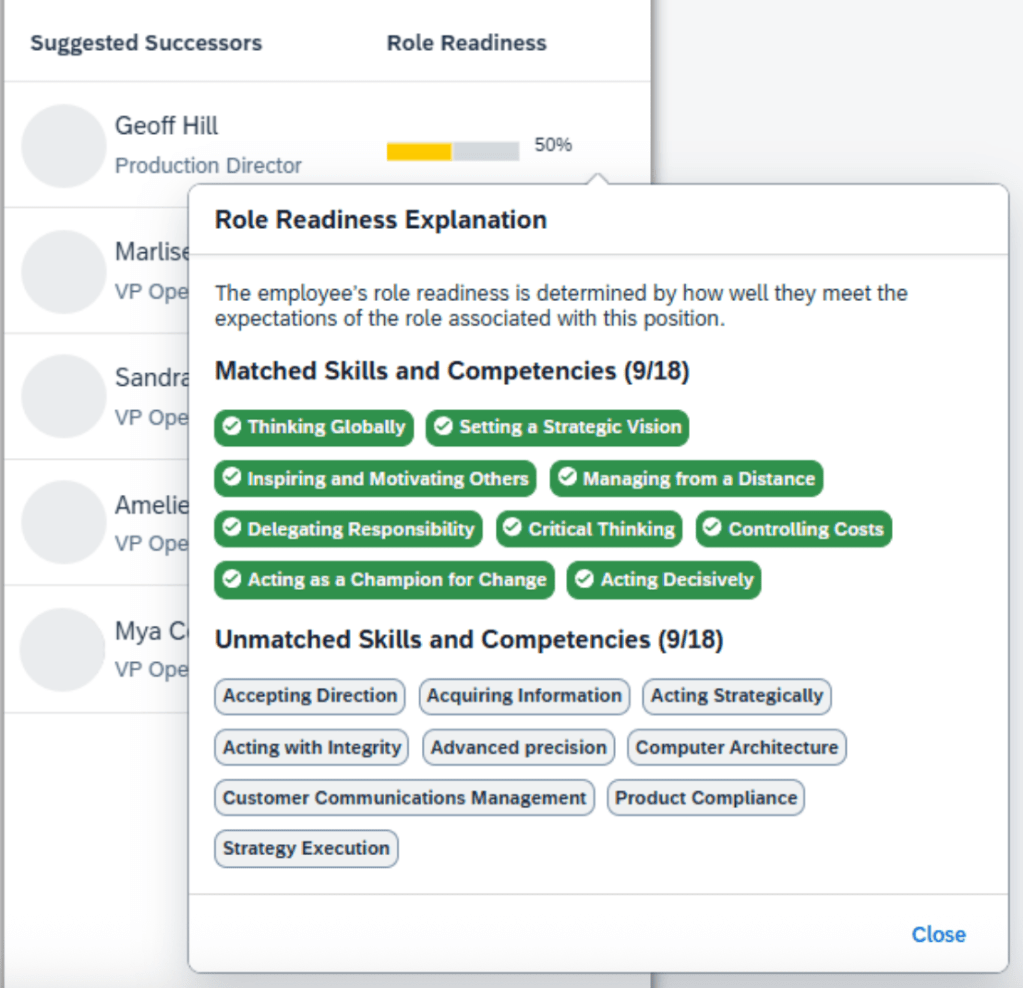
The Suggested Successors feature now supports using the skills and competency proficiency levels from Growth Portfolio. Users may also view a role readiness explanation for each suggested successor.
Role Readiness Explanation
The attributes required by the position’s role are grouped into two sections: “matched” and “unmatched”. The grouping is ased on whether the suggested successor’s current ratings meet the expected ratings of these attributes.
Filter Position Tile View with Foundation Objects
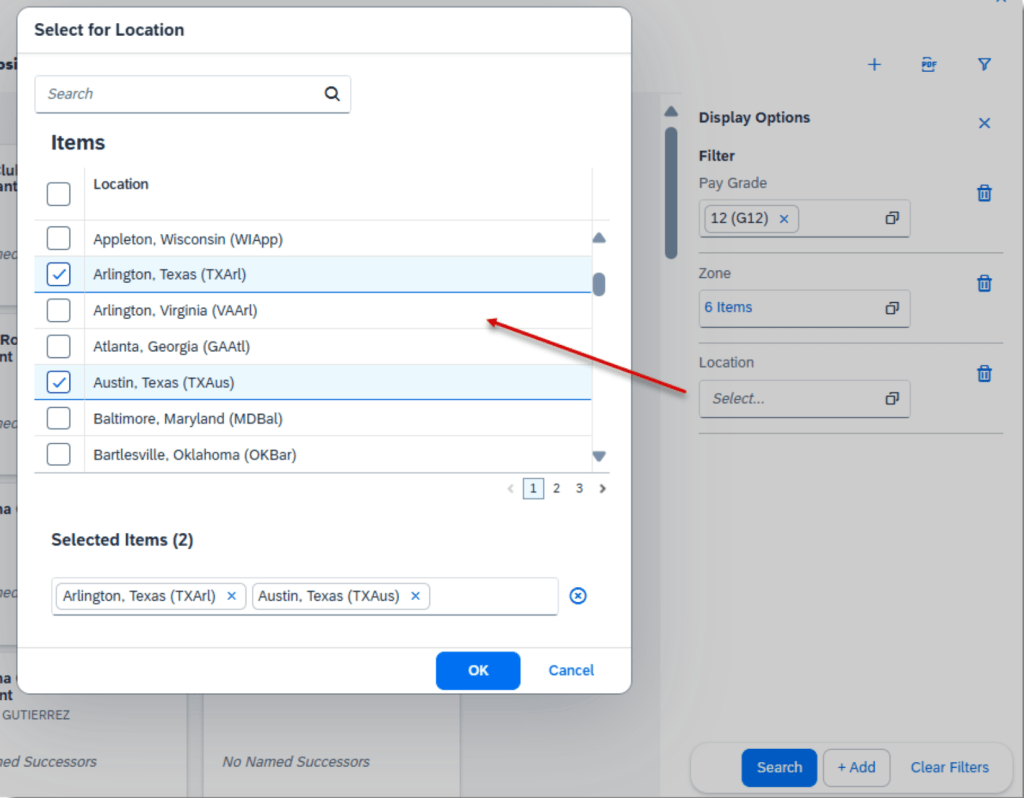
Foundation Objects can be used to filter position tiles displayed in the the Position Tile view.
This requires the setting to include Foundation Objects in filters and adding Foundation Object fields as searchable fields to the Position object. Then Foundation Objects will show up as available filters in the Position Tile view.
Adding Foundation Type Filters for Position Tiles
In Succession Settings, enable “Include Generic Objects and Foundation Objects in filters in the Position Tile view”.
Separate Permission Control for Viewing Nomination History
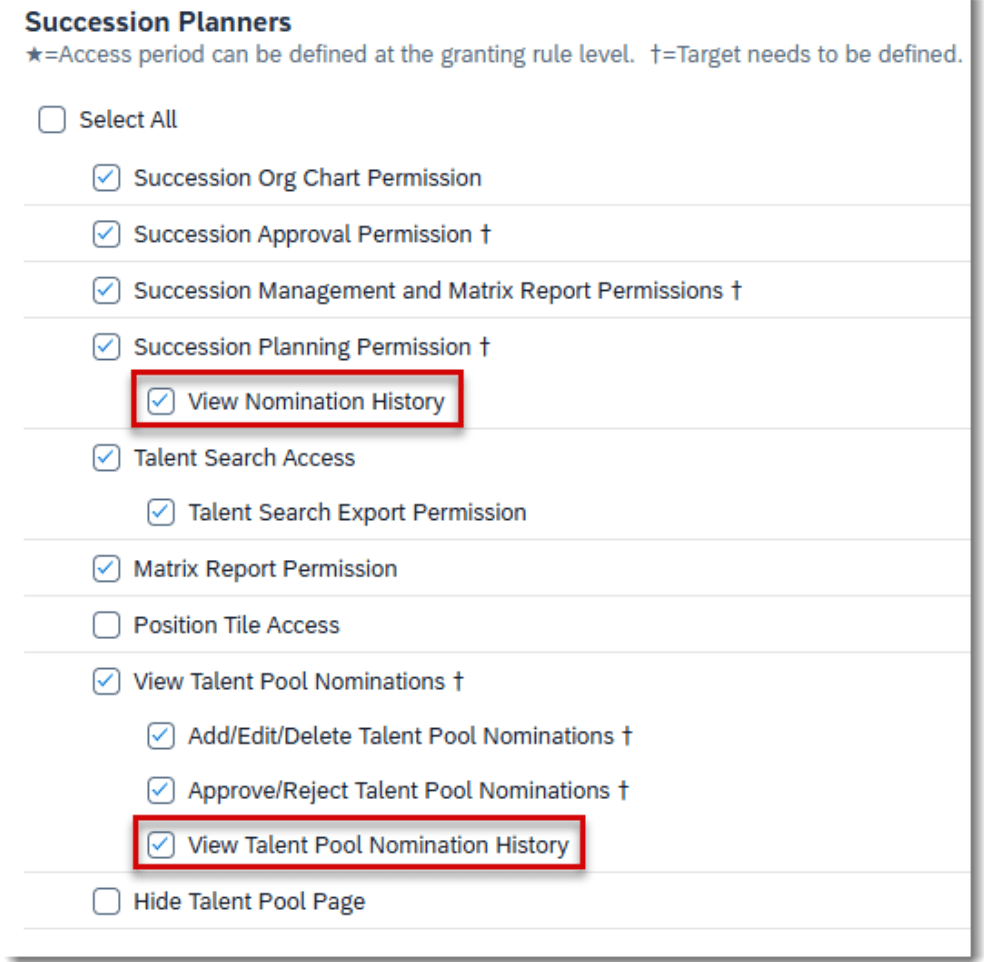
Role-based permissions can now be used to control whether users who can nominate successors or view talent pool nominees are allowed to access the history of successor or talent pool nominations. This provides more specific access control over nomination history data.
Succession Planners permissions to view nomination history is now separate from Succession Planning Permission and View Talent Pool Nominations permissions.
Child permissions have been added:
View Nomination History, which allows users who nominate successors ability to view the nomination history on the position card, Succession talent card and in the People Profile
View Talent Pool Nomination History, which allows users who view talent pool nominees to also view the nomination history in the talent pool details page and the People Profile
Permissions Needed
If a user already has Succession Planning Permission or View Talent Pool Nominations parent permission, the corresponding nomination history permission is automatically granted.
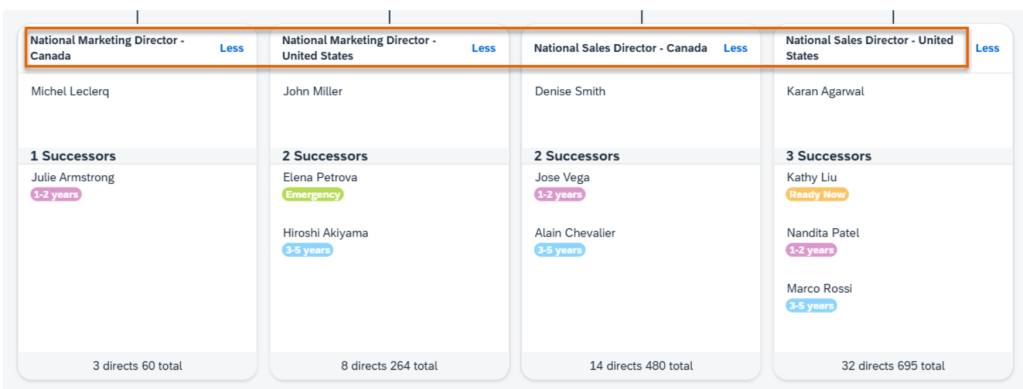
Sort Succession Org Chart by Position or Employee Title
Additional sorting options are now available for same-level nodes in the Succession Org Chart. In addition to the incumbent’s username, can be sorting can also be done alphabetically by position title or employee title.
Succession Org Chart Sorted by Position Title
The title-based sorting is helpful when comparing succession plans for similar positions or roles. The order remains the same when incumbents change.
To enable this sorting:
MDF or legacy position-based nomination method
In the Org Chart Configuration>Succession Org Chart, “Sort Succession Org Chart by position title” is selected
For the role-person nomination method
In the Org Chart Configuration>Succession Org Chart, “Sort Succession Org Chart by employee title” is selected
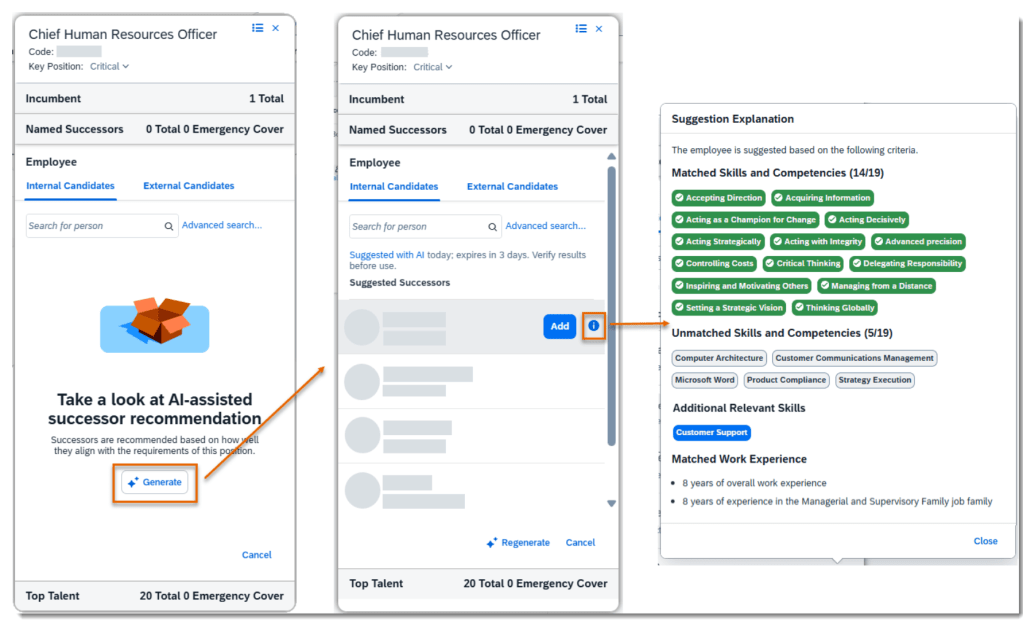
AI-Assisted Successor Recommendation
If you have purchased AI units license, are using Talent Intelligence Hub and enabled Growth Potential, succession planners can use the power of AI generative capabilities to view a list of recommended successors based on their skills, competencies, and work experience.
With the Suggested Successor setting enabled, weights can be configured for skills and competencies and work experience.
Successor Recommendations Settings
When settings for both are set, generative AI uses the following data to recommend successors:
Position-related job families, roles and profile in Job Profile Builder
Skills and competencies in the Growth Portfolio
Job information and external work experience in People Profile
In the Suggested Successors list, hover over an employee and use the Add button to nominate them as a successor. Once the employee is nominated, they are removed from this suggested list. Users can also choose the information icon to view why the employee is suggested in a popover dialog. The dialog contains up to four sections:
Detailed Successor Recommendations
For greater details, you can view the full set of documentation in the What’s New Viewer here.
For tips on how to manage a release, check out our blog here.
Continuous Performance Management
There are no major updates for Continuous Performance Management, they are generally available and require no additional updates. Here are a few notable updates.
All Responses shown on Feedback Given tab
The Feedback Given tab for Continuous Feedback page now shows all feedback given, both unsolicited feedback and responses to feedback requests, not just feedback response for the target population for their permission role.
Search for an activity and link to feedback
The word count for Continuous Performance fields is now based on characters instead of bytes.
In addition, several field lengths have been extended:
Users can request and review feedback on their activities in any channels where they are the participant
When a user is the participant in a channel, they can request and view feedback on all their activities. Previously, the feedback functionality was only available for activities recorded in channels between managers and direct reports.
Share Activities Across Channels on Continuous Performance Page
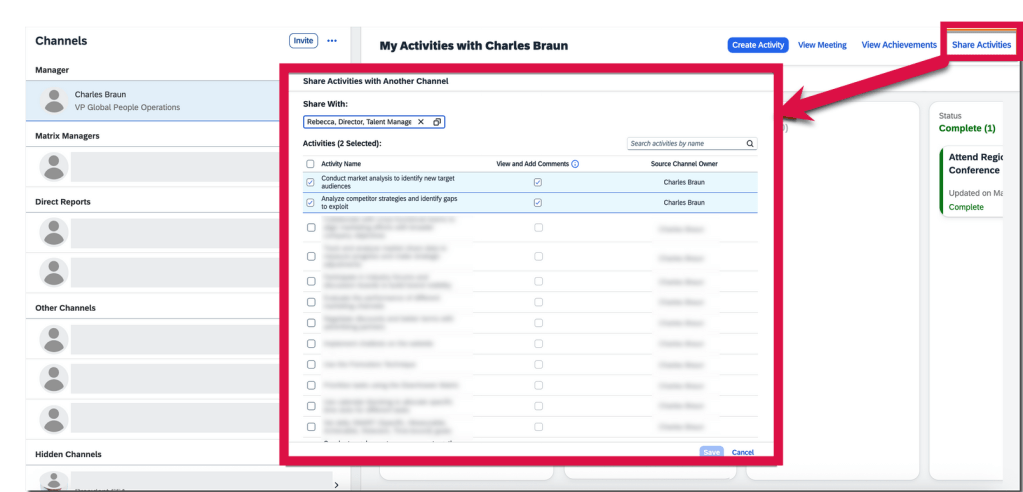
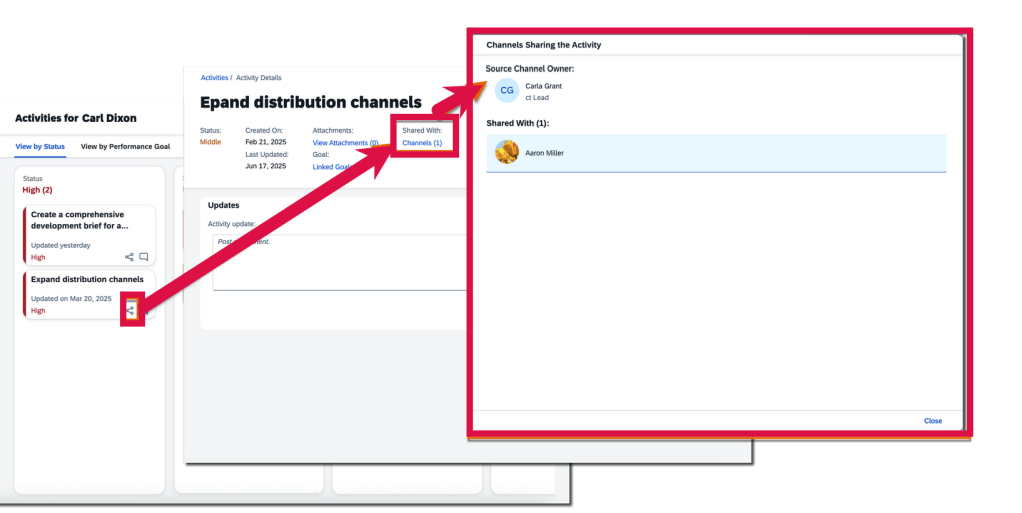
Users are now able to share their activities across channels where they participate, giving relevant users the ability to view and edit these activities for seamless collaboration. These activity sharing records are reportable with Story reports.
Only the channel participant, who is responsible for completing the activities within a channel, can share them with other channels in two ways. They can also control whether the target channel owners can view and add comments on each activity. This setting is pre-selected as the default.
On My Activities with <channel owner’s name> page, select Share Activities button and choose activities that they want to share with another channel in the pop-up dialog.
Share Activity with Another Channel
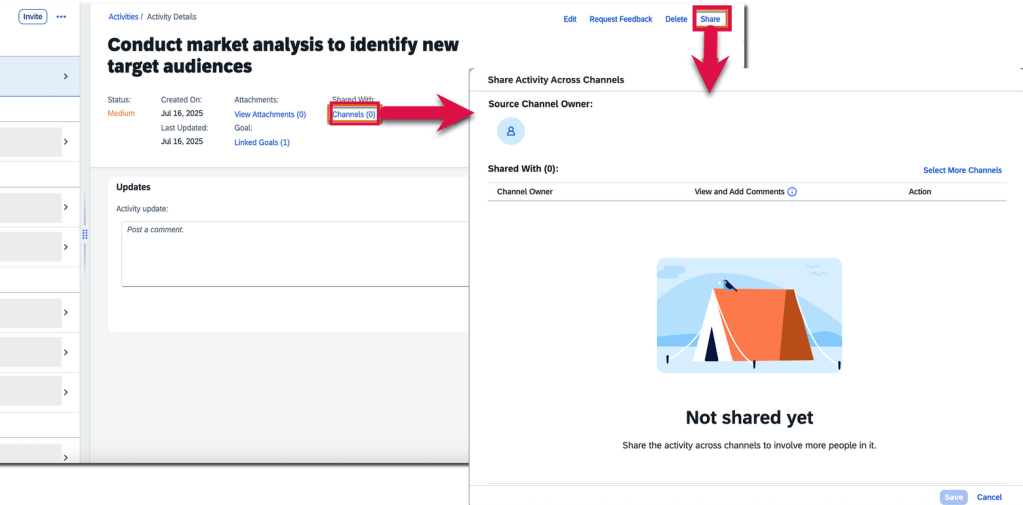
On the Activity Details page, users may choose channels that they want to share an activity with.
Share Activity within Activity Details
Channel owners can track the source and destination channels of a shared activity through the Channels link in the Shared With: field on the Activity Details page. However, the field and link are only available for activities shared across channels. On the activities overview page, channel owners and participants can see the “shared across channels” icon on the card of activities that have been shared, to distinguish them from those haven’t.
Share Icon Visible for Shared Activities
AI-assisted writing is now available in more text areas on Continuous Performance and Continuous Feedback pages
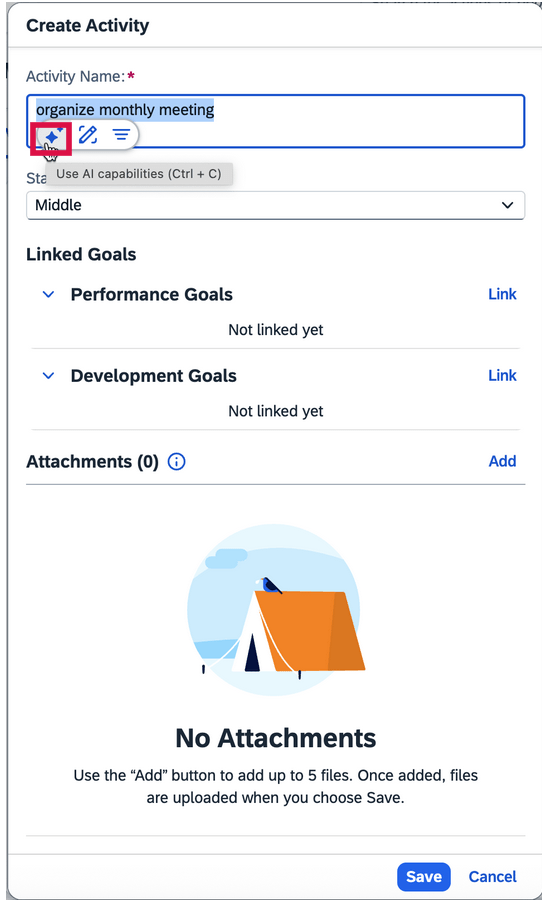
When the AI units license has been purchased, AI-assisted writing now includes feedback topics and feedback questions for Continuous Performance. All free text areas now support AI assistance. Text areas also include activity names, activity updates, achievement names, meeting notes, discussion topics, and channel invitation notes.
AI Assistance for Writing Tasks
To learn more and get more details, see the full set of documentation in the What’s New Viewer here.
For tips on how to manage a release, check out our blog here.
The SAP SuccessFactors 2H 2025 release focuses on enhancing the user experience and leveraging AI. For your convenience, we’ve summarized the highlights of what’s new for the second half of 2025 release for Performance Management below.
Performance Management
Replacement of Legacy Performance Management Form Experience with Latest Experience
The latest experience of Performance Management forms is replacing the legacy one, which will reach end of development on November 14, 2025 and will be deleted on November 20, 2026.
The latest experience was automatically enabled in the Preview environment for customers using the latest Goal Management in the 1H 2025 release. This is not the case in the Production environment, the latest experience wasn’t enabled by default.
The latest experience has the key features in the legacy version with an enhanced user experience, a more flexible layout, more business rule scenarios, and generative AI features if the AI user license is purchased.
Enhancements to Latest Experience of Performance Management Forms
Some of the new features now available:
EZ rater
Goal comments and learning activities available when printing form
Forms can be printed in custom layout
“Print” button available for form snapshot
Additional fields are available on side panel: unofficial rating, expected rating, rating gap
Goal status colors display in form (if configured)
Help text added for rating field for competency with behaviors
Warning message to appear if proxy user does not have access to missing form content
Read only forms will not show action buttons
Mass Route Ungrouped Forms to a Specific Step
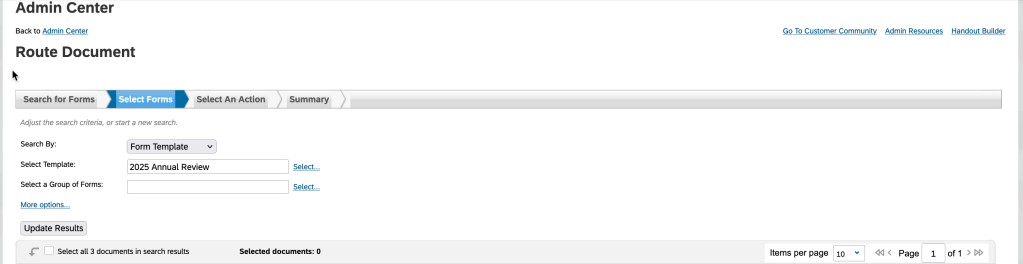
Using the “Route Form” action, forms may be mass routed to a specific step when they are using the same template and route map. In the past, only a group of forms from the same launch could be mass routed, not forms across launches for the same template.
Within the “Route Form” action, search for the forms by specifying the template or uploading form IDs. In the search results, select the forms you wish to move
“Route Forms” action
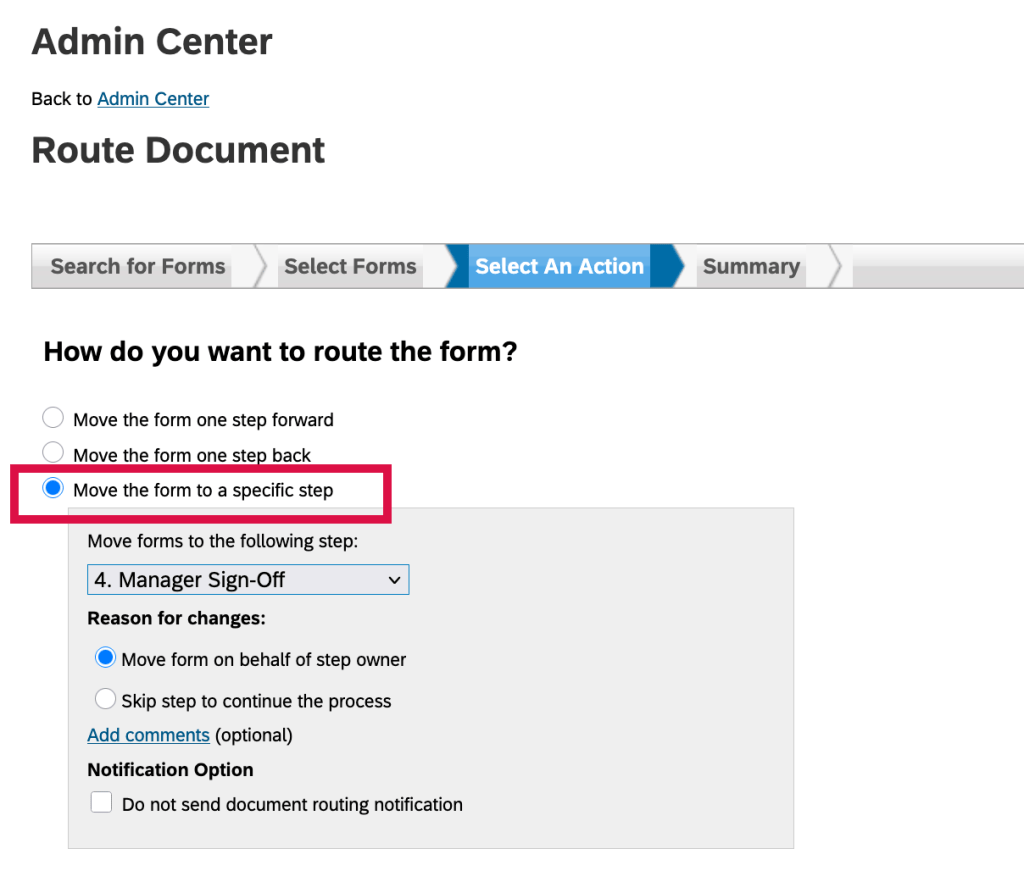
Once the forms are selected, they can be mass routed using the Move the form to a specific step option in the “Select An Action” step of the routing process.
Move ungrouped forms to a specific step
Enhanced AI-Assisted Writing in Performance Management
With the purchase of the AI units license, the AI-assisted writing actions, Generate Comments and Improve My Feedback are now available for goals, as well as skills, competencies, and behaviors.
When a goal is assigned a rating, users can access the two actions in the comment box for that goal, from the context menu of the AI-assisted writing tool.
New Business Rules
There are some new business rules that may be configured when using the latest experience for Performance Management:
Conditional Field Visibility, Editability, Required/Optional
Create business rules to set specific form fields to visible or hidden, editable or read-only, and required or optional, when certain conditions are met
Creating conditional rules provide flexibility to show form fields differently based on user input. For example, a manager giving a certain rating would require a comment
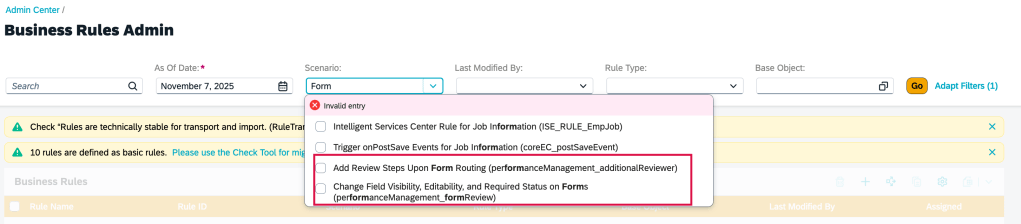
Add Review Steps upon Form Routing
Business rules may be configured to add steps to the Modify stage of the form based on meeting certain conditions. For example, a certain rating by a manager can trigger an additional step to add another reviewer to the process.
These steps are pre-configured in route maps and marked as Hidden Until Rule Execution. When the conditions defined in the rule are met, and the form with a hidden step is being routed forward, the rule is executed, making the step visible on the form.
All step types are supported
New Business Rules
Add link to People Profile Card View from Performance form
Links can be configured to the latest People Profile cards in the form template when the full profile of the latest People Profile is enabled.
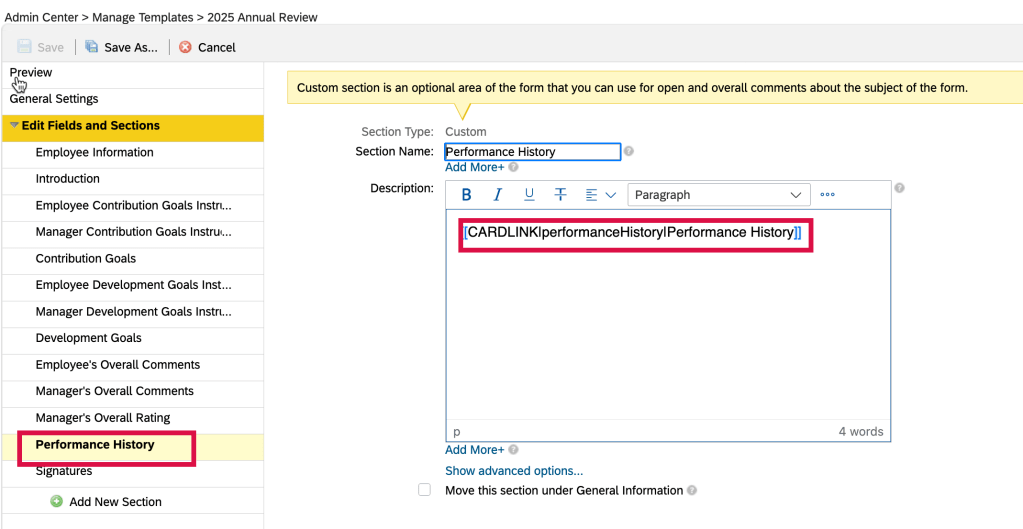
In the Manage Templates admin tool, you can use the new configuration “[[CARDLINK|<cardId>|<displayName>]]” in the description section of a field to a add card link to a form template.
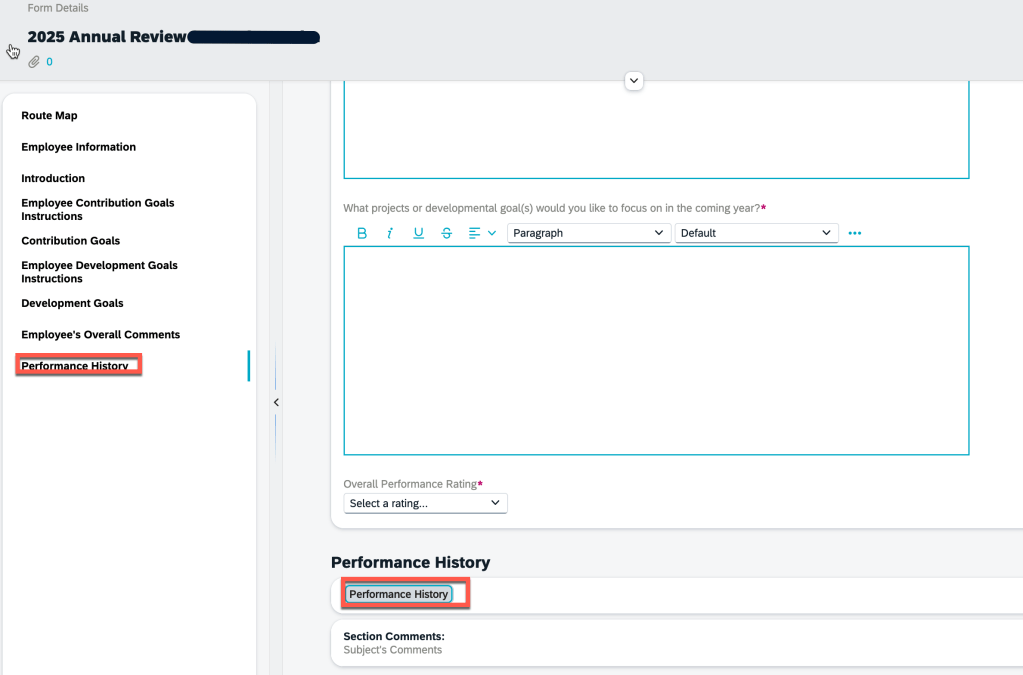
Add card link to a section within the performance template
This allows the ability to link to a card in the latest People Profile when working within an employee’s form where they can view and edit the profile.
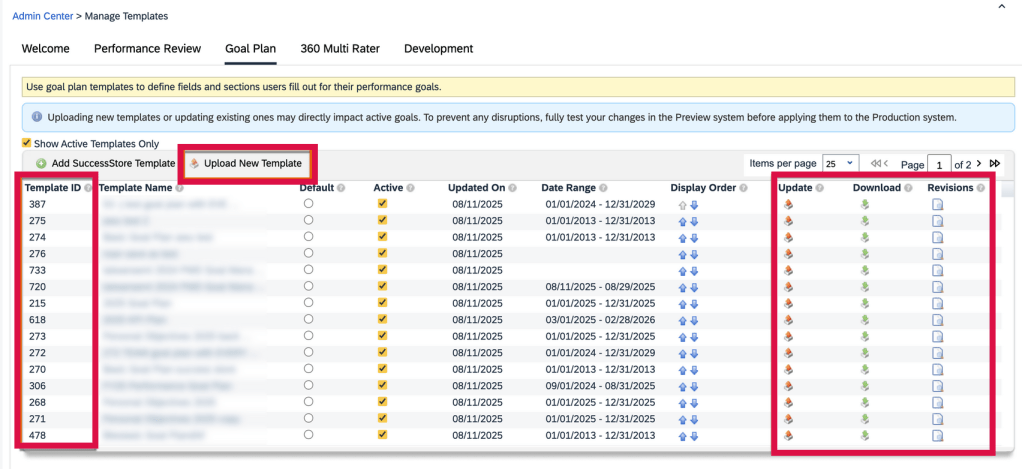
Access to Manage Templates to update, download and edit XML templates
A great new feature allows templates to be downloaded, viewed, edited and added via “Manage Templates”. This removes the need to use Provisioning to update the form template XML.
This permission is applicable to performance form templates, 360 form templates, goal plan templates, and development goal plan templates. You can download templates and view template revisions without any configurations.
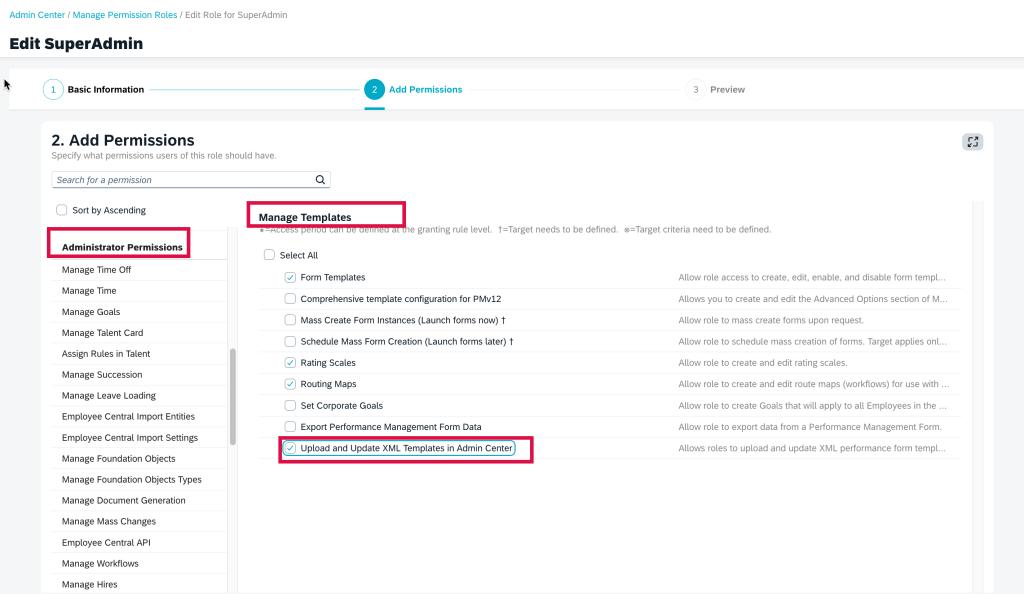
This does require an update to a role’s role-based permission to a upload new templates and update existing ones. Care should be given to users that will receive this access.
Manage Templates Role Based Permission for Upload and Update XML Templates
Once the role has permission to upload and update XML templates, the user can upload new templates, update existing templates, view historical XML and download the templates via Manage Templates.
Upload and Update Templates in Manage Templates
Goal Management
Here are some of the highlights of updates for Goal Management.
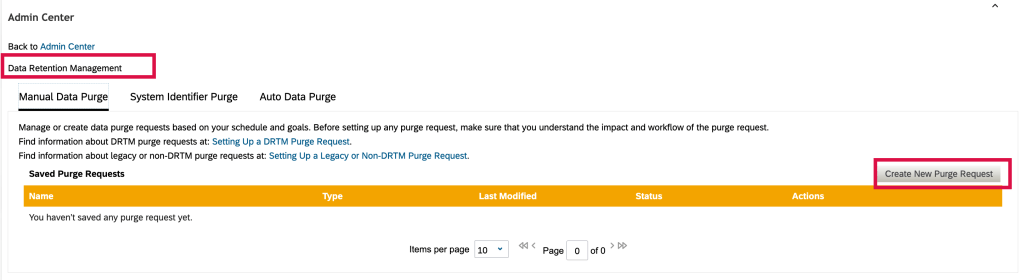
Purge Goals by Goal ID
The admin tool, Data Retention Management, has been used for data purge requests. For goal management, it has been used to purge performance and development goals by selecting the goal plan template in the purge request. This meant the process purged goal data for a specific user’s goal plan, and not just purging a single goal on the plan.
Create Purge Request
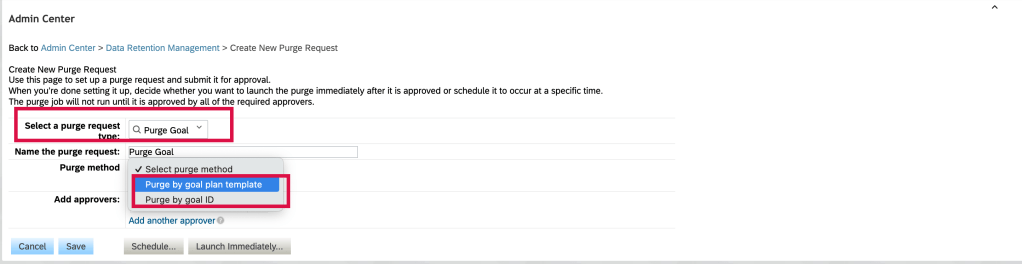
Now there is greater flexibility in purging user performance and development goals. In the latest version, the “Purge method” lists two options for purging goals: Purge by goal plan template and the new Purge by goal ID.
Purge by Goal ID or Goal Template
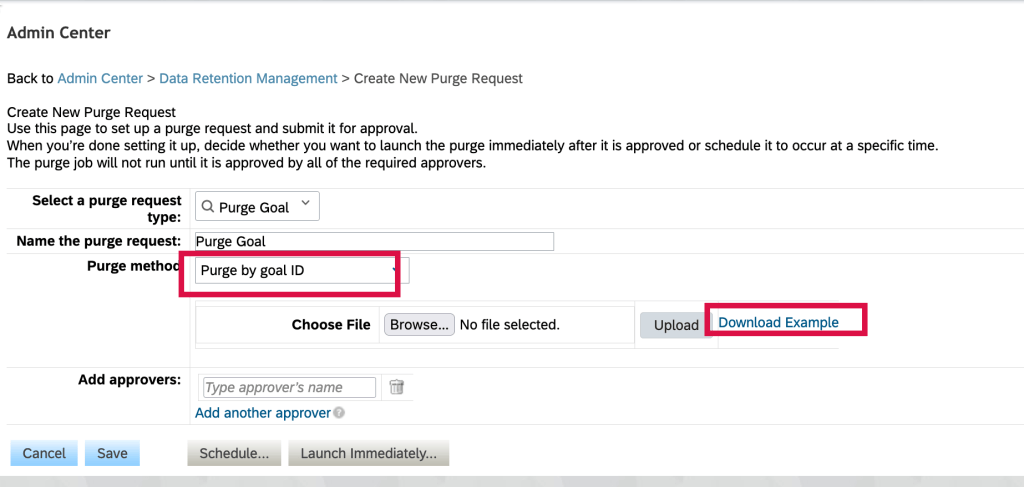
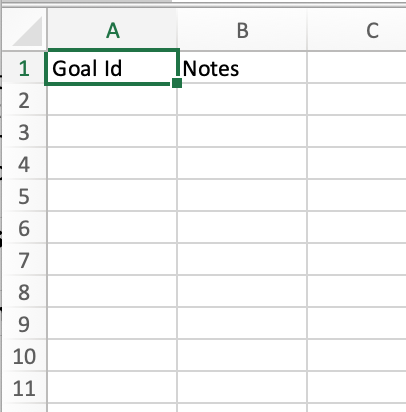
To purge specific goals, use the “Purge by goal ID” purge method. You can download the sample CSV file to get the proper file columns.
Purge by goal ID
You will need to populate a CSV file with the goal ids. Goal IDs can be found by creating a goal management ad hoc report that lists the goal plan template goal name, goal owner and the goal ID.
Sample Purge file by Goal ID
Once the goals to be purged are identified, add the goal IDs to the CSV file and upload to the purge request.
The existing method, to purge by goal plan template will purge all data associated with the template.
Import Goals for Target Population
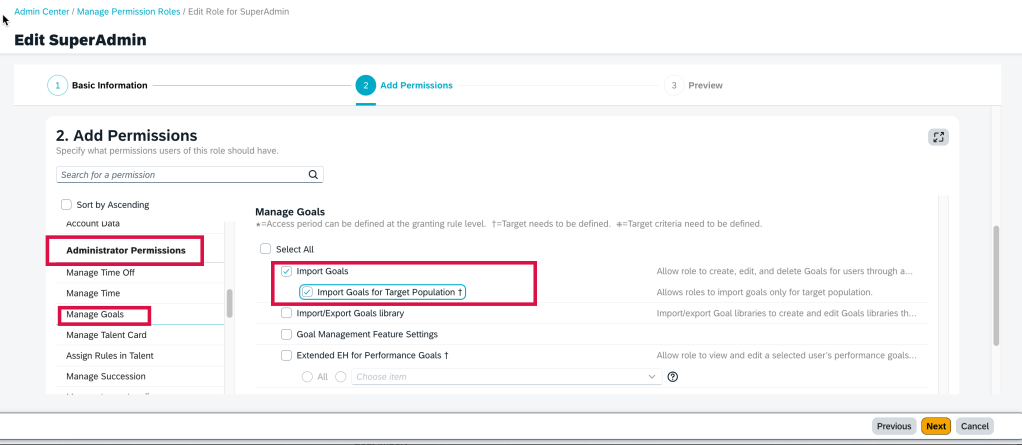
Within a role based permission role, in the Administrator Permissions section>Manage Goals, there is now an option to specify a target population to import goals for.
Import Goal by Target Population
Previously, a role having permission to import goals would be able to import goals for any active users.
Now if attempting to import goals for users outside their target population, there would be an error message in the goal import email notification.
Minor Goal Management Enhancements
There are some minor goal management enhancements in this release which streamline the goal management experience for users.
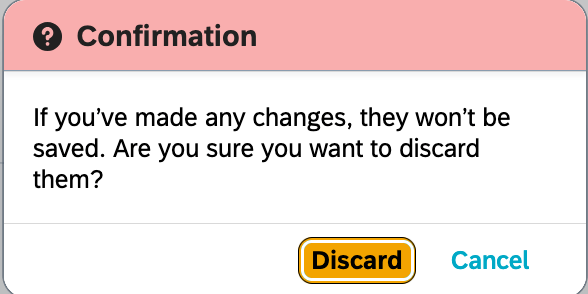
For the confirmation message and button label in the confirmation dialog for Edit Performance Goal, Create Performance Goal, Edit Team Goal, Create Team Goal, Edit Development Goal, and Create Development Goal pages. the confirmation dialog was “Are you sure you want to discard the changes?”, and the corresponding button label was “Keep Going”.
This has now changed to “If you’ve made any changes, they won’t be saved. Are you sure you want to discard them?” and the “Keep Going” label is changed to “Cancel”.
Updated Cancellation Confirmation Message
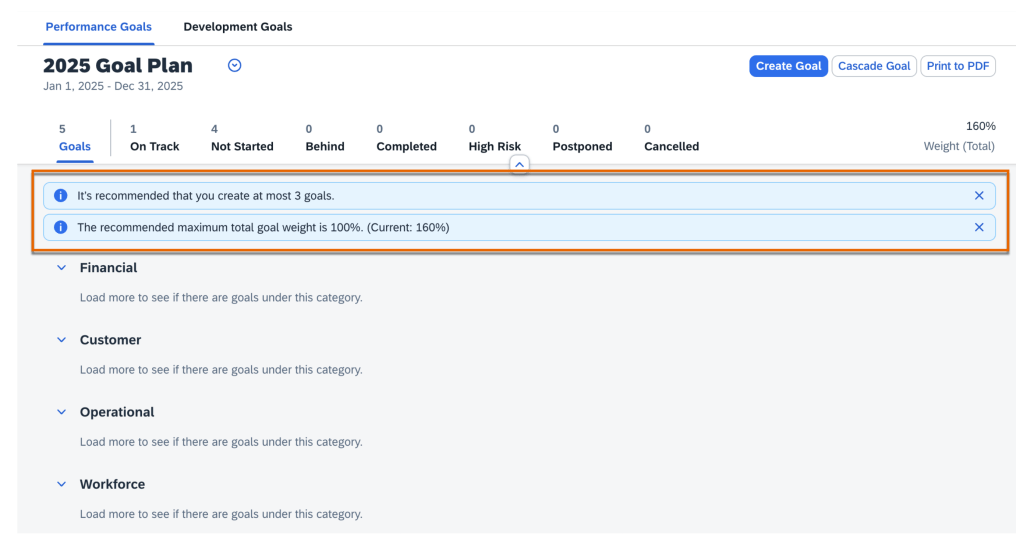
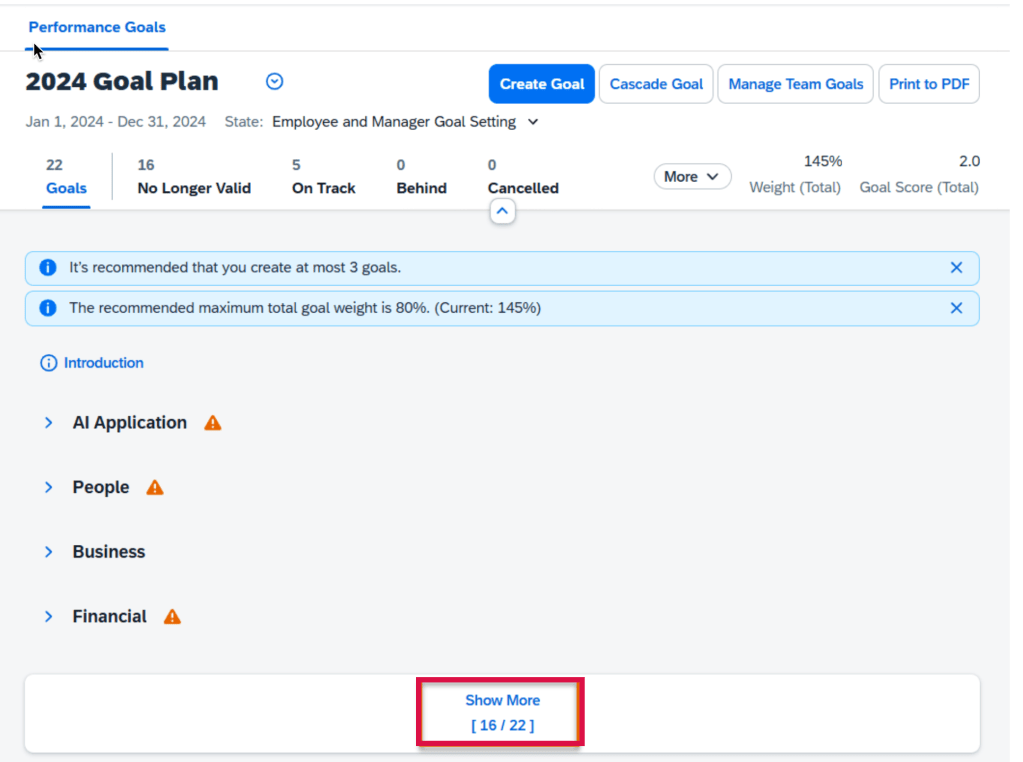
On the Goals landing page, the warning messages for goal number and weight limits are now displayed as message strips. This highlights to users the defined limits of goal number and total goal weight.
Goal Warning Messages
On the Goalslanding page, the goal filter component no longer uses status colors
Goal Status Without Colors
Assigning Team Goals – users can select all loaded goals during the goal selection step in the Assign Team Goal and Cascade Goal dialogs. The number of goals is now increased to 100 from 20, and the checkbox is renamed “Select All Loaded Goals”
Update to Sharing, Unsharing Team Goals – users with the Share Team Goals permission can now share and unshare team goals with anyone in the organization
A more user friendly error message displays when saving goal plan template, it shows the cause of the error and provides a solution
Goal Plan Save Error
Consistency in use of “More”: on the Goals landing page and Manage Team Goals page, the button label “More” is changed to “Show More “
“Show More” replaces “More”
360 Reviews
Here are some notable updates for 360 Reviews.
Add Link to Detailed 360 Report in Email Notifications
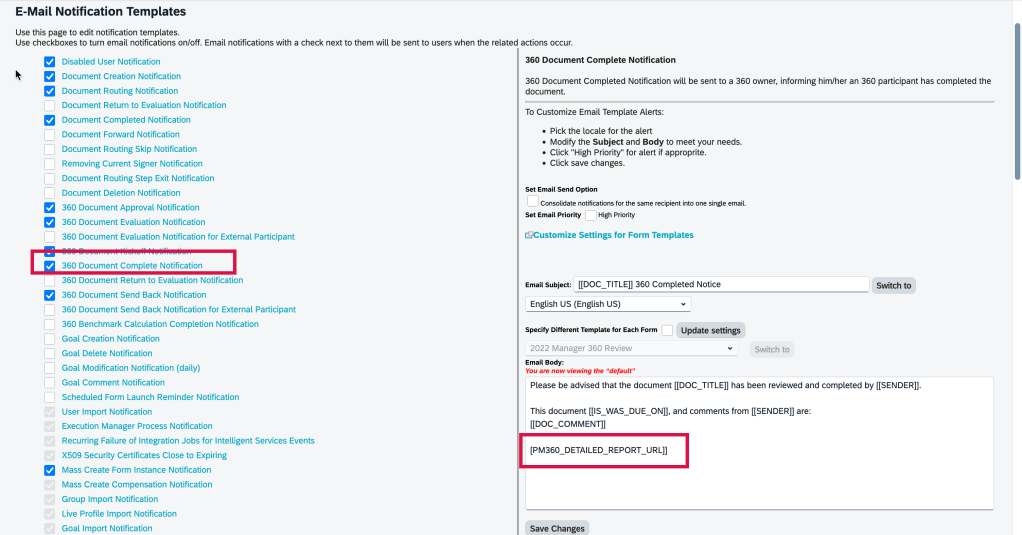
A link can be added to the Detailed 360 Report in the “360 Document Complete Notification” email template by using a new tag [[PM360_DETAILED_REPORT_URL]].
When this tag is added to the 360 Document Complete Notification email template, users have immediate access to Detailed 360 Reports from their email.
New Token for 360 Document Complete Notification
How the tag is rendered depends on whether the option Enable HTML email notifications is selected in Company System and Logo Settings:
If selected, the tag appears as a clickable phrase: Detailed 360 Report for {subject user’s full name}.
If not selected, it’s resolved as a clickable URL, preceded by an introductory text: For an overview of raters’ feedback, view {URL}.
New switch to hide Radar Charts on 360 Detailed Reports
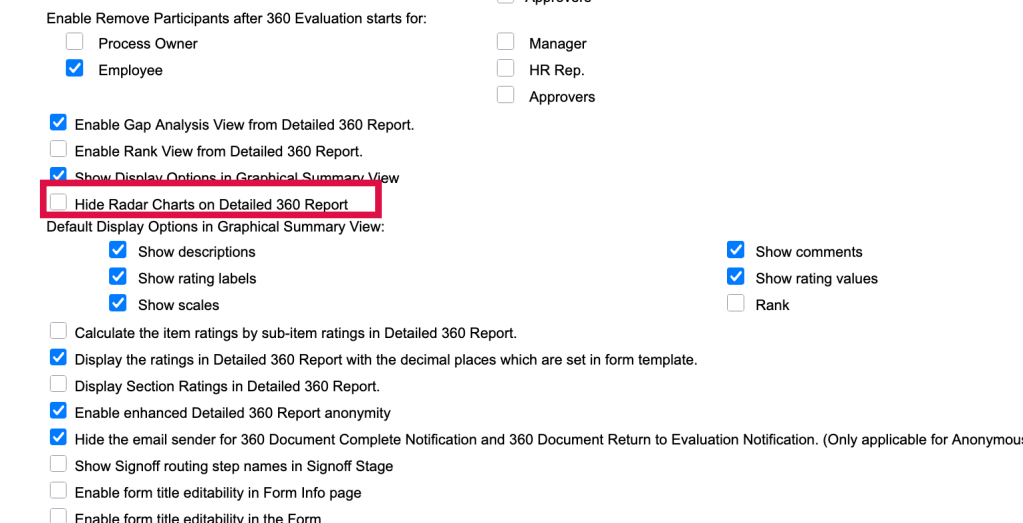
In the Advanced Settings for a 360 template in Manage Templates, there is a new option to hide radar charts on the Detailed 360 Report. The switch “Hide Radar Charts on Detailed 360 Report” is turned off by default.
Advanced Settings – Option to Hide Radar Charts on Detailed 360 Report
Minor 360 Review Enhancements
There are new visual and functional enhancements in this release.
The spacing of Competency and Objective sections have been improved
When adding back deleted participants during the Evaluation stage, participant’s original category information is retained and pre-filled in the Add Participants dialog
The Suggestions for Improvement section in Assisted 360 Reviews Insights now includes links to generate development goals
Error messages now explain the issue and provide troubleshooting.when users open, send, save, or perform other actions on a form
Information about behaviors (names, descriptions, ratings) is now used as input for generating comments
Multiple Review Reminders for Upcoming 360 Review Steps
You can now schedule several reminder notifications to prompt participants before a 360 review step is due.
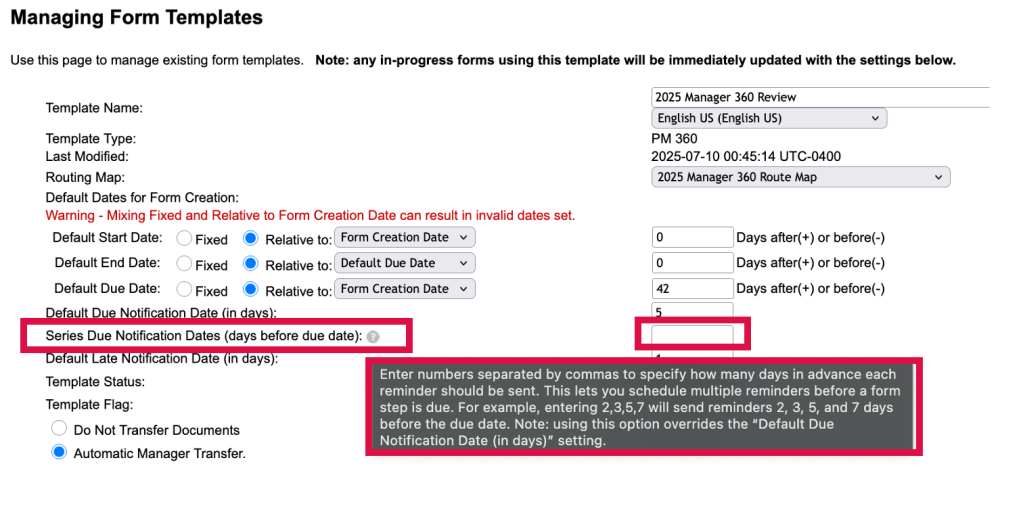
In Manage Templates, in the Advanced Settings for a 360 template, there is a new option, “Series Due Notification Dates (days before due date)“. Using this option enables you to schedule multiple reminders when using step due notifications for the template.
You may set a series of reminders before a step due date. Simply enter the number of days prior to the step due date to define how many days in advance reminders are sent. Separate each number of days with a comma.
New Series Due Notification Dates
Using this option overrides any settings for the existing option Default Due Notification Date (in days), which supports only a single reminder.
To learn more, see the full set of documentation in the What’s New Viewer here.
For tips on how to manage a release, check out our blog here.
Hide “Create from Scratch” Option for Goal Creation
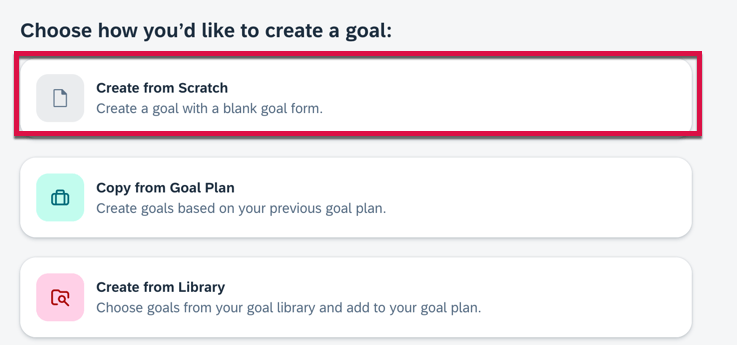
When creating on goal on a goal plan using the latest Goal Management, it is possible to create a performance goal from scratch, copy a goal from another goal plan or create a goal from a goal library. The options are shown below.
Create Goal Options
The Create from Scratch goal option for performance goals may be hidden. To hide this option, there is a switch to set in the goal plan template XML:
Once the switch is set to turn off this button, the option to create goals from scratch will no longer appear.
Copy Goals on Behalf of Others
In the latest Goal Management, managers can now go to a user’s goal plan and copy personal goals on the user’s behalf. The Copy from Goal Plan option is available only for the latest goal plan.
Configuration Requirements
Using the latest Goal Management
The TGM/CDP Goal Transfer Wizard feature is enabled
Users are assigned more than one goal plans
The create permission for goals is granted in the goal plan template XML
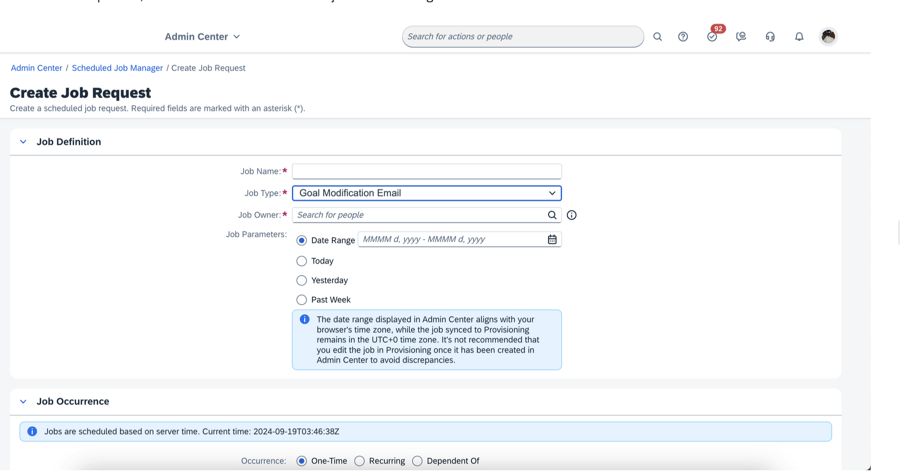
Goal Modification Email Notification Jobs in Admin Center
You can now create a job request for the goal modification email in Scheduled Job Manager. It no longer has to be set up in Provisioning.
Create Goal Modification Notification
The date range displayed in Admin Center aligns with your browser’s time zone, but the job synced to Provisioning remains in the UTC+0 time zone.
Link and Unalign Goals
In the latest Goal Management, It is now possible for users to link their performance goals with another user’s goals or unalign goals In their own goal plan:
Choose the Link Goal option on a goal card and follow the on-screen instructions.
Go to another user’s goal plan, choose the Link with Mine option on a goal card, and complete the linking steps.
Goal Plan Template Cascade/Align Permissions
In the goal plan template XML:
Grant cascade-align permission for roles to link goals
Grant unalign-parent or unalign-child permission for roles to unalign goals
Minor Enhancements for latest Goal Management
Some enhancements for the latest Goal Management have been added to make it easier to use.
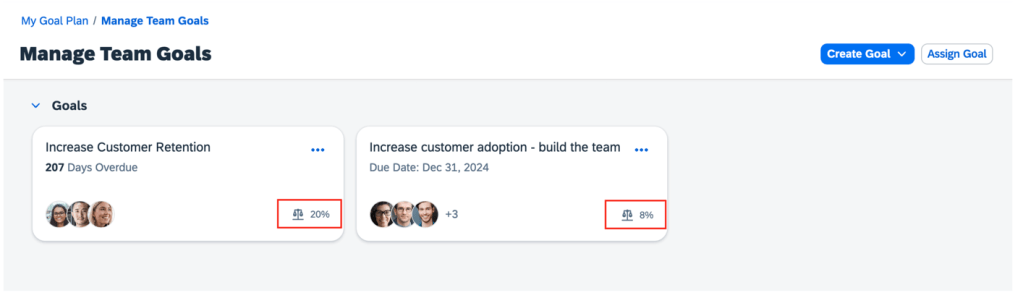
Weights for Team Goals on Goal Cards
Weights are now displayed for team goals on goal cards.
Weights on Team Goals
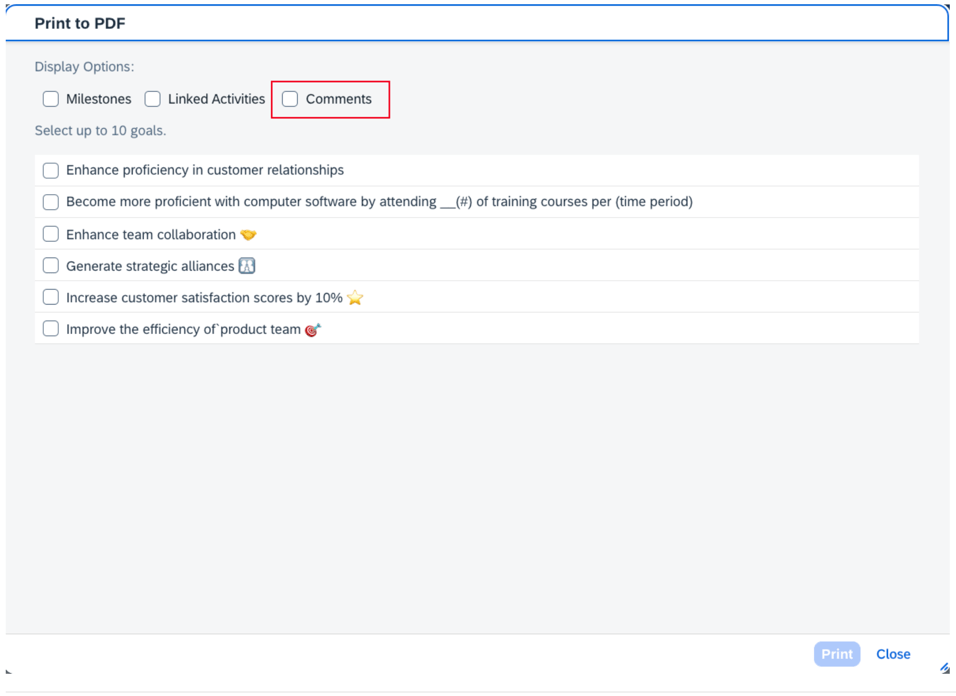
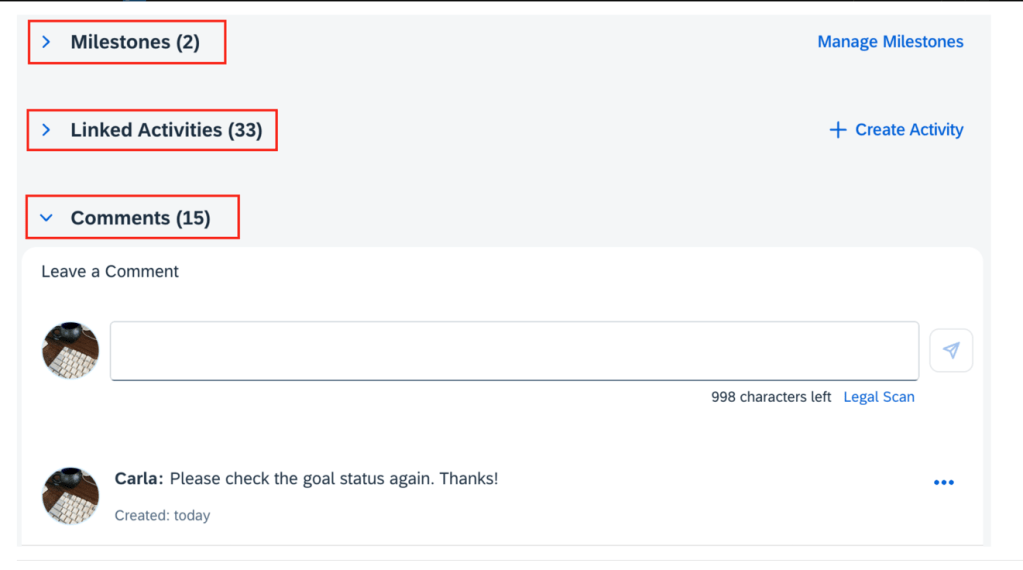
Comments on PDF
Users can now include comments in the PDF output for goals.
Print Comments
Inactive Users in People Search for Goal Plans
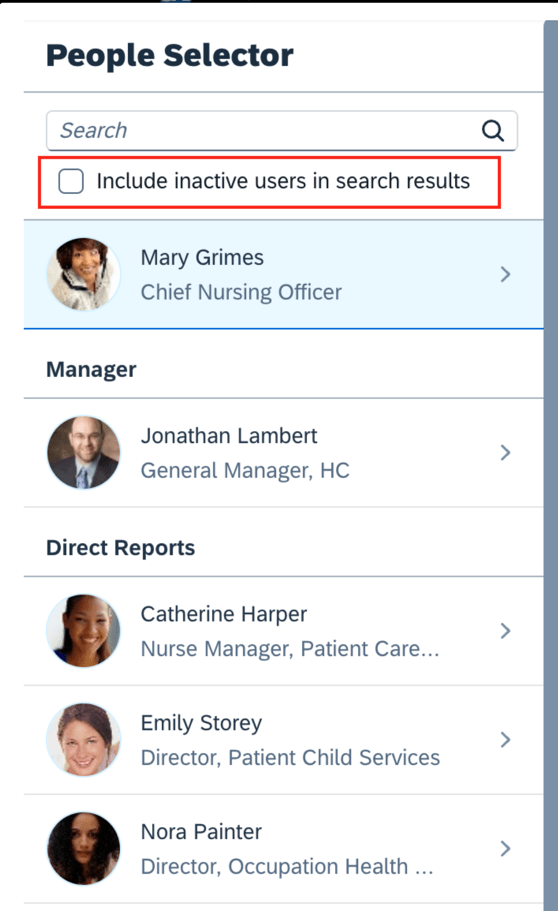
Inactive users may now be included in search results in People Selector and their goals may be edited.
Search for inactive users
Goal Details Page Updates
There are enhancements to the goal details page.
The left-hand sections of the goal details page can be collapsed.
Collapse Goal Sections
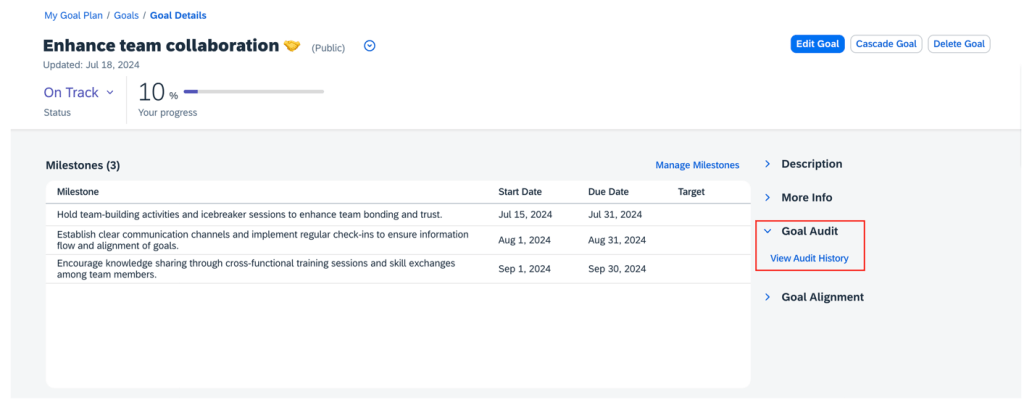
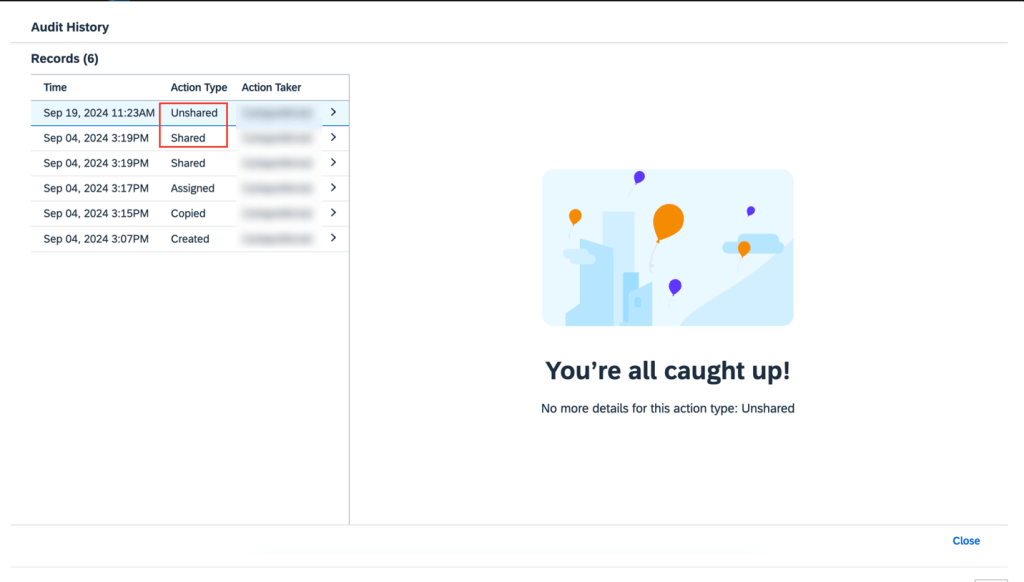
Audit history is now a new section on the right side of the page instead of a button to click to view the audit history.
Audit History in Right Panel
All milestone fields are visible and the milestone table can be scrolled horizontally.
Milestone Fields
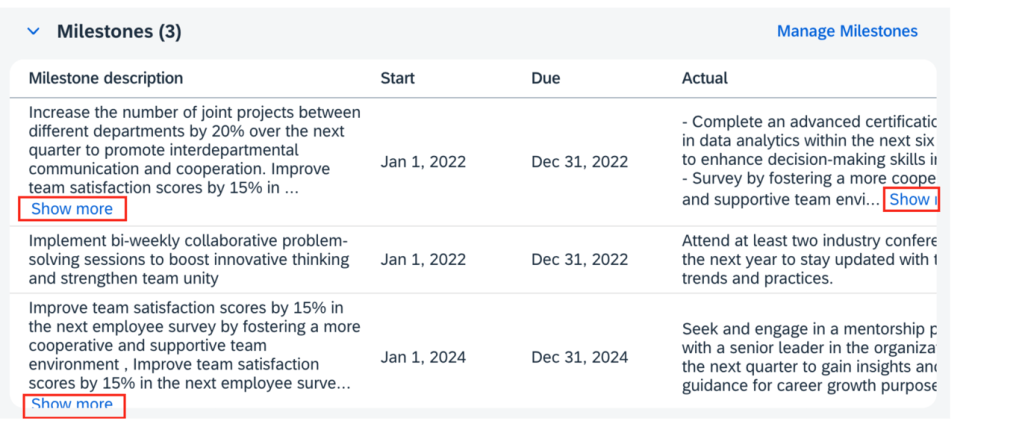
For milestones, the Show more button expands to display all of the content of the milestone fields that are configured as textarea type. This eliminates the need to click the Manage Milestones button to see all the text.
Show more for Milestones
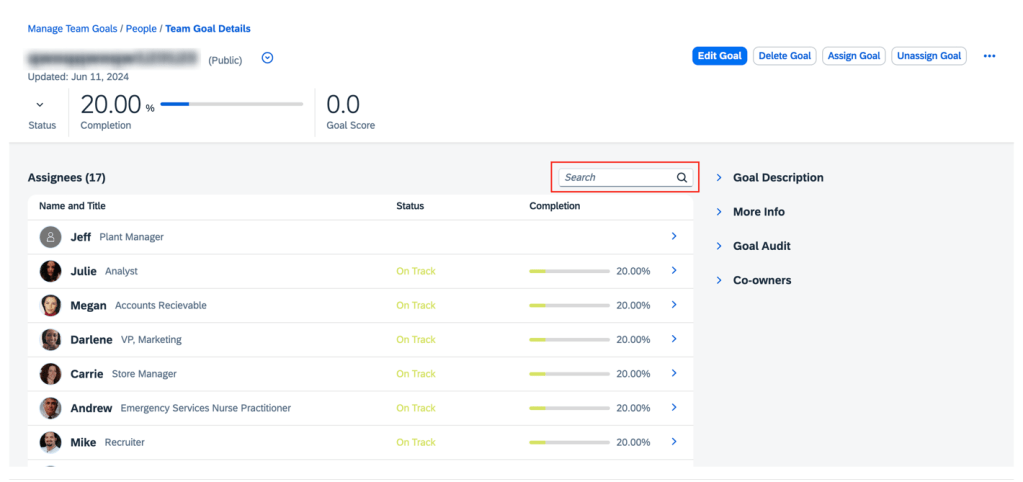
Users can now search for assignees on the Team Goal Details page.
Assignee Search on Team Goals Page
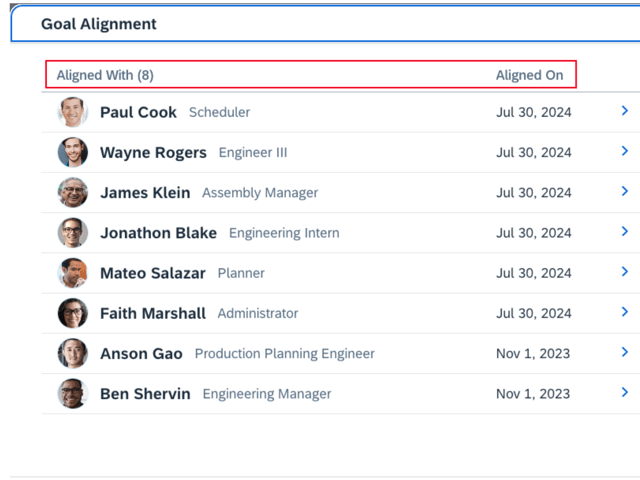
On the Goal Alignment pop up, headers have been updated to show Aligned With with a count and the aligned on date.
Goal Alignment Headers
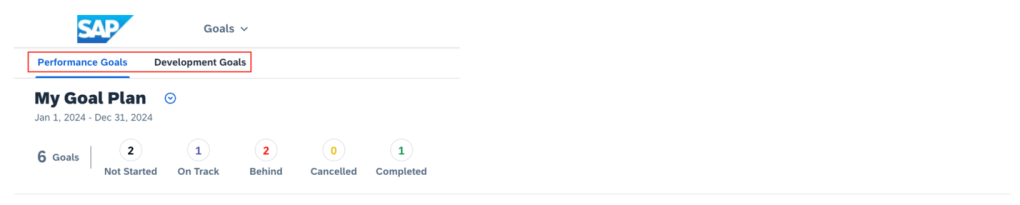
On the landing page, the tab names for Performance goals and Development goals now use the plural form.
Goal Tab Names
There is no limit to the number of goals that can be displayed in the personal and team goal list views.
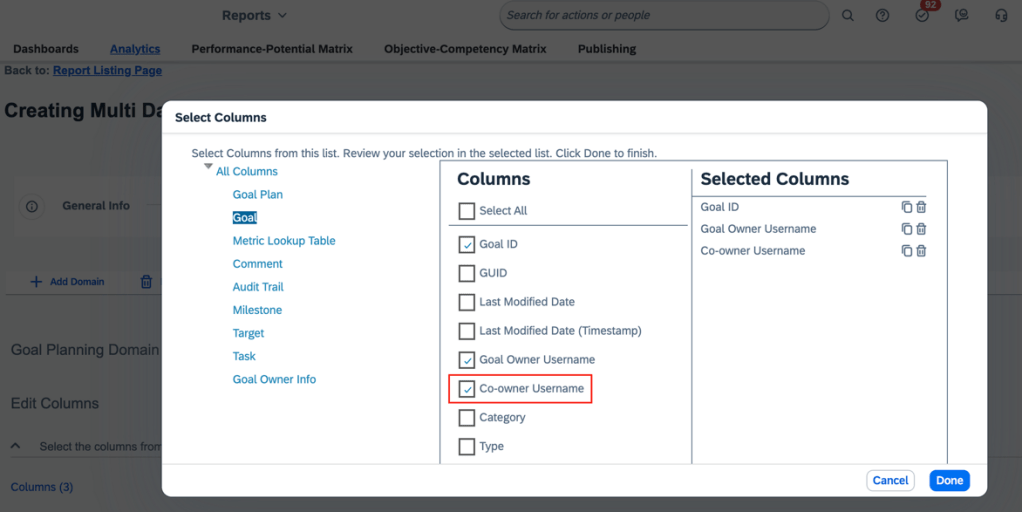
When creating reports for master team goals, there is a new Co-owner Username column. This is available in both Story reports and Table reports.
New Column for Reporting
In audit history, “Shared” and “Unshared” are now supported as new action types for team goals.
New Action Types for Team Goals
Roll-up Calculation for Cascaded and Linked Goals
Roll-up calculations can now be used for cascaded and linked goals in the latest Goal Management.
Bizx-actual, bizx-target, and bizx-pos fields can be set to average or sum using the rollup-calc-type attribute.The sum or average values for these fields are automatically calculated across cascaded and linked goals based on your configuration. These values are then reflected in source goal details.
When a parent goal is cascaded or linked, two audit records are generated for it, one record indicates the action type (“Cascaded” or “Linked,”) while the other record shows “Modified” due to changes in the roll-up fields.
AI-Assisted Goal Creation Enhancements
If you have purchased the AI units license, have enabled the latest Goal Management, and have assisted goal creation is enabled and properly configured, you will experience a more engaging AI-assisted goal creation experience.
Updates include:
Updated AI tag: On the goal creation page, the tag for fields with content generated by AI is now “AI-generated content”, replacing the previous “AI-enhanced content”.
Improved content comparison: the Compare Generated Content page has been eliminated. It is replaced by the AI-assisted writing tool to enhance content at the field level.
Enhanced prompt template: The prompt template automatically applies goal plan configurations, such as start, due, and maxlength, to AI-generated goals.
Custom fields: Custom fields of text and textarea types are now supported for performance goals. You specify the context by providing meaningful text for <field-description>. This allow AI to generate more better suggestions for your goals.
For tips on how to manage a release, check out our blog here.
Delegation Available for Performance Reviews
Managers can now delegate their performance review tasks to others for a specific time period. It also allows administrators to create delegations on behalf of managers.
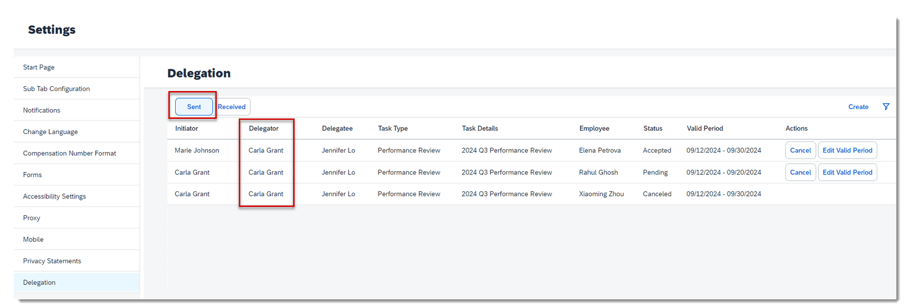
From Settings, go to the Delegation tab, this will display a Delegation page where a user can:
Create a delegation request for themselves
View and manage the delegations they created and those created by administrators on their behalf
Accept or decline the delegation requests they received
Go to the delegated task they accepted
Delegation will not display on the side panel if the user does not have the permission to use it.
A Sent and Received tab will be visible.
Delegations Page
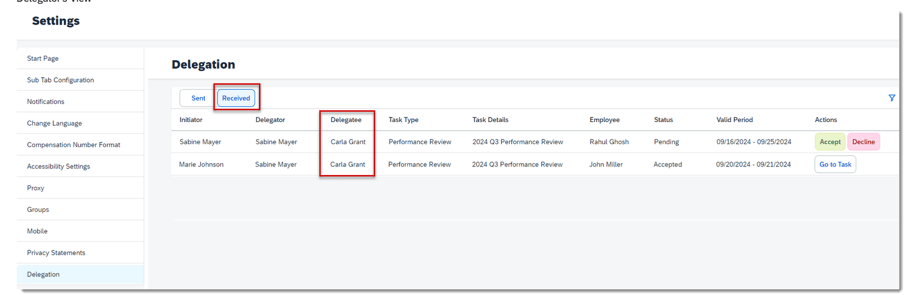
On the view for the delegatee, they can see any delegation requests and accept or decline requests.
Delegation Requests Received
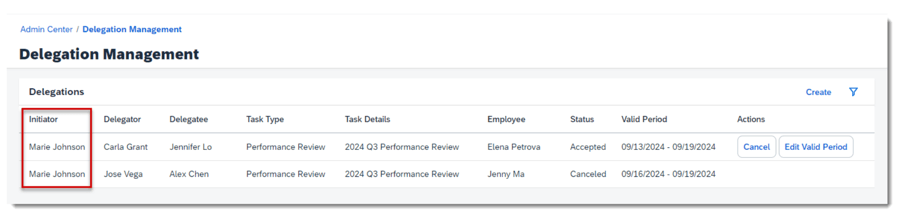
On the Admin Center Delegation Management page, an administrator can:
Create a delegation request for users
View and manage the delegations they created on others’ behalf
Admin Features
Delegation Steps
Create Delegation – a request to delegate is initiated by a manager or an admin. The validity period and form template must be identified in the request.
Respond to Delegation – the delegatee receives a notification to act as a delegate. Within Settings, clicking the Delegation tab, details about the request are shown and they may choose to accept or decline the request. The requestor is notified of their decision.
Perform Delegated Task – a Go to Task button is visible on the Delegation page during the validity period. The delegatee can perform the action on the form. The original manager sees the form in their inbox as read-only.
Edit or Cancel Delegation – The delegator may edit the validity period of the delegation or cancel the request.
Complete Delegated Task – The delegatee completes the task and the form moves to the next step in the route map.
Delegation Related Email Notifications
Email notifications are automatically generated in the following steps of the delegation process:
Delegation Created/Pending Action notification goes to the delegatee
Delegation Accepted or Declined notification goes to the delegator and delegatee
Delegation Canceled Manually notification goes to the delegator and delegatee
Delegation Request Auto-Canceled due to Inactivity notification goes to the delegator and delegatee
Delegation Expired notification goes to the delegator and delegatee
Requirements for Delegation
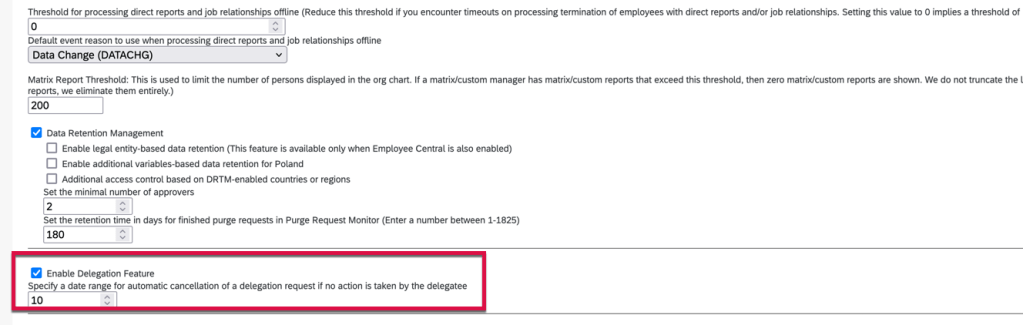
Delegation must be enabled within Company System and Logo Settings. A number of days to automatically cancel a delegation request if no action is taken by the delegatee must be set as well.
Enable Delegation in Company System and Logo Settings
Permissions for Delegating Performance Review Tasks
To allow all managers to delegate, permissions need to be added to their role. If you wish to allow administrators to delegate on manager’s behalf, the admin role will need additional permissions as well.
First let’s review the various roles in a delegation scenario.
Initiators: managers and administrators
Delegators: managers
Delegatees: managers’ peers and those directly above them
Employees: managers’ direct reports
Based on the roles, we will need to add delegation permissions to the various permission roles.
User Permissions >Delegation>Create Delegation Based on Form Templates
Delegators Role:
User Permissions >Delegation>Delegator-Delegatee Relationship, defines who can be selected as the delegatees of a delegator during the delegation creation process.
User Permissions >Delegation>Delegator-Employee Relationship, defines who can be selected as the delegatees of a delegator during the delegation creation process.
Create Performance Reviewer (Delegation) Role
A permission role needs to be created as well, this allows users can access the Performance Management forms delegated to them from the Delegation page. Do not assign the role. It’s expected to be inactive.
Required to allow access of forms from the delegation page:
User Permissions>General User Permission>User Login
User Permissions>Performance>Performance Management Access
Optional
To add, edit or delete goals on the PM form: User Permissions>Goals>Goal Plan Permissions
To view People Profile blocks through links on the form: User Permissions>Employee Data>View (identify the elements to view)
To restrict access to inactive users’ forms: User Permissions>Performance>Restrict Data Access of Inactive Users’ Forms
Delegation Role with Required Permissions
When the delegatee goes to their delegated form, the system automatically grants them the role’s permissions, with the form subject (employee) being the target population.
Enhancement to the Latest My Forms Page for PM Forms
If you are using the latest My Forms Page, there are some improvements for the user’s experience. The My Forms page has updates to form creation, form lists and filters.
Form Creation
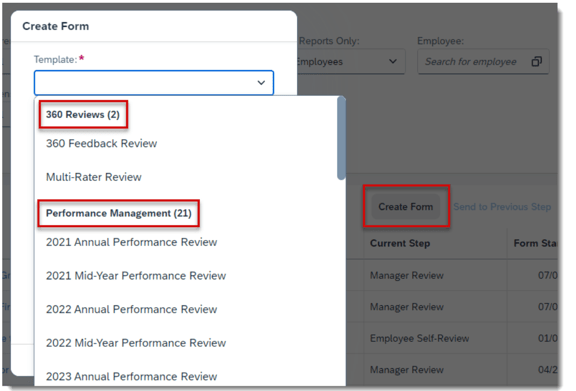
The Create Form button is now only visible for users that have permission to create at least one PM or 360 form.
The dropdown list of forms is now grouped by under 360 Reviews and Performance Management. Each heading lists the number of forms available for the category.
Create Form Templates
Form Lists
The number of forms is included in the forms list title.
Form List View with Number of Forms
Filters
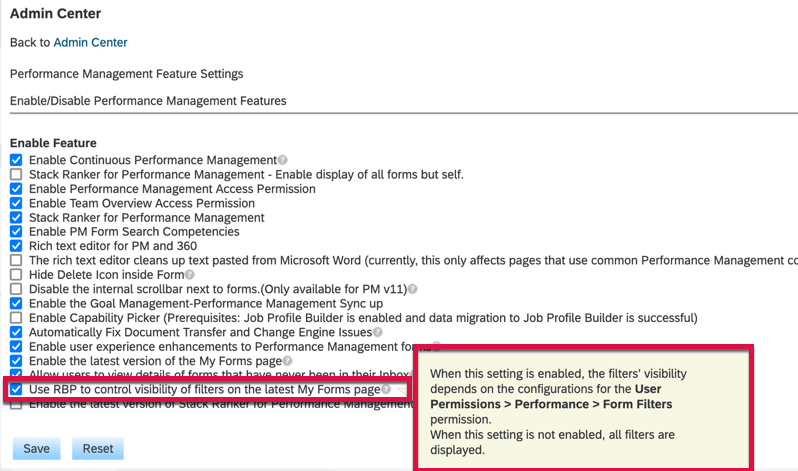
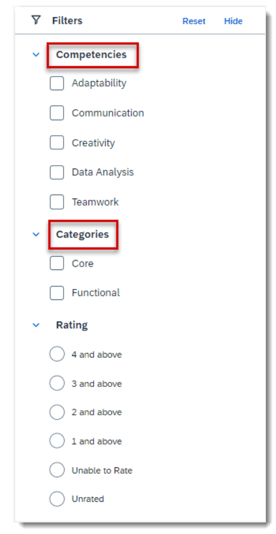
Standard and custom filter visibility can be controlled by role. All filters display by default but can be hidden using role based permissions. Enable Use RBP to control visibility of filters on the latest My Forms page in Performance Management Feature Settings.
Performance Management Feature Settings
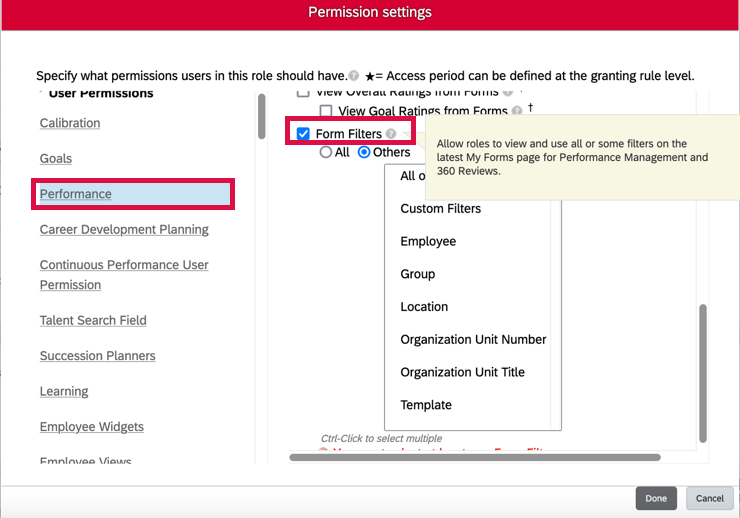
Then, grant users the User Permissions Performance Form Filters permission to show all or certain filters to them.
Form Filter Permissions
A All or Reports Only filter is available for users with direct reports, matrix reports or HR reports
The Template filter is now dynamic and changes based on templates of forms in a folder, previously all templates were listed
There is a reset button to clear filters
Filters
Performance Management Text Changes
If you aren’t using Talent Intelligence Hub, the filters have been renamed from Attributes to Competencies and Tags to Categories.
For tips on how to manage a release, check out our blog here.
Easier Experience of Nominating Talent Pool Members to a Position
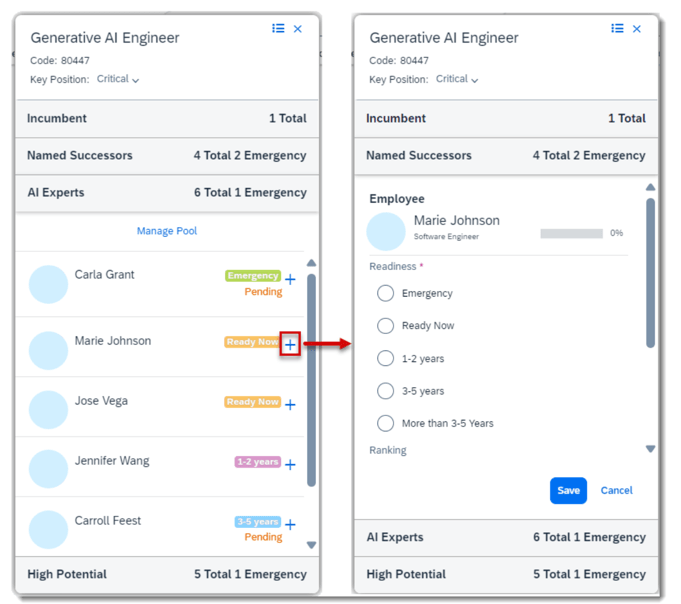
Succession planners can now add successors directly from the talent pool sections on the position card in the Succession Org Chart or in the Position Tile view. This applies to positions associated with talent pools.
Before the latest release, the user had to navigate to the employee’s talent card to begin the nomination process, including searching for the position. Now when the user selects the “Add as successor” button for a member of a talent pool, the Named Successors section expands to view more details before nominating the employee to the position.
Add a Successor from a Talent Card
Succession Text Changes
There are some minor visual changes for Succession. Previously the search box in Talent Search didn’t have a label. Now the search box is labeled Keywords: and the placeholder text has been changed to Enter your keywords.
Updated Talent Search
On the details page of a talent pool, the field to filter the talent pool nominees did not have a label and was in the same line as other filters. Now it is labeled Nominee with Search for nominee in the placeholder text.
Talent Pool Nominees Filter
Now, this field is labeled as Nominee and has placeholder text and it is now placed above other filters.
Succession Notification Card Available in Microsoft Teams
If you are using the integration of SAP SuccessFactors and Microsoft 365, there is a new notification card available for users to review and approve pending nominations to a talent pool.






















 Worklogix Blog